The number of books read was dramatically smaller this year, close to zero in fact! However, I did finished a lot of music, so I’m going to start tracking that here as well as each song take about as much time (and a lot more effort!) than reading an entire medium-length book.
Books Read
Keep Going, Austin Kleon (fourth time)
A Woman of No Importance, Sonia Purnell
Creed or Chaos?, Dorthy Sayers (partial)
Sourdough, Robin Sloan
Messenger, Lois Lowry
Music Finished
Finished mixing the Dante 1981 Paradiso album and released it. All of it was written and recorded in 2022, but I hadn’t finished editing it all and done the final listening and mixing passes until this February.
I just finished my second album of music under the Dante 1981 name. It’s an ambient/synthwave instrumental journey through Dante’s medieval conception of heaven. Analog synths and thick chords give way to J.S. Bach counterpoint and live instruments as one gets closer to God near the end of the journey. Interpret that how you will!
This blog was started in early 2007, near the height of the golden age of personal short-form (and occasionally long-form) online writing. Social media platforms buried many of them for a good decade or more, but now with the recent meltdowns at Facebook and Twitter and the increasingly flash-in-the-pan-ness of TikTok and Insta Reels and such, a sizable number of folks have been turning back to something that resembles the old forms! Often this is in the shape of something like a Substack newsletter, but they function very similar to the way the old blogs did with a smaller dedicated base of readers with more thoughtful interactions in the comments. I hope this trend continues! I’m not the only one! I believe it’s much more healthy for thinking, for debate, for intellectual property, and for internet archival longevity among other things.
Keep Going, Austin Kleon (third time)
Paradiso, Dante (Sayers/Reynolds translation)
Echos of Exodus, Alastair Roberts and Andrew Wilson
Amusing Ourselves to Death, Neil Postman
Richard Hooker: A Companion to His Life and Work, Brad Littlejohn
Planet of the Blind, Stephen Kuusisto
The Evangelical Movement in Ethiopia, Tibebe Eshete
Neuromancer, William Gibson
La Vita Nuova, Dante (Reynolds translation)
Haben, Haben Girma
Liturgy of the Ordinary, Tish Harrison Warren
Advent, Fleming Rutledge (partial)
Being Consumed, William T. Cavanaugh
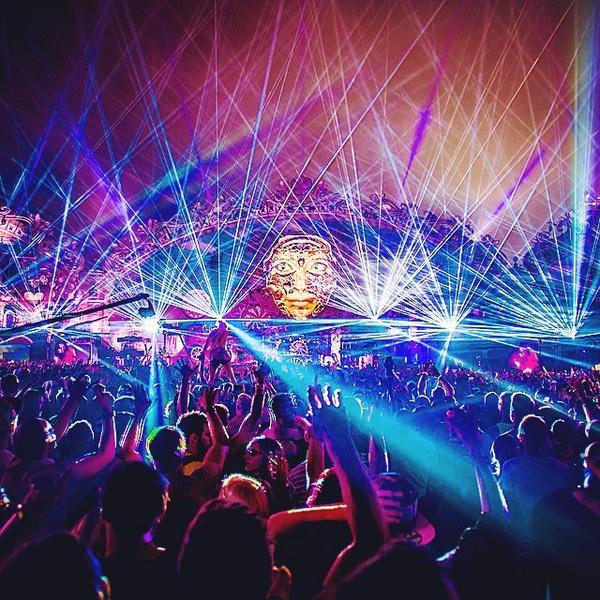
One of the online music magazines I enjoy reading pretty regularly is Attack. A recent article from them titled “Manufactured Moments” laments the loss of the true sublime dance club experience and how festivals and promoters armed with elaborate laser shows, glitter cannons, and pyrotechnics try to artificially recreate or induce that elusive feeling. At the center of the discussion is a grainy 40-second video from a club in the UK from 1990 that surfaced recently showing a throng of ravers going absolutely bonkers when the beat drops.
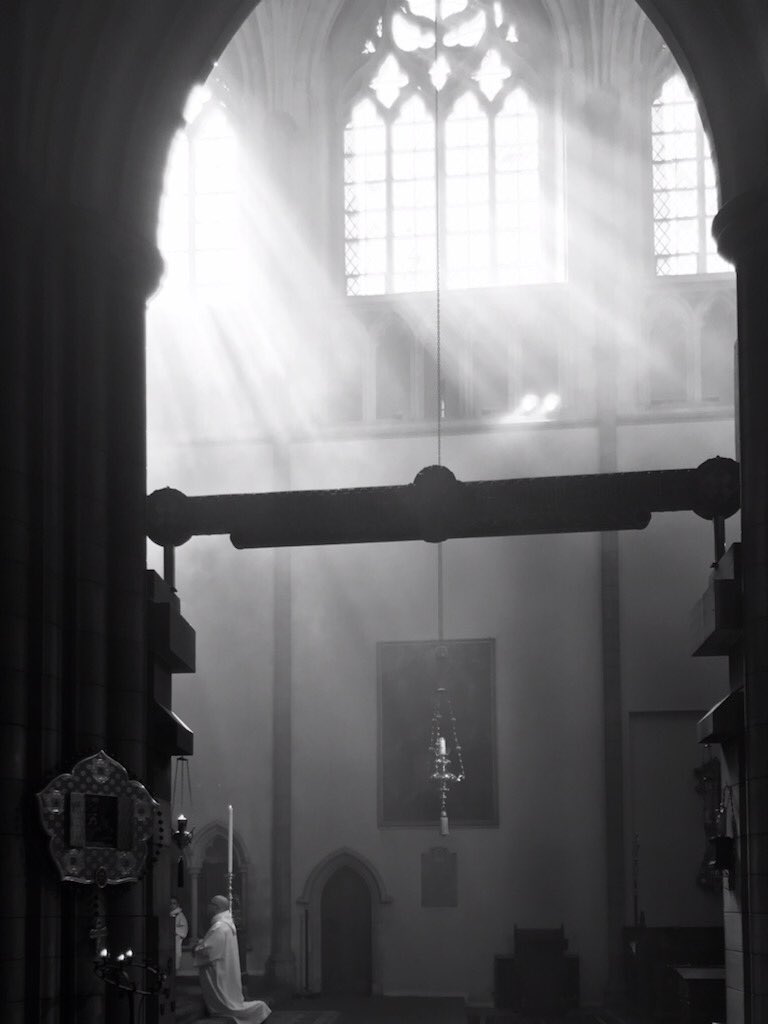
What’s of interest to me is that I’ve read nearly this exact same article many times before… about church! This sort of thing is so common in Christian circles that it could almost be its own genre. One of the most memorable examples was a long thread (sorry, I don’t have the link) where the author pines for their early days in the Anaheim Vineyard Christian Fellowship. At the center of the discussion is a fuzzy hour-long tape recording from a worship service from about 1983 where a large crowd enthusiastically sings praise choruses. The comment section is filled with people who were there or had a similar experience, lamenting how the current songs and lighting and routines from tightly-produced groups like Hillsong and Elevation are nice in some ways, but just don’t capture that original energy. Not even close. They are trying to manufacture a moment and it’s just not nearly the same. The Holy Spirit seems gone.
Lest you be tempted to think this is just something charismatics think about, I’ve seen more than a few high-church liturgical types write their own versions of this story. It usually boils down to something like “things were really magical back when we (fill in the blank: chanted the psalms, burned more incense, knelt during the eucharist, listen to brilliant teaching from father so-and-so, sang the long version of the Sanctus, etc.), but now the worship service has gone to pot with all this modernization and I’m just not feelin’ it anymore”. The Holy Spirit seems gone.
I think we can learn something from both people telling this similar story. Quite simply, many of the most important things that happen in a person’s life… you just had to be there to get it. It really can’t be replicated, and it’s disingenuous to even try. The miracle of your conversion, or the way God met you in a certain place and time or surrounded by a particular community, is not replicable, nor should it be. Everyone else is going to have to live their own story… including the older version of you!
At the same time, the good liturgist or worship leader knows that the church service IS fundamentally something we manufacture. And that’s OK. It’s good to reinforce our faith with traditions, especially the proclaiming of the word and the administering of the sacraments. And we should do that as well and as thoughtfully as possible. This is how we, as humans, in time, in the rhythm of the week, and the seasons, can remember what God has done for us and can worship him, which is good and right.
So I don’t fault Hillsong for trying to produce really polished worship music with highly trained and skilled performers and technicians. But I do fault anyone who goes along with the marketing that this can make the magic happen. It could be a good thing but it’s been ridiculously oversold and overrated.
At the same time, I don’t fault the liturgists for wanting to reform the traditional worship service, or even to spend a lot of money on some new stained-glass windows. But I don’t think they should oversell or overrate these good things either. God meets us in and around these things, and often in the hours when we are away from the church service altogether. Let us ask him to increase our faith that we might be steadfast whatever situation we find ourselves in.
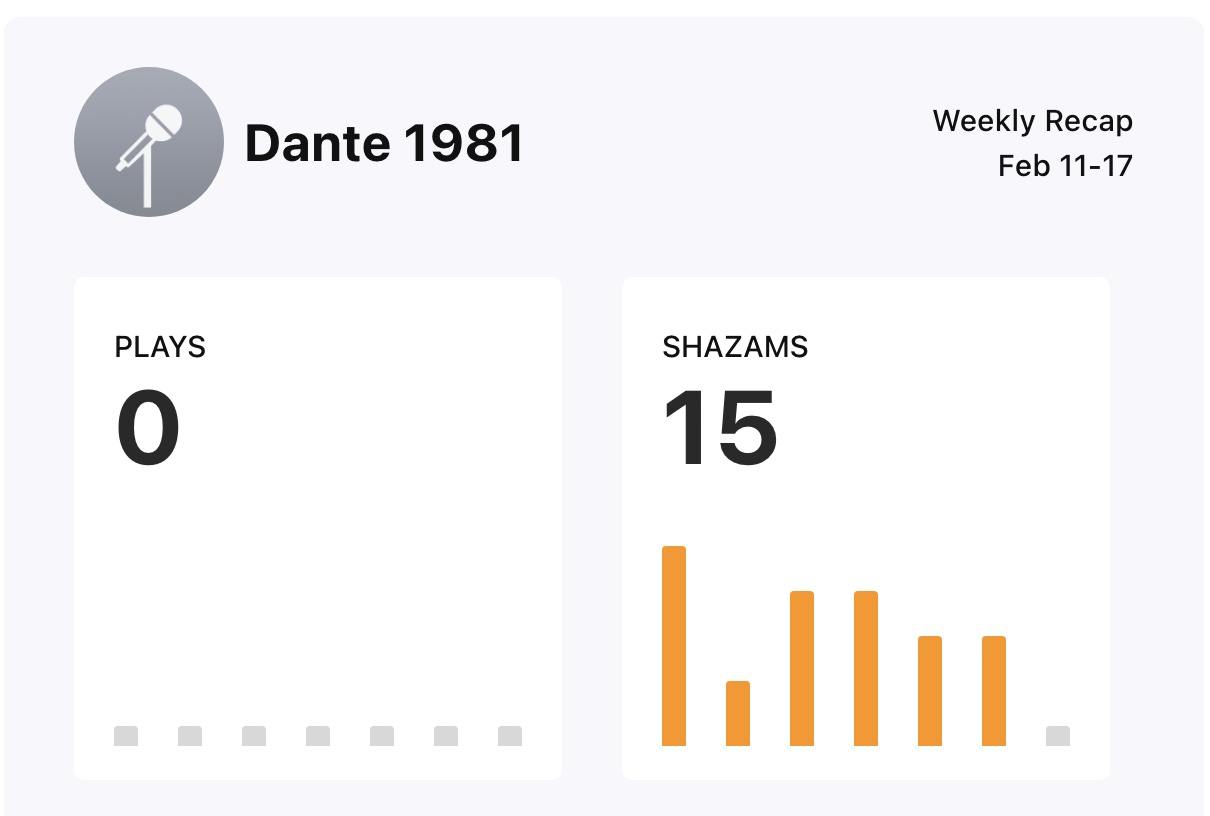
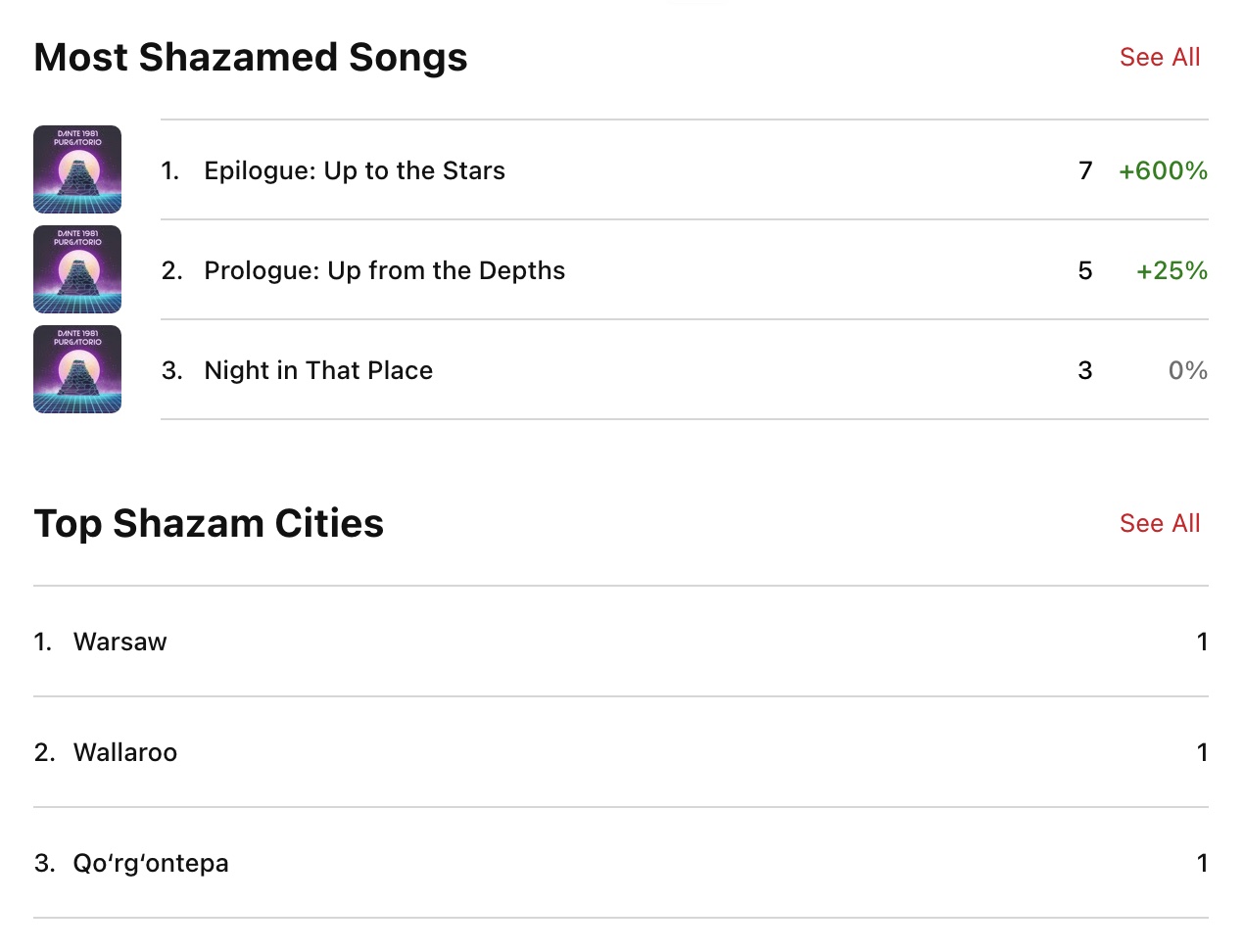
The Dante’s Purgatorio concept album I finished a few months ago has an introduction track on it that functions as a slow-building cinematic ambient drone piece before the “real” songs start. It’s been interesting to see these it show up in relatively high numbers on the stats that Apple (who owns Shazam) sends out each week. Here is what last week’s report looked like:
At first glance, it’s “Wow! 15 people were listening to my songs last week!” But then I look at the breakdown. Nearly every time it looks like this:
Those tracks, the Prologue, Epilogue, and “Night in that Place” are the three ambient tracks on my album. They always constitute the bulk or entirety of the Shazam stats. Was some guy in Warsaw really listening to it? I’m certain they were not. During that same time I had virtually zero streams on of any of those tracks on any service. Nobody touched any of the tracks on Spotify, Amazon, iTunes, Tidal, Bandcamp, YouTube, etc. It seems clear to me that Shazam is mis-identifying the track.
I can verify this from the other direction as well. There is a coffee shop in town I frequent that often plays ambient and “chillout” music in the background. I think they might be playing some Sirius XM radio playlist. Who knows, but I will often try to Shazam the tracks from my phone for fun. What do I find? Well if the song has vocals or a clear melody it usually picks it up right away. If it’s ambient though… well, it will think about it a while and then give me some obviously wrong answer. So I try again. A different wrong answer. Sometimes I’ll Shazam it eight times in a row and get eight different answers! It has no clue.
I’m pretty sure that’s what’s happening with my ambient tracks as well. Whatever Shazam’s sonic analysis algorithm is looking for, a pile of droning synths just breaks it completely. It can’t make heads or tails out of what it’s hearing, so it just throws out garbage matches to the listener in desperation.
I’m sure that improving this is really challenging and some developer at Shazam has probably been tearing his hair out trying to figure out how to improve the matching for this sort of thing for years. I’d love to talk to that guy actually. It would be really interesting to hear about how they’ve tired to improve it and what hasn’t worked (yet). Someone might use this as an opportunity to dunk on ambient music as being trash, but I don’t think so. It’s qualities are just difficult for computers to discern.
In the meantime, if you produce ambient or cinematic music, you might want to not get too excited about your Shazam stats, alas.
(This post was prompted by seeing the weirdness in my own Shazam stats, and by reading a recent newsletter where Robin Sloan was excited about the Shazam stats for his ambient project The Cotton Modules. Sorry to be a downer Robin! Love your work.)
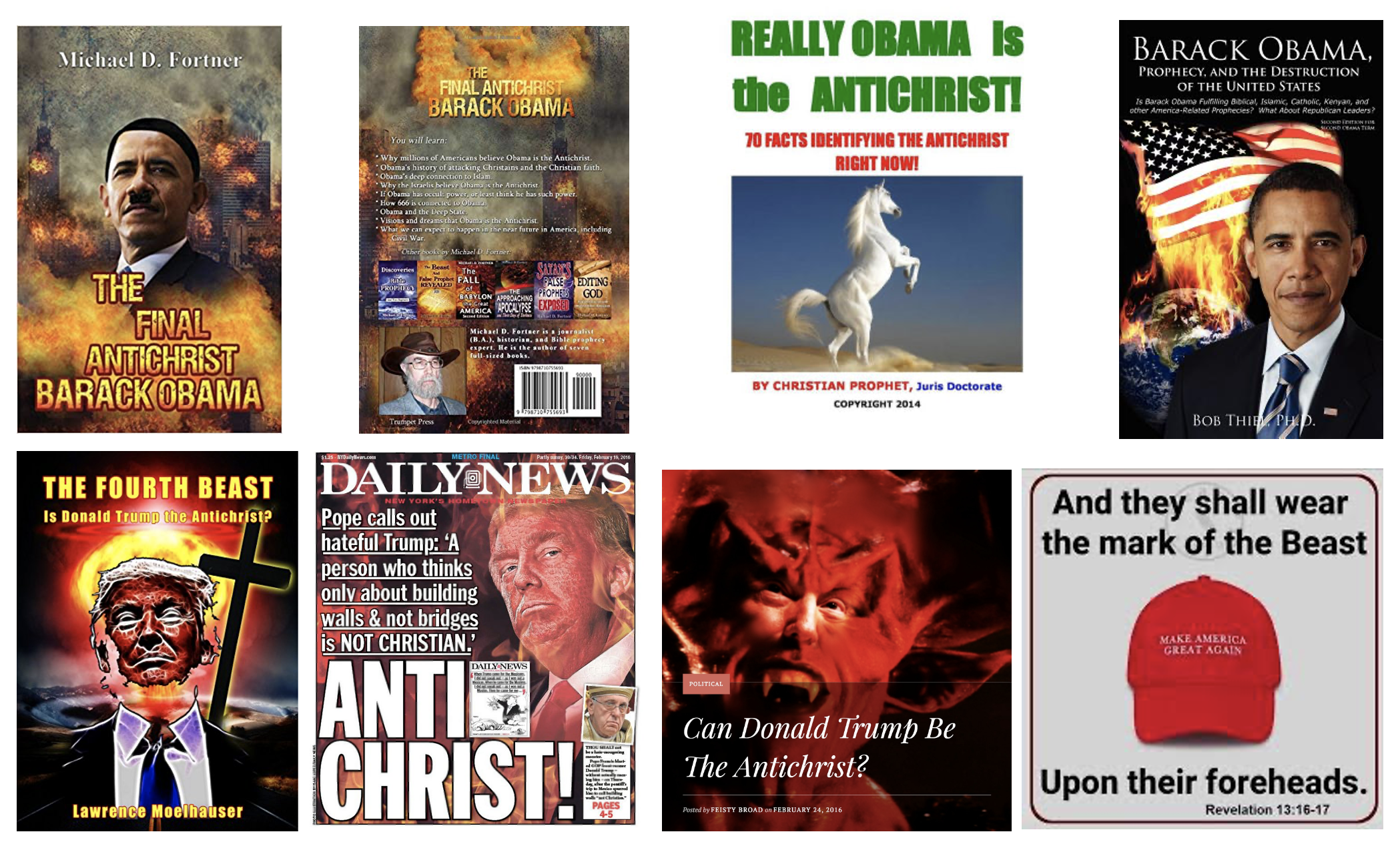
I remember numerous people declaring that former US president Barak Obama was probably the anti-christ spoken of in the book of Revelation. I heard it regularly from different corners during his eight years in office. Then, when Donal Trump was elected, I started to hear the same thing about him. A quick google search shows that numerous books and articles were published about both of them. Here are a few of the covers:
I had assumed this was a more recent phenomenon driven by the sort of dispensational millennialist eschatology that is popular in parts of America. Reading Dante today though, I discovered a much older case of it!
In Canto III of Paradiso, Dante meets Constance, mother of Frederick II, one of the last great Holy Roman emperors. Though she is in heaven, she is remembered for breaking her vows to be a nun and leaving her convent to marry.
It was believed in Dante’s day that she was at one time a nun and had been taken from the convent against her will, in order to be married to Henry VI. The marriage took place in 1185, when Henry was 22 and Constance about 32. Their son was not born until nine years later. His enemies, who sought to identify him as the Anti-Christ, seized on the story that his mother had been in a convent, for according to an ancient prophecy the Anti-Christ would be born to an elderly nun.
-from the Sayers/Reynolds commentary on Paradiso III.109
I don’t know where this idea that the anti-christ would be born to an elderly nun came from, but it’s not so different than contemporary ideas like that The Mark of the Beast being a computer chip implant. Who knows. Still, in the middle ages having your first son at the age of 41 would have indeed been a bit unusual so it apparently served as a good enough excuse for Frederick’s political opponents to cast shade on him about 800 years ago.
There are SO many voices telling you that as an independent musician you MUST promote your work on every freakin’ social media platform. So I gave it a shot for once when I released my Dante 1981 Purgatorio album back in December 2021. It was tiring to keep everything updated! Here are the rough results for anyone curious:
Soundcloud: Nothing but bots and spammers.
Facebook: Absolute ghost town.
Twitter: Almost nothing.
Bandcamp: Dead quiet.
Numerous playlist submissions: Zilch
Website: Nothing.
Instagram: Some activity!
YouTube: Some activity!
Newsletter: About 50% looked.
Verdict from my small personal experience:
YouTube is the easiest way to reliably share new stuff. It doesn’t require a streaming service.
Instagram seems by far the best way to get your stuff in front of strangers, at least in a fleeting way.
A newsletter with an email list of personal friends is by far the best, BUT even then, expect a lot of people to just be too flooded with information to actually read it or click through. Also, despite people personally subscribing, several reported it still ended up in their spam folder.
I can see why an artists would want to sign to a label, even if they lost a big chunk of revenue, just so they could outsource all the hype-machine stuff to someone else.
There are a lot of aspects about contemporary progressive concepts of justice that one could criticize, but I think the lack of the possibility of forgiveness is it’s chief failure. Notice I didn’t say “redemption”, which is, in theory, possible (though astonishingly difficult), but forgiveness.
Say some celebrity does something really bad. He gets called out. He apologizes. He gets criticized for not apologizing enough. So he apologizes more. He makes a written statement. He donates a million dollars to some foundation-against-badness. He makes the talk show rounds and declares how wrong he was. He gets replaced in all his upcoming film acting roles. His character on that hit TV show gets retconned. His book gets cancelled by the publisher. He’s kicked off his sports team. His career collapses. Heck, maybe he even spends a couple years in federal prison (e.g. Michael Vic). He’s very sorry and very publicly sorry. But is it enough? No, it’s never enough. There is no forgiveness for his doing of bad things. Even if he seems redeemed or atoned for, his accusers will continue to accuse him for the bad thing he did. It cannot be undone as there is no time travel, and so there is no end to justice’s blade. Ever.
I was reminded of this attitude while reading a review of the new Bill Cosby documentary. The film is made by comedian W. Kamau Bell, who idolized and was deeply inspired by Cosby in his youth and who was then devastated when it came out that for all those years Cosby was at the top of family-friendly comedy, he was also serially drugging and date-raping women. Bell is as upset about this as anybody on earth.
Though I’m not black or a comedian, I share some of that same devastation personally as well. I grew up listening to Cosby’s comedy acts on cassette tape on repeat. I can recite the entire “The Chicken Heart that Ate up New York City” bit by heart, or the one about his friends racing go-carts. The Cosby Show was one of the few (and I mean very few!) shows I was allowed to watch growing up. I still remember the episode where he has a trippy bad dream after eating too much spicy food and his daughter is playing a purple saxophone. I have no idea why I remember that stuff, but it’s great. I was also upset to find out about all the horribly things did. For years I thought for sure he was one of the “good guys”. It totally sucks.
Bell, in his documentary tries to grapple with that and in the end comes to a conclusion that he must separate Cosby the man from the art he created, somehow. This is a conclusion come to by a lot of historians who study great but also terrible people. Sculptor Eric Gill comes to mind. But the reviewer at Vulture is pissed off about it.
Most frustratingly of all, in the end, after persuasively illustrating over four hours that this artist and this man are intertwined, Bell decides the best option is to keep them separated. Returning again to the question he raised about how to think about Bill Cosby now, he confesses, “I wanted to hold on to my memories of Bill Cosby before I knew about Bill Cosby. I guess I can, as long as I admit, and we all admit, that there’s just a Bill Cosby we didn’t know.” He suggests that if we can absorb the lessons taught by the good Bill Cosby, then we can create a world where bad Bill Cosbys are less likely to exist. Which: sure, maybe. But that’s a pretty pat note to end on given the complicated, knotty analysis that has preceded it.
The much harder but more honest thing to do is acknowledge that there is no division — or, as Jelani Cobb, writer and Columbia University professor, puts it, “Some people tended to see it as Dr. Jekyll and Mr. Hyde. I think that you could make an argument that it’s all Mr. Hyde.” If you ever admired Bill Cosby, it may hurt to hear that. But just about everything in We Need to Talk About Cosby, excluding Bell’s own conclusion,suggests that Cobb is absolutely right.
-Jen Chaney, We Need to Talk About Cosby Wrestles With a Fractured Legacy, (emphasis mine)
See what the reviewer did there? I’m not sure who this professor she quotes is, but it’s a perfect statement of contemporary social justice: There is no Dr. Jekyll. There is only Mr. Hyde. And Mr. Hyde can NEVER be forgiven. How dare you even suggest a framework where it might be possible to forgive Bill Cosby? That’s not “honest”. How dare you!?
This right here is a key contrast to the gospel. The gospel says: yes, you really did do all these terrible things. In fact, they are even more awful and sinful and evil and destructive than you can even imagine. BUT, Jesus forgives you. Yes, if you clean up your act and become a better person, that’s great, but it’s not required. In fact, there may be little you can do to can’t fix the past anyway, but you don’t need to. You can be reconciled to God and also reconciled to others through the power of his forgiveness.
Justice has a sword, but it has a flat edge as well.
I meanwhile thought of how thrilling it is when a baseball outfielder grabs the ball off the wall and throws it dead-on to home plate to catch a runner. Doesn’t happen very often. A computer with a throwing arm, of course, could do the same every single time, without fail. A simple machine can throw a baseball miles further than any human. I thought of what a composer teacher of mine told me about his first experience with electronic music. When he started working with an analog synthesizer and tape (that being what you did in the ‘70s) he was interested in creating complex rhythms beyond the capacity of human musicians. He did so. And he discovered that it didn’t sound like anything, was about as interesting as throwing a handful of gravel on a tin roof. Which is to say, it didn’t matter. “What I realized,” he told me, “was that I wanted the intensity of real musicians struggling to play complicated rhythms.”
– from Jan Swafford’s great piece on the attempt to fabricate Beethoven’s Symphony 10 using AI (emphasis mine)
I recognized this idea as something similar to what hit me about 15 years ago when I discovered the wonderful solo guitar music of Pierre Bensusan. One could listen to a wonderful Celtic band like Lunasa play a set of tunes on their pipe, whistle, fiddle, and bass. Or you could listen to Pierre play the same tune with all the harmonies stuffed onto the six strings of the guitar with just his two hands. Sometimes it seemed that despite all his skill and “harp sustain” technique, that he was just barely, barely keeping the thing glued together! It’s like, you aren’t supposed to play all those notes on a guitar and the thing was always on the edge of crashing and burning. But it didn’t, and that frantic energy in the playing made the music very exciting in a way that’s difficult to describe and virtually impossible to communicate on sheet music.
It also reminds me of a quote from Brian Eno’s autobiography about pushing music technology to it’s limits, or even over them.
“Whatever you now find weird, ugly, uncomfortable and nasty about a new medium will surely become its signature. CD distortion, the jitteriness of digital video, the crap sound of 8-bit – all of these will be cherished and emulated as soon as they can be avoided. It’s the sound of failure: so much modern art is the sound of things going out of control, of a medium pushing to its limits and breaking apart. The distorted guitar sound is the sound of something too loud for the medium supposed to carry it. The blues singer with the cracked voice is the sound of an emotional cry too powerful for the throat that releases it. The excitement of grainy film, of bleached-out black and white, is the excitement of witnessing events too momentous for the medium assigned to record them.”
-Brain Eno, A Year With Swollen Appendices
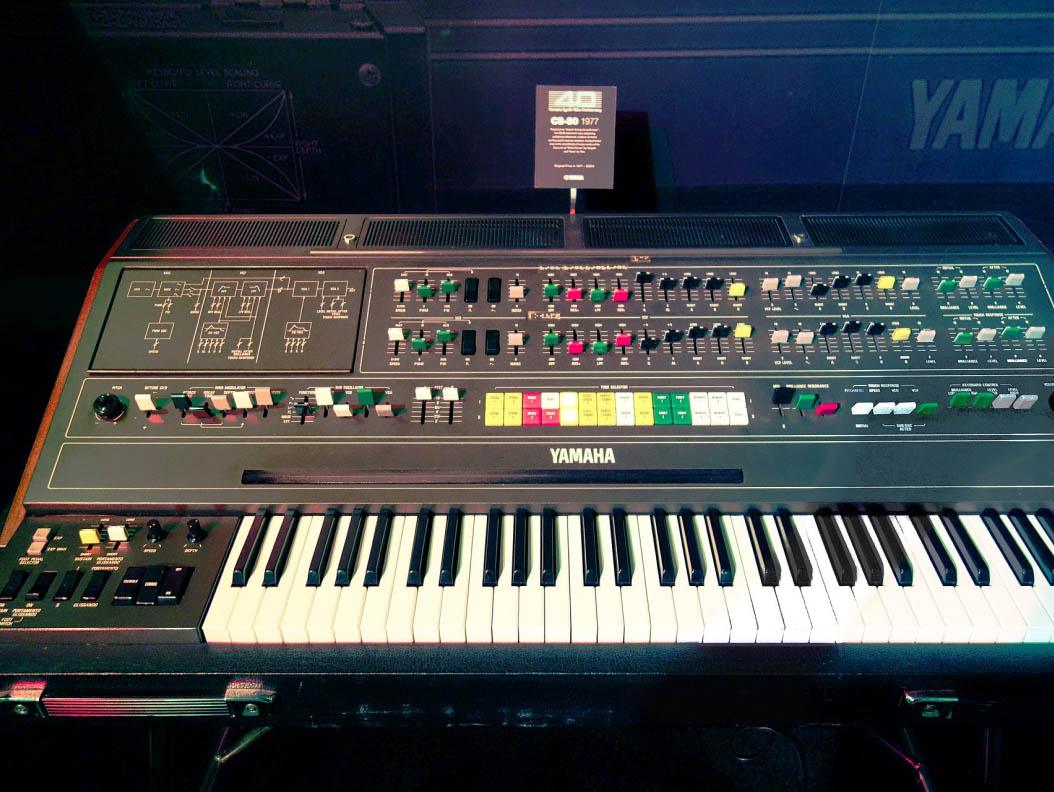
This all sounds very familiar as I spent much of the last year creating a synthwave album that features synthesizer sounds recreated in such a way that the original noise of the circuits and unstable tuning of the originals is carefully recreated with software to give the sound a nostalgic or authentic sonority.
All three of these things I just mentioned are similar in that they are grappling with the human experience element in music, and how big of a role it plays, and how it can’t exactly be controlled like other aspects.