For the first ten years life, my parents were largely successful and shielding me from the wiles of pop culture. I was only familiar with classical music up until then. I had heard a little bit of country (Garth Brooks I think it was) and was not at all interested. I was unbelievably naive about all but a very narrow world of art. Then, ironically enough, on the bus to a church youth event, the driver had the radio tuned to a local pop station. I was 11 years old and starting 5th grade.
I’ll never forget it. They played “The Sign” by the Swedish group Ace of Base several times on the way to and from the hockey game or whatever it was we were going to see. The tune seems a bit cheesy looking back on it, but it had me captivated. I began listening to the radio in my bedroom in the evenings just to hear it again. And would you believe it, amidst the noise, I found other music I enjoyed too. This is all years before internet and file sharing, so the next logical step for me was to go buy an album. I remember running off in Walmart, fingering that CD with the $13.99 price tag, wondering on earth I was going to convince my mother to let me purchase it. Somehow, I must have gotten a hold of it, because I remember what came next.
Oh the horror. My parents listening to the CD. Reading through the lyrics on the liner notes. Trying to figure out what the songs where about. Seeing if they were about drugs, or sex, or gang-bangin’. Remember, this is Ace of Base we’re talkin’ about here. The high drama of “my boyfriend left me” was about as seedy as it got. I remember having to explain how the line “All that she want’s is another baby” on another one of the tracks was about how the girl is anxious to find another lover, NOT declaring some kind of serial pregnancy obsession. Really. I don’t mean to put my parents in a bad light. That’s not what this post is about and they were doing the best they could. But I’m not making that part up. It was ruled that I must get rid of the album. Actually, I can’t criticize them too much anyway - a few months later, someone had to explain to ME that Tom Petty’s “Last Dance with Mary Jane” really WAS about smoking marijuana.
Anyway, what bought this all to mind was another wonderful bit of verse by Billy Collins titled Introduction to Poetry:
Introduction to Poetry
I ask them to take a poem and hold it up to the light like a color slide
or press an ear against its hive.
I say drop a mouse into a poem and watch him probe his way out,
or walk inside the poem’s room and feel the walls for a light switch.
I want them to waterski across the surface of a poem waving at the author’s name on the shore.
But all they want to do is tie the poem to a chair with rope and torture a confession out of it.
They begin beating it with a hose to find out what it really means.
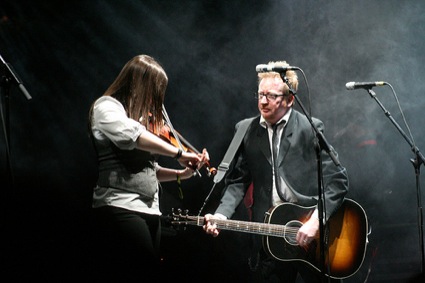
OK, so it’s been many years since I’ve followed pop radio, but last year I discovered The Weepies after hearing an interview on NPR. They are pop/folk duo with remarkable songwriting skills and melodies. Most of their songs and arrangements are very simple and straight-forward but oh-so-good. I mean, when is the last time you heard an album where every song was good? One after another!
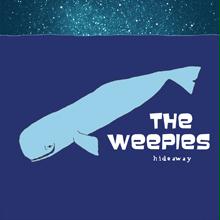
Their latest album Hideaway (recorded in the their house) just came out and I was a sucker to get it. I’ve only listened through it a couple times and can’t say it is as good as their previous effort Say I Am You, but it looks to still have a lot of gems on it.
Here is the lyrics and a 30-sec clip from the opening track “Can’t Go Back Now”.
Listen
Yesterday, when you were young,
Everything you needed done was done for you.
Now you do it on your own
But you find you’re all alone,
What can you do?
You and me walk on
Cause you can’t go back now.
You know there will be days when you’re so tired that you can’t take another step,
The night will have no stars and you’ll think you’ve gone as far as you will ever get
But you and me walk on
Cause you can’t go back now
And yeah, yeah, go where you want to go
Be what you want to be,
If you ever turn around, you’ll see me.
I can’t really say why everybody wishes they were somewhere else
But in the end, the only steps that matter are the ones you take all by yourself
And you and me walk on
Yeah you and me walk on
Cause you can’t go back now
Walk on, walk on, walk on
You can’t go back now
Not long ago, I had the opportunity to spend the evening reading at the big table in Bucer’s Coffeehouse Pub. It’s one of my favorites places and it’s difficult not to eavesdrop.
Many of the student’s at New Saint Andrews classical college study here in the evenings. This night was pretty typical I believe. To my left were two young men who spoke at length about how this Easter came very early this year because of the complicated formula used to determine what Sunday it should fall on. It was noted that the Orthodox church (and the Jews) still have Easter (or Passover) coming later this year due to the fact that their calendar isn’t accurate. Apparently it doesn’t have leap-years frequent enough to keep the equinox lined up correctly.
Across the table from me was a young man working on translating a cryptic Hebrew text for one of his classes. He occasionally joined in to the discussion about the church calendar with comments about how he had recently visited an Orthodox church on his trip to the Balkans where the daily scripture reading was recited in 10 different languages to cover all the people that might be attending.
To my right was a guy reading Peter Leithart’s new book Solomon Among the Postmoderns. Well, at least he started on it. He ended up spending most of the hour surfing Facebook.
About this time, I realized that exactly 5 years ago, it was me sitting in the same chair with my sheet music spread all over the huge table. I was analyzing a Miles Davis solo transcription as the final project for Theoretical Basis of Jazz at the university. My professor at the time, Dan Bukvich, recently marked his 30th year at the music school. My wife and I contributed a story to a memory book that was being compiled for him. Wow, what a wonderful time. I miss school. Part of me envied all the guys around the table that evening.
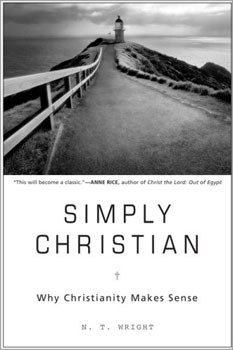
About a year ago, I heard a brilliant 1 hour interview with N.T. Wright about his new book Simply Christian. It’s meant to be a introduction to Christianity and a basic apologetic in the tradition of C.S. Lewis’s Mere Christianity. I’m not sure why I put this one off so long, but I finally got a hold of a copy and read through it this week.
My verdict is that Mere Christianity still quite a bit better, though Simply Christian has some very excellent sections. Just like Lewis, Wright approaches spirituality in general and then gradually brings in central Christian beliefs and finally church mechanics. In the middle section on Jesus, Lewis stays calm and concise where Wright gets a little bit too excited and tries to deal with too many things at once. Nevertheless, his chapters discussing our desire for beauty are a really excellent and an angle completely missing from Lewis’s work. His concise overview of scripture (The Book God Breathed) is also quite useful. He doesn’t get hung up on any details.
Anyway, the book is definitely worth reading, regardless of where you are on your journey to or in Christianity. It turns out all of the very best parts were quoted in the interview I originally listed to. Smart guy. This extended excerpt begins one of my favorite parts:
One day, rummaging through a dusty old attic in a small Austrian town, a collector comes across a faded manuscript containing many pages of music. It is written for the piano. Curious, he takes it to a dealer. The dealer phones a friend, who appears half an hour later. When he sees the music he becomes excited, then puzzled. This looks like the handwriting of Mozart himself, but it isn’t a well-known piece. In fact, he’s never heard it. More phone calls. More excitement. More consultations,. It really does seem to be Mozart. And, though some parts seem distantly familiar, it doesn’t correspond to anything already known in his works.
Before long, someone is sitting at a piano. The collector stands close by, not wanting to see his precious find damaged as the pianist turns the pages. But then comes a fresh surprise. Te music is wonderful. It’s just the sort of thing Mozart would have written. It’s energetic and elgiac by turns; it’s got subtle harmonic shifts, some splendid tunes, and a ringing finale. But it seems…incomplete. There are places where nothing much seems to be happening, where the piano is simply marking time. There are other places where the writing is faded and it isn’t quite clear, but it looks as though the composer has indicated, not just one or two bars rest, but a much longer pause.
Gradually the truth dawns on the excited little group. What they are looking at is indeed by Mozart. It is indeed beautiful. But it’s the piano part of a piece that involves another instrument, or perhaps other instruments. By itself it is frustratingly incomplete. A further search of the attic reveals nothing else that would provide a clue. The piano music is al there is, a signpost to something that was there once and mght still turn up one day. There must have been a complete work of art which would now, without additional sheet music, be almost impossible to reconstruct; they don’t know if the piano was to accompany an oboe or a bassoon, a violin or a cell, or perhaps a full string quartet or some other combination of instruments. If those other parts could be found, they would make complete sense of the incomplete beauty contained in the faded scribble of genius now before them.
This is the position we are in when confronted by beauty. The world is full of beauty, but the beauty is incomplete. Our puzzlement about what beauty is, what it means, and what (if anything) it is there FOR is the inevitable result of looking at one part of a larger whole. Beauty, in other words, is another echo of a voice - a voice which (from the evidence before us) might be saying one of several different things, but which, were we to hear it in all its fullness, would make sense of what we presently see ad hear and know and love and call “beautiful.”
…Beauty, like justice, slips through our fingers. We photograph the sunset, but all we get is the memory of the moment, not the moment itself. We buy the recording, but the symphony says something different when we listen to it at home. We climb the mountain, and though the view from the summit is indeed magnificent, it leaves us wanting more; even if we could build a house there and gaze all day at the scene, the itch wouldn’t go away. Indeed, the beauty sometimes seems to be in the itching itself, the sense of longing, the kind of pleasure which is exquisite and yet leaves us unsatisfied.
Wright goes on to explain how this unmet longing is actually the voice of our creator God calling to us. Goooooood stuff.

In his autobiography, Thomas Merton recounts a scene from his early college years:
Two attempts where made to convert me to less shocking tastes. The music master lent me a set of records of Bach’s B Minor Mass, which I liked, and sometimes played on my portable gramophone, which I had with me in the big airy room looking out on the Headmaster’s garden. But most of the time I played the hottest and loudest records, turning the Vic towards the classroom building, eighty yards away across the flowerbeds, hoping that my companions, grinding out the syntax of Virgil’s Georgics, would be very envious of me.
-Thomas Merton, The Seven Story Mountain, P. 99
I clearly remember my first week in college, living in the “scholar’s residence” which was on old Greek row with all the frats and sororities. Most of the houses had procured large, Van Halen-roadshow-sized speaker systems from which they blasted ACDC and Snoop Dog at volumes that would ricochet off the sides of the football stadium a mile away. I remember walking by them and casting a look of scorn in their direction while secretly wishing I might blast a few of my own tunes back. Our professor of early music history suggested Verdi’s Dies Erie. Very good choice. Love that bass drum solo right before the first repeat.
I just finished reading Chasing Francis by Ian Morgan Cron. Cron is an Episcopal pastor with a interesting postmodern/emergent/liturgical slant. In this pseudo-novel, the main character is a successful American mega-church pastor who goes through a crisis of faith. He spends much of the book trekking across Italy tracing the life and thoughts of St. Francis. I appreciate that he admits up front that the book isn’t much of a novel or much of a thought-out piece on ecclesiolgy. Nevertheless, I enjoyed the book even if a lot of it was pretty contrived.
One fakey part I have to point out though. During one chapter our evangelical mega-church pastor has a conversation with a young woman who happens to be a professional cello player. This is the vehicle the book uses to discuss aesthetics. Anyway, during the conversation, our hero mentions that he enjoys the music of Arvo Pärt. Wait a minute! Stop the tape! I’ve known a lot of American evangelical pastors. And with almost no exceptions, not a single one of these guys could tell you the difference between Mozart and Beethoven, let alone claim to be a fan of the minimalist Estonian composer. I remember writing a paper on Arvo in university. He’s written some fascinating music, making extensive use of harmonics in his orchestration. I couldn’t find a real nice example to post here. Sadly, I don’t own any recordings of his works. Here is a something though from YouTube. Pardon the cheesy photo montage.
Anyway, I’ve spent the last two years being drawn toward our local reformed congregation. They have a thriving church here. Some of the following I can only see in hindsight now. Anyway, I’m not directly involved with them now. The thing is, it wasn’t that I was enamored with Calvinism, it was simply the higher culture of many of the people in the congregation, especially some of the leadership. I was so sick of hearing every January sermon laced with Super-Bowl references. I was tired of loving classical music and having the only thing on my pastor’s musical radar be the latest Casting Crowns album. Now I know Christ is neither high-brow nor low-brow. He is neither Vouvray nor Bud Light (nor Pepsi for that matter). The pastor who knows Bach inside out is not higher spiritually than the one who loves NASCAR. Frankly though, I don’t really want to hang out with the racing fan all day. I think he feels the same way about me.
I believe groups of people form communities most of the time based upon their interests, things held in common, and how well they get along with various individuals. Doctrinal distinctives just aren’t often as driving of a force as we make them out to be. I am willing to bet that most churches are divided along lines of culture and demographics, not doctrine. Just some of the leaders think it is doctrine and the people follow, as is appropriate. Anyway, I’m still looking for someone that digs the same music I do. But the Lord will build me into his church based on a lot more than that I think!
Has there ever been a piece of music that just won’t let go of you? Of course, if you really love music you’ll know what I’m talking about. There are so many works and recordings I could say that about. Many of them I play over and over again. A few I hide away and almost never take out. I don’t want them to lose their magic. Over the years, the one that seems most special to me has been a melancholy gem on one of Maire Brennan’s earlier solo albums. I stumbled upon it and at first thought the album was pretty weak. However, “Misty Eyed Adventures” conveys a beautiful sadness with an underlying undying faithfulness. The opening marimba chords are sublime. The way the words “call” and “fall” are subtly swapped in the last chorus just works so darn well when you hear it. It’s the simple things done just right that can matter the most. I don’t expect anyone to understand what I hear in it, but here it is nonetheless:
Gently reach the blossom
Part the leaves and journey on
Don’t be afraid, seas are deep
Stay close to me
Picture ships full of treasures
Stormy weather, warning clouds
Don’t be afraid, oceans are wide
Feel our time is precious
Fol la low ro fol la low
Promising that you turn to me
Side by side, arm in arm
My love is true
Misty eyed adventures
Frame of thought, be brave and bold
Don’t be afraid, birds will sing
Always for you
Springtime days will grow longer
Building castles happy and sad
Don’t be afraid, years will pass
Feel our love is endless
Fol la low ro fol la low
Promising that you turn to me
Side by side, arm in arm
My love is true
Echo sound of raindrops call (Echo sound of raindrops fall)
Never fear, I’m there when you fall
Echo sound of raindrops fall
Side by side, hand in hand
Never fear, I’m there when you call
My love is true
Side by side, hand in hand
My love is true
While waiting for the son to drift off to sleep late last night I turned to reading back trough part of Chesteron’s Orthodoxy. There really are some wonderful things in chapter six, “Christianity and Paradox”. The paradoxes and mysteries of Christianity are difficult to describe, but G.K. really presents some brilliant illustrations here.
THE real trouble with this world of ours is not that it is an unreasonable world, nor even that it is a reasonable one. The commonest kind of trouble is that it is nearly reasonable, but not quite. Life is not an illogicality; yet it is a trap for logicians. It looks just a little more mathematical and regular than it is; its exactitude is obvious, but its inexactitude is hidden; its wildness lies in wait. I give one coarse instance of what I mean. Suppose some mathematical creature from the moon were to reckon up the human body; he would at once see that the essential thing about it was that it was duplicate. A man is two men, he on the right exactly resembling him on the left. Having noted that there was an arm on the right and one on the left, a leg on the right and one on the left, he might go further and still find on each side the same number of fingers, the same number of toes, twin eyes, twin ears, twin nostrils, and even twin lobes of the brain. At last he would take it as a law; and then, where he found a heart on one side, would deduce that there was another heart on the other. And just then, where he most felt he was right, he would be wrong. It is this silent swerving from accuracy by an inch that is the uncanny element in everything. It seems a sort of secret treason in the universe.
Now, actual insight or inspiration is best tested by whether it guesses these hidden malformations or surprises. If our mathematician from the moon saw the two arms and the two ears, he might deduce the two shoulder-blades and the two halves of the brain. But if he guessed that the man’s heart was in the right place, then I should call him something more than a mathematician. Now, this is exactly the claim which I have since come to propound for Christianity. Not merely that it deduces logical truths, but that when it suddenly becomes illogical, it has found, so to speak, an illogical truth. It not only goes right about things, but it goes wrong (if one may say so) exactly where the things go wrong. Its plan suits the secret irregularities, and expects the unexpected. It is simple about the simple truth; but it is stubborn about the subtle truth. It will admit that a man has two hands, it will not admit (though all the Modernists wail to it) the obvious deduction that he has two hearts. It is my only purpose in this chapter to point this out; to show that whenever we feel there is something odd in Christian theology, we shall generally find that there is something odd in the truth.
If he were to discern where the heart was, he would be less a mathematician and more like a god. We are in the creator’s image, but we are not him. Our world is a place we can ponder to great end, but yet only so far. The God who revealed himself years ago to the Hebrews, the God who stepped down in the incarnation of Jesus Christ, the God whose spirit works invisible this hour, he alone fills in all of the odd truths and gets them all right, even when we don’t understand how it could be possible. He alone gives us free will and yet doesn’t lay down his sovereignty to do it. He alone can hold grace in one hand and vengeance in the other in a way that actually amplifies the glory of both, instead of canceling them out.
In C.S. Lewis’s afterlife fantasy The Great Divorce, he comes across people in heaven singing and describes them this way:
If I could remember their singing and write down the notes, no man who read that score would ever grow sick or old.
What music could be so powerful that only looking at the score, not even hearing it played, could alone reverse the decaying effects of the fall of Adam? Beethoven’s 9th? Lightyears away, but nonetheless hinting at it I believe. I have heard Christians speak this way of the scriptures - of the power of the physical written scripture on the page, of hugging their bibles close, of the joy felt by a prisoner who discovers a single page of the “The Gospel According to St. John.”
The law that Moses bought down from Mount Sinai was etched in stone by God himself. What fear and trembling must the sight of those tablets stirred in the people of Israel? Behold the law, announcing our certain death. Many years later, the gospel completes the law and announces our redeemer. Behold, the Lamb of God, who takes away the sin of the world. Jesus Christ. He is the one the angels sing of. We join them now, and even more so in the endless days to come!
I recently picked up Loreena McKennitt’s latest album “An Ancient Muse“. Unfortunately, it’s definitely not as strong as her past works. Reviewers are calling it “The Mask and Mirror Part II” and I must agree in many regards. Nonetheless, there are some moments of sublimity and I’ve grown to like it quite a bit. The musicianship is wonderful and the exotic stringed instruments (oud, hurdy gurdy, sitar, ???) are captured with a clarity that is rarely heard when they show up on other projects. Throughout the album she continues to explore spirituality, nodding at Christian, Muslim, and Jewish ideas, sometimes all at the same time while not being willing to embrace any of them.
One of the pieces is called “Never-Ending road”. Upon writing down the text, I realize it loses much of it’s energy and even meaning. LM’s lyrics and poetry is often VERY much tied to it’s music. It doesn’t usually stand on it’s own as well. You might want to listen to part of it.
Nevertheless, here it is:
The road now leads onward
As far as can be
Winding lanes
And hedgerows in threes
By purple mountains
Round every bend
All roads lead to you
There is no journey’s end
Here is my heart, I give it to you
Take me with you across this land
These are my dreams, so simple and few
Dreams we hold in the palm of our hands
Deep in the winter
Amidst falling snow
High in the air
Where the bells they all toll
And now all around me
I feel you still here
Such is the journey
No mystery to fear
Here is my heart, I give it to you
Take me with you across this land
These are my dreams, so simple so few
Dreams we hold in the palm of our hands
The road now leads onward
I know not where
I feel in my heart
That you will be there
Whenever a storm comes
Whatever our fears
The journey goes on
As your love ever nears
Here is my heart, I give it to you
Take me with you across this land
These are my dreams, so simple and few
Dreams we hold in the palm of our hands
And from her notes:
The last song “Never-ending Road” was inspired by the tradition found within certainly the Christian, Judaic and Muslim traditions of mystics writing metaphoric poetry that is really reaching towards capturing the essence of the relationship between humanity and God. And I’ve loved this process of creating a document that speaks in this way. And in so far as this life is a journey with all its joys and sorrows and hardships, that it’s a never-ending journey, it’s a never-ending road. And that as conscious as I am of the far greater talent and vision of those who have inspired me, this song is really a modest gesture to that tradition.
Though the tone of the music is very different, in my mind this song strongly resembles “Obsession” from an early Delerious? album:
What can I do with my obsession?
With the things I cannot see
Is there madness in my being?
Is it wind that blows the trees?
Sometimes you’re further than the moon
Sometimes you’re closer than my skin
And you surround me like a winter fog
You’ve come and burned me with a kiss And my heart burns for you
And my heart burns
And I’m so filthy with my sin
I carry pride like a disease
You know I’m stubborn God and I’m longing
to be close
You burn me deeper than I know
I feel lonely without hope
I feel desperate without vision
You wrap around me like a winter coat
You come and free me like a bird
And my heart burns for you
The later is painfully aware of our fallenness; our inability to cast the Lord aside and still live. LM may not have a very “right” theology, yet I believe she has perceived an important attribute of the character of God: Love. This isn’t the distant agnostic God watching the world spin far below. This isn’t the impersonal force in the trees and dirt. This isn’t the authoritarian task-master in the sky. This is a God of relationship with actual real humans like us. Mysterious and invisible yes, but also very near and not unknowable. You have to trust him. We resist and yet want to trust even more.