
So not all my dough fit in my pan, so I put one in a small baking dish.
It was yummy. You wish it was yours.

A scrapbook of thoughts on arts, culture and the Christian life.
So not all my dough fit in my pan, so I put one in a small baking dish.
It was yummy. You wish it was yours.
In Peter Leithart’s book Against Christianity, he has a chapter on theology where he proposes an experiment for you to try at home. Though making a volcano out of vinegar and baking soda would probably have been more fun, I decided to give it a shot.
9. Theology is a “Victorian” enterprise, neoclassically bright and neat and clean, nothing out of place. Wheras the Bible talks about hair, blood, sweat, entrails, menstruation and genital emissions.
10. Here’s an experiment you can do at any theological library. You even have my permission to try this at home.
Step 1: Check the indexes of any theologian you choose for any of the words mentioned in section 9 above. (Augustine does not count. Augustine’s theology is as big reality, or bigger.)
Step 2: Check the Bible concordance for the same words.
Step 3: Ponder these questions: Do theologians talk about the world the same way the Bible does? Do theologians talk about the same WORLD the Bible does?
The University of Idaho has several large shelves of theology. Unfortunately, I didn’t have more than a few minutes on my lunch break to thumb through hundreds of indexes. I decided to grab a few volumes from names that I recognized. These include:
and just to check on his other claim…
Now this isn’t a very scientific experiment. Barth wrote thousands of pages of high-caliber material and the volume I grabbed is only 600 pages of theology proper. Augustine’s City of God would probably be more likely to contain the words I’m looking for. Borg’s brief (and rather gnostic) book on Jesus is unlikely to talk much about sweat and entrails. But that’s the point, isn’t it?
I also decided to skip the word “blood”. I’m sure blood shows up a lot in all of these. However, the “blood of Jesus that covers our sins” is an entirely different thing than the blood that squirted out on the soldier Longinus when he pierced the side of the Lord. He had to send his robe to the laundry after that.
That being said, off we go!
| Hair | Sweat | Entrails | Menstruation | Genitals | |
| Origen | 0 | 0 | 0 | 0 | 0 |
| Calvin | 0 | 0 | 0 | 0 | 0 |
| Niebuhr | 0 | 0 | 0 | 0 | 0 |
| Barth | 0 | 0 | 0 | 0 | 0 |
| Kung | 1 | 0 | 0 | 0 | 0 |
| Borg | 0 | 0 | 0 | 0 | 0 |
| Augustine | 0 | 0 | 0 | 0 | 0 |
| The Bible | 83 | 3 | 0 | 3 | 0 |
Wait a minute! What happened?
The only reference I found in ANY of these books was Kung exploring the theology of Broadway musicals, where he quotes from a song in the 1966 show Hair:
My Hair like Jesus wore His Hallelujah,
I like it Mary loved her Son,
Why doesn’t my mother love me?
I was almost sure I had found menstruation in Augustine, but it turned out to be mensuration, which has to do with geometry. Hmmm.
Finally, the Bible struck out on a lot of these. I was using Strong’s old concordance for the KJV. Wrong words.
Another problem was that of these 6 theology books, only the one by Augustine had an exhaustive index of words in the text. The others were only lists of subjects covered. That’s not playing fair compared to a linguistic concordance.
It sure seems like fun to crawl around the library studying, weighted down with olde tomes of wisdom. But I have realized my folly. Is my job in web and databases or not? Fool! I should have just used the search features in Google Books to discover all the answers! I’m going to try again tomorrow.
Last night, in the parking lot of the temple of organic food, I saw the following bumper sticker:
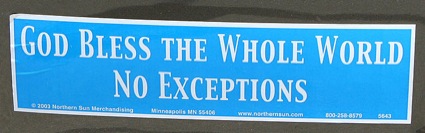
God Bless the Whole World, No Exceptions!
I’ve seen in before of course, but it only came to mind then what it really meant:
There probably isn’t a God, but even if there is, then there is still no sin.
Thus sayeth the driver of the green Subaru Outback in parking row #7. And perhaps President Obama, since his smiling face was on the bumper sticker right next to it.
I was thinking earlier about how all of us fallen human beings are really not that different from each other. We don’t like the effects of the fall (rightly so), and set out to do something about it.
The fundamentalist tries to get rid of sin by changing everyone’s behavior.
The liberal tries to get rid of sin by redefining sin so that it (almost) doesn’t exist.
Continue reading “Bumper sticker musings”
Prolific American novelist John Updike passed away yesterday.
One of his best quotes?
“Of plants tomatoes seemed the most human, eager and fragile and prone to rot.”
-The Witches of Eastwick
No, I haven’t actually read any of his stuff. But enough people have told me that I should some time.
My wife wrote a concise and well-thought-out post knocking down the most popular rational for why it’s entirely OK to terminate the lives of unborn children.
You can read it here.

God teaches us in tribulations. The most unfortunate people in the world are those who know no tribulations. The most unhappy men are really the ones who are able to bribe their way out of suffering and tribulation, and to evade the issue, in pleasures, in wars…
-Thomas Merton, Secular Journal, p.167
More really good stuff from Merton on faith and paradox.
Surely, the faith that science can contradict itself and still be science is a faith that doesn’t honor science at all, because the only value science pretends to have is that it is certain and cannot cancel itself out.
The greatest weakness of Marxists, for example, is the readiness with which they can explain absolutely anything in brisk and chatty and pseudo-scientific terms. They have not yet begun to feel ridiculous at the way their explanations have taken to contradicting themselves completely from one day to the next.
Faith, on the other hand, seems to be contradicting itself, because everything we say about God is so inadequate that it always runs us head first into a paradox.
In certain things, it is even more the glory of the Catholic than of the skeptic to say “I don’t know.”
It should be the great pride and strength of every Catholic [I’ll make that Christian] that there is no ready, ten-minute, brisk, chatty answer to the question what we believe, except in the words of the Apostles’ Creed, which are not comprehensible to scientists anyway. It should be our greatest strength that we don’t have, on the end of our tongues, a brief and pithy rationalization for the structure and purpose of the whole universe, only a statement that, to some scientists, is a scandal.
-Thomas Merton, Secular Journals, May 30 1940
If there is any endeavor in with the reformation really dropped the ball, it was in trying to rewrite the creeds so as NOT to be a scandal to the scientists and logicians.
“Opinions are like a**holes, everybody has one” the old saying goes. Where do they come from though? Careful synthesis of rational thinking and personal experience? Intuition? Faith?
I believe Merton’s observations about this are superb:
Instead of having faith, which is a virtue, and therefore nourishes the soul and gives it a healthy life, people merely have a lot of opinions, whcih excite the soul but don’t give it anything to feed it, just wear it out until it falls over from exhaustion.
An opinion isn’t one thing or the other: it is neither science nor faith, but has a little bit of either one. It is a rationalization bolstered up by some orthodoxy which you happen to respect, which, naturally, starves the mind instead of feeding it (and that is what people who have no faith imagine faith does, but they don’t know what they are talking about…)
H.G. Wells has tried to spend his whole life telling people “What he believes,” that is, trying to get them to accept this own confused opinions about the purpose of human life, if any. Since, from what I hear, he isn’t even a particularly good scientist, he hasn’t even got the basis he things he has for all his other statements; but even if he were a good scientist, his science isn’t a sufficient basis for the metaphysical and moral statements he tries to make. At the same time he complicates his position very curiously by denying that metaphysical or morals are really relevant at all.
-Thomas Merton, Secular Journal, May 30 1940
His description of H.G. Wells could be applied to many of our pundits today including Bill O’Rielly, Al Franken, and about half the people on Fresh Aire.
From Merton’s personal journal in 1940:
What (besides making lists of the vices of our age) are some of the greatest vices of our age?
To begin with, people began to get self-conscious about the fact that their misconducted lies were going to pieces: so, instead of ceasing to do thing things that made them ashamed and unhappy, they made it a new rule that they must never be ashamed of the things they did. There was only to be only once capital sin: to be ashamed. That was how they through they could solve the problem of sin, by abolishing the term.
While watching a German propaganda film about their conquest of Poland, Merton marvels at how peaceful and devoid of death all the footage was. Then, he catches a scene the censors should have thrown out:
…but there was one shot of some Germans riding by on caissons, dead tired, and some of them slumbering. Suddenly one man got in the eye of the camera, and gave back the straightest and fiercest and most resentful look I ever saw. Great rings surrounded his eyes which were full of exhaustion, pain and protest. And he kept staring, turning his head and fixing his eyes on the camera as he went by demanding to be seen as a person, and not as the rest of the cattle…You began to realize how tired and disgusted all those soldiers must have been. It added great weight to the effect of all the garbage that had gone before. What a thing to be proud of! To have turned one whole country into a junk heap!
Later on, he comments:
The most actively obscene shot in the whole picture was one of a bomber releasing a stick of bombs which fell away from under its belly in a group: it was like some vile beetle laying eggs in the air, or dropping its filth.
I grew up watching exactly things like this on the show Wings on the Discovery Channel. This was some of the best TV I ever saw growing up: an examination of mechanized warfare. How Sidewinder Missles worked, how the Stealth fighter was invisible to radar, how the Harrier could take off vertically and hover, how the C-130 super cargo jet was equipped with solid state rocket boosters to help it take off on a short runway, and more. Men, and boys love this stuff. It makes us want to be soldiers, or mechanical engineers at least. To bad at the end of the day it’s just serves to make families fatherless on the other side of the world.