
On not glossing over the first century church

Over and over again, I’ve read and been preached to about how the first century church was this wonderful apostle-led community and that it’s been going downhill ever since. If only we could just GET BACK to that. That’s what church should really look like. House church advocates, cell group people, a lot of people pull this one out. To be fair, some of them have a much richer understanding of this period and don’t hang out in nostalgia. But it happens often enough.
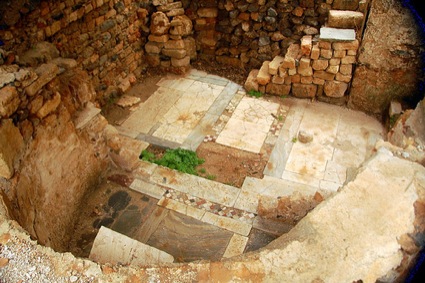
Wright, throughout this book, denounces this idea from various angles. Remember the book of Acts?

It is not surprising that Christianity developed in a multiplicity of ways. The ‘myth of Christian origins’, or in more vulgar language the ‘big bang’ theory of church origins, has been shown up as a later Christian fiction. A ‘pure’ period, when everyone believed exactly the same thing, lived in a community without problems or quarrels, and hammered out True Doctrine for the coming Great Church, never existed.

Though Acts is often regarded as an attempt to whitewash the early Christians, it must be judged singularly unsuccessful. The sin of Ananias and Sapphira, the dispute between Hebrews and Hellenists, the vacillating of Peter, the major division over circumcision, the fierce quarrel between Paul and Barnabas – even the heroes of Acts are shown emphatically to have feet of clay. The idea of early uniformity and stability owes more the Eusebius [4th century historian] and his successors than to a first-century writing; the reality was too close to be covered up.

At the same time, we must also resist the more subtle myths that crown in once we reject the facile one. If the early church was not a pure community, and to be imitated as such, no more can we assume that it was an early version of the ecumenical movement, and to be imitated as such.

-N.T. Wright, The New Testament and the People of God, p.452

Why do I even write this sort of thing down? More than anything, I want to see the church flourish, unhampered by the worldliness that has creeped into so much of what we do. What the “pure” church would really look like is important to me. It’s a big part of why I wanted to read this book. I just skipped ahead 350 pages to that part! I know the early church had it’s problems, but what clues are there about what they did right (Jesus-shaped things) that can be dug up for today? It’s important for me to find out.

Photo credit

Lack of humility in the sciences

How can any scientific enquiry not allow for the possibility that its own worldview might be incorrect?

If it is replied that certain types of argument and enquiry would cut of the branch on which the worldview was sitting, the counter-reply might be that, if that is where the argument leads, you had better find yourself another branch, or even another tree.

-N.T. Wright, The New Testament and the People of God, p.92

Objective/Subjective a false dichotomy

The fear that ‘actual events’ will disappear beneath a welter of particular people’s perceptions is a fear…to be rejected as groundless. As a particular example, it must be asserted most strongly that to discover that a particular writer has a ‘bias’ tells us nothing whatever about the value of the information he or she presents. It merely bids us be aware of the bias (and of our own, for that matter), and to assess the material according to as many sources as we can.

Intellectual honesty consists not in forcing an impossible neutrality, but in admitting that neutrality is not possible. (quoting Arthur Holmes)

Similarly, the fear of ‘objectivization’ which so affected Rudolf Bultmann’s theology may be laid to rest. Bultmann, within his neo-Kantian philosophical heritage, was anxious about seeming to talk of objects or events other than by talking of them in relation to the observer. He therefore insisted (among other things) on doing theology by doing anthropology, following Feuerbach in collapsing god-talk into man-talk.

We simply do not have to accept such false dichotomies. It is not the case that some things are purely objective and others purely subjective, or that one must reduce either to the other. Life, fortunately, is more complicated than that.

-N.T. Wright, The New Testament and the People of God, p.89

Selecting history…love, cameras, and idealogy

Later on, Wright explores the psychology behind a “point of view”: (boldface mine)

At a general level, it is clear from a moment’s thought that all history involves selection. History shares this with other knowing. At any given waking moment I am aware of a vast number of sense-impression, out of which I make a very limited selection for my current focus of attention and interest.

(One of the reasons why art, or for that matter falling in love, are what they are, may perhaps be that they involve the heady experience of a wider-than-usual set of simultaneous selections.)

At the most trivial level, any attempt to record ‘what happened’ without selection would fail, for the sheer overwhelming volume of information – every breath taken by every human being, every falling leaf, every passing cloud in the sky. SOME human breaths might be worth recording: that of aperson thought to be dead, for instance. SOME falling leaves and passing clouds might suddenly attain significance, depending on the context (consider the small cloud Elijah’s servant saw from the top of Mount Carmel.

But even a video camera set up at random would not result in a completely ‘neutral’ perspective on events. It must be sited in one spot only; it will only have one focal length;it will onloy look in one direction. If in one sense the camera never lies, we can see that in another sense it never does anything else. It excludes far more than it includes.

-N.T. Wright, The New Testament and the People of God, p.83

And later on:

The fact that a human mind has to organize and arrange the material does not ‘falsify’ the history. This is simply what ‘history’ is.

At the same time, Thucydides and the rest were every bit as aware as we are of the historian’s solemn duty to strive towards intellectual honesty and severe impartiality. It is not the ancients who were deceived about the nature of isotry, living in a pre-modern age and not knowing what critical though consisted of. It is we who, in the Enlightenment’s rejection of reliance on auctores, ‘authorities’ in a multiple sense, have come to imagine ourselves to be the first to see the difference between subjects and objects, and so have both misjudged our forebears and deceived ourselves.

Inventing ‘history’ by a backwards projection of idealogy is as much if not more a modern phenomenon as it is an ancient one.

It is something from which New Testament scholars themselves are not exempt.

-p.85

More of “objective” history

There is not, nor can there be, any such thing as a bare chronicle of events without a point of view. The great Enlightenment dream of simply recording ‘what actually happened’ is just that: a dream. The dreamer is once more the positivist, who looking at history, believes that it is possible to have instant and unadulteratd access to ‘events’.

At a naive level, this results in the precritical view:

Observer –> Evidence –> Past Event. Simply looking at the evidence and having access to the ‘facts’.

At a more sophisticated level, awareness that evidence cna mislead gives rise to a chastened positivism: the observer sifts the evidence, and reckons that, though some of it is more or less worthless, other bits give the desired direct access. This is the analogy of the positivistic rejection of metaphysics in favour of supposedly ‘hard’ scientific knowledge: Looking at the evidence, sifting it, rejecting some bits and accepting others.

-N.T. Wright, The New Testament and the People of God, p.82

Wright goes on to explain how this really just results in a sort of filtered naivety. It still assumes that a lot of the evidence has direct access to what actually happened. Not only that, but as you can clearly see in the realm of “hard scientific knowledge”, it puffs up the observer with pride about what a brilliant job he has done digging up the real truth. Heh. My rejecting metaphysics, we leave ourselves more in the dark than before.

Action verbs: The real stuff of theology

The Bible full of information about God and creation right?

God IS this way. THIS is how everything works.

This is the ontology of God. He’s three and one in this particular way.

This is the epistemology of the human race. His mind works THIS way (not THAT way).

This is the comprehensive aesthetics of the Lord’s creation. This is beautiful and that isn’t and here’s WHY.

Is that what’s really in the Bible?

No. It’s full of stories about what God DID. Stories about some people whose paths crossed with God’s and what happened. Sentences with verbs in them, as Wright points out below. God spoke to Abraham and he followed the instructions. God called his people out of Egypt. He fed them in the desert. Because the people burned incense to idols, God allowed the Babylonians to take over the country. A remnant of his people remained faithful to him. Some turned back. Jesus walked down the road to Jerusalem. John is exiled on an island, writing down what God showed him in a dream. He has trouble finding the right words to describe some of what he is shown.

Some of the New Testament letters actually are explanations of some of the stuff in the Bible. Hebrews is nice this way. But most of the special revelation is action. It’s the real stuff of theology.

The phrase “monotheism and election” does not refer to two abstracted entities existing outside space and time. It is a way of summoning into the mind’s eye an entire worldview. It is a way of summoning into the mind’s eye an entire worldview. In this, as we shall describe presently, Israel told and retold the story of how there was one god, the creator, and of how he had chosen Israel to be his special possession, and of how therefore he would eventually restore her fortunes and thereby bring his whole creation to its intended fulfillment. To provide the whole explanation each time would be impossibly wordy. It would also, in any case, be unnecessary – provided one remembers that, like so many theological terms, words like “monotheism” are late constructs, convenient shorthands for sentences with verbs in them, and that sentences with verbs in them are the real stuff of theology, not mere childish expression of a ‘purer’ abstract truth.

-N.T. Wright, The New Testament and the People of God. p.78

Remember your grammar? Is, was, are, has, seems, will be – those are linking verbs, not action verbs.

The Lord is merciful. That’s nice. Why? Because he LOVES us.

Paul was telling stories, not proof-texting

Paul is often held up as the model for contemporary exegetical preaching and writing. As if he got BEYOND the stories about Israel and Jesus and mined the abstract timeless truth treasures, bringing them to up to the surface. But was that really what he was doing?

What about Paul? Surely he forswore the story-form, and discussed God, Jesus, the Spirit, Israel and the world in much more abstract terms? Was he not thereb leaving behind the world of the Jesish story-theology, and going off on his own into the rarefied territory of abstract Hellenistic speculation?

The answer is an emphatic no. As has recently been shown in relation to some key areas of Paul’s writing, the apostle’s most emphatically ‘theological’ statements and arguments are in fact expressions of the essentially Jesish story now redrawn around Jesus. This can be seen most clearly in his frequent statements, sometimes so compressed as to be almost formulaic, about the cross and resurrection of Jesus: what is in fact happening is that Paul is telling, again and again, the whole story of God, Israel and the world as now compressed into the story of Jesus.

So, too, his repeated use of the Old Testament is designed not as mere proof-texting, but, in part at least, to suggest new ways of reading well-known stories, and to suggest that they find a more natural climax in the Jesus-story than elsewhere.

-N.T. Wright, The New Testament and the People of God, p.79

Parables just repackaged truth?

Telling stories was (according to the synoptic gospels) one of Jesus’ most characteristic modes of teaching. And, in the light of te entire argument so far, it would clearly be quite wrong to see these stories as mere illustrations of truths that could in principle have been articulated in a purer, more abstract form. They were ways of breaking open the worldview of Jesus’ hearers, so that it could be remoulded into the worldview which he, Jesus, was commending. His stories, like all stories in principle, invited his hearers into a new world, making the implicit suggestion that the new worldview be tried on for size with a view to permanent purchase.

-N.T. Wright, The New Testament and the People of God, p.77 (emphasis mine)

Jesus spoke in parables because the people were too stupid and poorly educated to understand a nice lecture on the nature of the trinity. If only he had had a better audience, we may have had a lot better stuff in the gospels right? Well, good thing he sent Paul to straighten us out on some of that stuff.

No. In fact, the stories in many way carry more weight than a sermon about sin/God/humanity/whatever could have in the abstract. I think this may have been why Jesus didn’t even explain some of his parables to the disciples. It would have actually weakened the message.

I find this striking because I had always sort viewed Jesus’ parables as the equivalent to a modern-day sermon illustration. Repackaging the timeless abstract truth in a funny story involving a guy and maybe a motorcycle. If only the congregation knew their Greek, were well-versed in Kirkegaard and had longer attention spans, we could skip that parable…

Maybe what Jesus said in the story is closer to the truth than what you could say ABOUT the story.

Selling off the Bible’s public relevance

The phenomentalist, reads the parable and finds herself addressed by it. Though she realizes that it may have a historical context, what matters is what it says to her today. This account fits to some extent bot the fundamentalist and the deconstructionist. What cannot be done with this sort of reading, however, it to claim any normativity for it: just because the text says this to ME, there is no reason why it should say it to YOU. If we are not careful, the claim ‘this parable speaks of Jesus dying for me’ will collapse into statements of no more public significance than ‘I like salt’ or ‘I like Sibelius’. The phenomentalist purchases the apparent certainty and security of her statements in relation to the text at the high cost of forfeiting public relevance.

-N.T. Wright, The New Testament and the People of God, p.66

When we take the gospel, or anything God speaks to us in the scriptures and wrap it in highly personal language, then we make it more meaningful to us. It increases the potency of the language.

Say you grew up listening to God spoke of in a way that made him seem a harsh and distant ruler. Then you come to college and you hear the Gospel preached, but with phrases like “God is crazy about you. Give him your heart and he will tenderly embrace you, ugliness and all. He is passionate about loving and resuing you.” And that strikes a chord with you that eventually leads to your choice to follow the Lord.

OK. Then you go on talking about God that way to everyone around you. After all, it’s what made the most sence to you. The things you read in the Bible seem a stiff shell surrounding the much more personal Jesus that you feel. So this is the story you tell.

There’s a problem though. The more personal you make Bible, the less relevant it is to the public. That is, the LESS potent you may be making the message for the next guy. He may not ‘get’ the gospel, filtered through the experience you had. I’m not discounting your experience one bit, but the more you stray from describing things the way Jesus, the apostles and prophets did, the more you are not actually communicating the same thing at all.

I wish I could come up with some better examples right now.

This can go other directions too: Clothing the Bible in very patriarchal language. This appeals to guys (typically trying to grow a beard) who wish they were patriarchs. That stuff is all in there, but when that’s what you talk about most of the time, then the story in the Bible has been personalized. The price you pay for this is the loss of the power of the gospel to the world in general.

That other guy you know who you wish would turn his back on the world and follow Jesus? You try to tell him the gospel, but you’re telling him the version that fit into your story. Without realizing it, you’ve tossed out half the goods. And it turns out those were some of the goods he needed.

This has got to be one angle on why there are so many groups and factions in Christianity. We all have the same orthodoxy, the same Bible. But my amping up certain parts of it, we make it more appealing to some (us) and less appealing to others (those guys). And these go quite a bit beyond theological debates and into our all elements of culture, class, geography, etc.

Darn, this is going to take a lot more work to articulate accurately. I wish I knew the Bible better.

A Mother’s Day Poem

The Lanyard
by Billy Collins

The other day as I was ricocheting slowly
off the pale blue walls of this room,
boucing from typewriter to piano,
from bookshelf to an envelope lying on the floor,
I found myself in the L section of the dictionary
where my eyes fell upon the word lanyard.

No cookie nibbled by a French novelist
could send one more suddenly into the past-
a past where I sat at a workbench at a camp
by a deep Adirondack lake
learning how to braid thin plastic strips
into a lanyard, a gift for my mother.

I had never seen anyone use a lanyard
or wear one, if that’s what you did with them,
but that did not keep me from crossing
strand over strand again and again
until I had made a boxy
red and white lanyard for my mother.

She gave me life and milk from her breasts,
and I gave her a lanyard.
She nursed me in many a sickroom,
lifted teaspoons of medicine to my lips,
set cold face-cloths on my forehead,
and then led me out into the airy light

and taught me to walk and swim,
and I, in turn, presented her with a lanyard.
Here are thousands of meals, she said,
and here is clothing and a good education.
And her is your lanyard, I replied,
which I made with a little help from a counselor.

Here is a breathing body and a beating heart,
strong legs, bones and teeth,
and two clear eyes to read the world, she whispered,
and here, I said, is the lanyard I made at camp.
And here, I wish to say to her now,
is a smaller gift-not the archaic truth

that you can never repay your mother,
but the rueful admission that when she took
the two-tone lanyard from my hands,
I was as sure as a boy could be
that this useless, worthless thing I wove
out of boredom would be enough to make us even.