Achtung!

This week, inbetween coding, I’ve enjoyed listening to U2’s album from 1991 – Achtung Baby. I always knew the band existed, but never paid much attention. Their work keeps coming up though among many of the bloggers I read so I thought I’d give ’em a shot. The Joshua Tree (their only other album I was familiar with) is a good from the get go. This one took me a few listens before I started to like parts of it.

Bono’s delivery is everything. It’s so full of emotion. I took a break from it the other day and popped in some Sting. Whoa. He sounded like he was half asleep!

There’s not a ton to say, but it’s worth posting this section from the song Acrobat.

And I must be an acrobat
To talk like this
And act like that
And you can dream
So dream out loud
And you can find
Your own way out
You can build
And I can will
And you can call
I can’t wait until
You can stash
And you can seize
In dreams begin
Responsibilities
And I can love
And I can love
And I know that the tide is turning ’round
So don’t let the bastards grind you down

Little we know of verse here

In the summer-house of the Cornish king
I kneeled to Mark at a banqueting,
I saw the hand of the queen Iseult;
down her arm a ruddy bold
fired the tinder of my brain
to measure the shape of man again;
I heard the king say: ‘Little we know
of verse here; let the stranger show
a trick of the Persian music-craft.’
Iseult smiled and Tristram laughed.
Her arm exposed on the board, between
Mark and Tristram sat the queen,
but neither Mark nor Tristram sought
the passion of substantial thought,
neither Mark not Tristram heard
the accent of the antique word.
Only the uncrossed Saracen
sang amid the heavy Cornish men;
only, a folly amid fighting lords,
I caught her arm in a mesh of chords,
and the speech of Moslem Ispahan
swung the hazels of Lateran.

From The Coming of Palomides, in Taliessin Through Logres, by Charles Williams

Guy’s night out

Timeout now for something that is more likely to appear on my wife’s blog.

Two years ago when my wife was stuck in bed pregnant with our first son (little mister), I spent many many hours with my daugher (curly miss). We played together, traveled around town in the stroller, ran errands, and talked a lot. We really bonded a lot during that season. I love my son, but we’ve never had the same kind of opportunity. I see him a lot of course, but his sister is always around too. It’s just different. I feel like we never have as much chance to connect on a certain level.

Tonight though, we decided to have respective guys and girls nights out. Wifey took curly miss to the mall to do who knows what. Little mister and I decided to do manly men things. We walked straight down to Bucer’s smoke room, lit up pipes and each had a pint of Guiness.

Except that little mister is only 2.5 years old, so we didn’t do that.

First, we needed to take charge, be responsible and get necessary chores out of the way. We scooped the very stinky cat box and then fired up some candles to fumigate the bathroom. Then we transferred laundry to the dryer. Little mister helped me throw each article in, declaring each one to be “wet!”.

After all this work, we needed a snack. Mister got out peanut butter and Ritz crackers form the little cupboard. Hit the spot! We practiced rubbing our sleave in the peanut butter on the table too.

With the minivan taken by the women, we resorted to travel in the “Stinky Banana Car”. It’s the only way to fly. I threw mister in the back seat and away we went. First stop: The service station to pump up the chronically flat front tire. Next to the gas station were 3 teenagers in full-plate armor whacking the crud out of each other with heavy metal swords. Part of the local Dungeons and Dragons reenactment crew or something. They looked like they were having a good time though so we resisted the urge to throw +6 attack lightning bolts at them as we drove by. Restraint of power is a kingly thing. I want my son to be virtuous like this.

After we were sufficiently inflated, it was time to become scientists. Little mister has been very interested in hills lately. Going UUUUUP the hill and DOOOOOOWWWWN the hill. It’s a study of gravity. On 6th street in our town is a very steep hill. The kind you avoid when it’s icy. We went UUUUUP and DOOOOOWWWWN this hill several times, observing the effect on our stomachs.

This reminded us that we hadn’t had dinner yet and we were starving.

I asked Mister: “Do you want to go to the grocery store and get some dinner?”
Mister: “doh-nut!”
Me: “You want a donut for dinner?”
Mister: “white one!”
Me: “You want a white donut for dinner? How about some chicken nuggets?”
Mister: “Nooo!! Doh-nut!”
Me: “We’ll see….”

Upon arriving at the deli, we order a very health dish of tofu on a bed of leafy greens with a side of steamed white rice.

Well, we tried to order that, but somehow we ended up with corn dogs instead.

After that is was on to daddy’s office, where we rode the elevator and experimented with the robotic door openers. If you hit the button enough times you can make ??? happen. Little mister apparently was shooting for this.

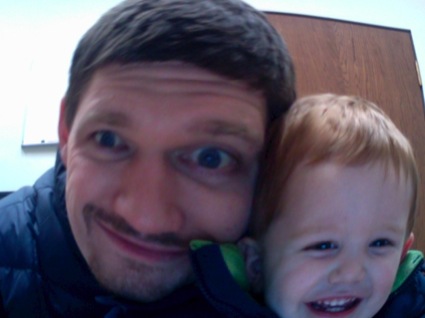
We also took some pictures with the built-in camera at the desk.

We also commanded Mario to stomp on a few goombas. I couldn’t have done it without him actually. We make a good team.

Finally, we made our way to his favorite coffee shop where commenced a deep literary discussion on the book at hand. The book was about dinosaurs of course:

Mister: BIG ino-or!
Me: Yeah, what’s he eating?
Mister: grass
Me: How about this one?
Mister: Big horn.
Me: Yeah, he has a big cool horn.
Mister: Make box

And that was the end of our reading. On to building several different size boxes made from little foam puzzle pieces. The pieces have pictures of Pocahantus and Snow White Spider Man and Beowulf on them so that was extra manly.

Finally it was time to return home. Wow, those two hours flew by with no show-stealin’ sister around! We had a good time. Little bits of his personality I don’t usually see came out. We’ll have to do that again some time.

Looking for wisdom in poetry

This short passage from Lewis is absolutely brilliant. It explains why so much contemporary literary criticism is crap. That 500 page thesis on “Transgender Identity in Shakespeare’s Sonnets”? How about “Dante: Animal Rights Activist”. Also related to this is why in high school you had to read Cider House Rules but not Milton. And that’s just the tip of the iceburg really. This helps explain all kinds of things!

I think we demand of a great poem something that can be called Wisdom. We wish, after reading it to understand things in general, or at least some things, better than we did before. Wisdom by itself does not make a great poem or even a poem at all: and the value of a poem is by no means in the direct ration to its wisdom. But the demand for wisdom remains. It is indeed so strong that critics to whom the obvious content of an old poet is mere ‘theological rubbish’ usually find it necessary to convince themselves that he had some profound wisdom of quite a different kind, some ‘real subject’ which no generation till our own ever suspected. The whole biographical bias of modern (or recent) criticism is possibly due to the desire to find wisdom in poems whereof the obvious meaning has ceased to appear wise. If Heaven and Hell, gods and heroes, the innocence of Imogen and the horrors of conscience in Macbeth, seem to man ‘rubbish’, then his last resource for restoring importance to the texts is to suppose that the poet is revealing the secrets of his own heart. The demand that to read great verse should be to grow in wisdom has not really altered.

-C.S. Lewis, Williams and the Arthuriad, p.190

More on Broceliande forest

It is indeed in that forest, inextricably mingled with the mystical sea-spiritual distance, that all these places of margel must lie. It is, after all, one of the great forests of myth – greater because of its hidden mysteries than Arden or Birnam or Westermain. The wood of Comus may be compared with it; and indeed it is poetically a part of it, except that itis a holy place and uninhabited by such sorcerers. A nobler comparison is with the forsest which Dante found at the foot of the Mount of Purgatory and where he came again to himself, or that other on the height o the Mount where Beatrice came again to him. But it is not proper to do more than shyly observe comparisons between such myths. It is a place of making and of all the figures concerned with making.

-Charles Williams, The Figure of Arthur, p.82

Other mysterious woods?

Arden, Birnam, Westermain, and Comus.

Where do we find these? Among other places…

Shakespeare (As You Like It), Shakespeare (MacBeth), George MacDonald, Milton

respectively.

But Broceliande is really more than any of these. It is THE place of making.

The home of immense dangers and possibilities

The mysterious forest of Broceliande figures heavily into Charles William’s account of Arthurian legend. It’s kind of in Wales, and kind of in the ocean, and is more of a fairy place that can’t always be gotten to. Both Carbonek (home of the Holy Grail) and the castle of the headless emperor on the edge of hell lie within it. Few who go deep within it ever come out. The ones that do are either astonished, like children, or lost in a bitterness the remainder of their life.

A casual glance may see it as simply an interesting stage for stories and adventures, just about anything you like, to happen, but it is so much more than that.

In a writer whose philosophy was Pantheistic or whose poetry was MERELY romantic this formidable wood rom whose quiet and timeless fecundity ‘the huge shapes emerge’ would undoubtedly figure as the Absolute itself. And indeeed Broceliande is what most romantics are enamoured of; into it good mystics and bad mystics go: it is what you find when you step out of our ordinary mode of consciousness. You find it equally in whatever direction you step out. All journeys away from the solid earth are equally, at the outset, journeys into the abyss.

Saint, sorcerer, lunatic, and romantic lover all alike are drawn to Broceliande, but Carbonek is beyond A CERTAIN PART of it only. It is by no means the Absolute. It is rather what the Greeks called the Aperon – the unlimited, the formless origin of forms. Dante and D. H. Lawrence, Boehme and Hitler, Lady Julian and the Surrealists, had all been there. It is the home of immense dangers and immense possibilities.

-C.S. Lewis, Williams and the Arthuriad, ch.2 p.101

Photo credit

On becoming our God

I’ve heard the notion of “you become what you worship” spoken of from a lot of different sources lately. I’m curious as to why I never heard this growing up. Maybe I did and just wasn’t paying attention. I’d really like to see specific examples of this explored more. It seems like a really good (and useful) spiritual principal. Since we all end up having a distorted view of God, do we “become” like this false image? I guess it’s mostly an image of him being not as truly good as he is. Or maybe or more defined one, like an image of our own father.

Every man becomes the image of the God he adores. He whose worship is directed to a dead thing becomes a dead thing. He who loves corruption rots. He who loves a shadow becomes, himself, a shadow. He who loves things that must perish lives in dread of their perishing. The contemplative also, who seeks to keep God prisoner in his heart, becomes a prisoner within the narrow limits of his own heart, so that the Lord evades him and leaves him in his imprisonment, his confinement, and his dead recollection.

-Thomas Merton, No Man is an Island, Ch.14 Sec.3

So what’s the point? To discover if this is the root of some of my own failings and sin. Then changing this image may be the doorway out, as opposed to just striving harder to be a “good person”, which as we all know, doesn’t really work.

Ever feel rotten?

Now we still have the desire to do the right thing, for we are created in God’s image and inwardly seek the things of God. But that godly desire is trapped and imprisoned with a wall of disordered flesh, emotions, and destructive thought processes. The spirit is no longer our primary driving force. It is covered over or forgotten.

Our bodies and souls are also changed by the Fall. The soul is disjointed and confused within itself. The body loses its original God-given beauty and innocence, a loss we try to cover over with often futile efforts to cosmetically enhance our appearance. In short, Adam and Eve’s banishment from the paradise of the Garden of Eden isn’t a long-ago fairy tale. It’s an existential, cosmic reality, and it’s something we experience in the here and now of everyday life.

-John Michael Talbot, The Music of Creation, p.40

On rereading William’s Taliessin (this time with a guide!)

For my second journey into the mind of Charles Williams, I chose his Arthurian poetry cycle, which includes Taliessin through Logres and The Region of the Summer Stars. Williams worked hard on these poems. All accounts say that he viewed them as his greatest achievement. Turning out novels and other books for some profit was always getting in the way of his accomplishing this task. In fact, death put a stop to it before he could finish the cycle with a third volume.

And so, I started to read. It was slow going. I only understood about 10% of what was going on. I almost quit…

Then, I discovered The Figure of Arthur, a concise history of Arthurian legend, written by Williams and published (in part) after his death by C.S. Lewis. This was immensely helpful, for now many of the names and places mentioned in his verse took on a history. The book also includes extensive notes and literary criticism from C.S. Lewis on the poems themselves. He admits that in some ways, they aren’t very good. But he praises them for other qualities that I hadn’t considered (perhaps more on that later). With Lewis to guide me through the cycle, it suddenly became much more interesting. The words on the page transformed right before my eyes! That is to say, suddenly the poem didn’t suck anymore.

Lewis explains that a lot of the best writing out there has prerequisites to reading it with understanding. That is why studying the classics is so valuable. However, you have to draw the line somewhere:

[concerning T.S. Elliot’s The Waste Land], if you have never read Dante or Shakespeare certain things in that poem will be obscure to you. But then, frankly, we ought to have rad Dante and Shakespeare; or at lest the poet has a right to address only those who have done so. And if the only result of a first reading of The Waste Land were to send you to Dante and Shakespeare, your time and money have been very well spent. Similarly in Williams. He assumes that you know the Bible, Malory, and Wordsworth pretty well, and that you have t least some knowledge of Milton, Dante, Gibbon, the Mabinogion, and Church history. Difficulties of this sort are wholly legitimate. But there are border-line cases.

When Mr. Eliot assumes that you know Miss Weston’s From Ritual to Romance, or Williams that you know Heracleitus as quoted by W.B. Yeats – or still more when the one assumes a knowledge of the Tarot pack and the other of the Sephirotic Tree – the difficulties are becoming less obviously legitamate. We have not indeed, reached the frontiers of vicious Privatism. The things referred to are accessible: the poet may be innocently mistaken about the extent to which they are – still more about the extent to which they ought to be – matters of common knowledge among educated people.

-C.S. Lewis, Williams and the Arthuriad, Conclusions p. 189

So I read something, and found it boring and confusing. But I wasn’t conviced is was the author’s fault. It had a hint of something more there, if only I could put my finger on it. So I spent a few days studying the background, then returned to it. What a difference!

The entire cycle really is pretty slow going. I don’t think I’ll end up carefully reading through the whole thing right now. There are other things I’d rather explore. Nonetheless, I was pleasantly surprised to find the extra effort worth it!

Naming your stuff “Ron”

I’m curious as to why, in some myths, the actors have names – proper first names – for much of their gear. Just to infuse them with more meaning and a sense of history I imagine.

In their early account of the battle of Badon hill, where Arthur defeated the Saxons, both early poets (Wace and Layamon, ~1155) point out that our hero had names for more than just his sword:

…,the king wore a sword forged in Avalon, almost a faerie place – forged ‘with magic craft’, says Layamon, who calls it Caliburen, but Wace names it Excalibur. Layamon adds that his helmet was called Goswhit, and his shield Pridwen, on which was engraved in tracings of reddish gold, the image of the blessed and glorious Mary. Both poets add that the name of his spear was Ron.

-Charles Williams, The Figure of Arthur, p.41

We all know about Excalibur, but what about Ron, man?!

Beowulf also had a magic sword, named Hrunting. In this same vein, Tolkien gave names to many of the important weapons in Middle Earth, including Sting (Bilbo/Frodo), Glamdring (Gandalf), Narsil (Isuldur), Anduril (Aragorn), Herudrim (Theodin),  and so forth. Apparently though, their helmets and shields are not important enough to mention. You’ve got to draw the line somewhere.

Do we still do this today? All the time I think. Musicians often name their instruments. Eric Clapton had Blackie. Pierre Bensusan has “The Old Lady”. In college, my friend’s french horn was named Leopold. The 2-ton concert tuba (available for check-out) was called Buba.

My car is know as the “Stinky Banana Car”, or SBC. Long story.

Computers are so cold and lifeless, so we typically give them names to infuse a little character into them. I’ve worked on servers called Coyotee, Hornet, Snake, Deathstar (how many servers out there have Star Wars names? Thousands?), Thalia, RedTape, BlackWidow, Redwood, Snarky, etc. Sometimes they told a story (RedTape audited accounts). Some were just fun. Now all our servers where I work have names like web-1, web-2, email-1, etc. Boring…

IT Director: Why is the new database server named “Ron”?

Developer: From King Arthur’s spear you uncultured swine!