Writing good literature

Speaking on the evolution of Arthurian legend to include Galahad, the Round Table, a more interesting Merlin, etc:

It is occasionally forgotten, or seems to be, in the great scholarly discussions, that anyone who is writing a poem or a romance is primarily writing a poem or a romance. He will, of course, be affected, as the Crusaders in their task were affected, by all sorts of other things – his religious views, his political views, his need of money, the necessity for haste, the instructions of a patron, carelessness, forgetfulness, foolishness. But he is primarily concerned with making a satisfactory book. He may borrow anything from anywhere – if he thinks it makes a better book. He may leave out anything from anywhere – if he thinks it makes a better book. And this (it can hardly be doubted), rather than anything else, was the first cause of the invention of the glorious and sacred figure of Galahad.

-Charles Williams, The Figure of Arthur, p.62

This is another thing you can put in the “captain obvious” file, but it’s worth bringing up. His point is that this is forgotten in some SCHOLARLY discussions. It’s also why a person you share nothing with politically, religiously, or socially can still write a book that you recognize as outstanding. If they’re intention was excellent literature, they will do whatever they need to craft it well. However, if they’re primary intention was to preach (be it about global warming or eschatology), they may easily end up writing garbage. Even if the agenda is something you favor, it doesn’t make the literature any better.

Which way does the admirable feminine mind spring?

I’ve found Charles Williams “The Figure of Arthur” to be much more interesting (and readable) than his own stab at Arthurian verse (Taliessin through Logres). It seems to be a thorough, yet concise history of how the legend evolved over the years. It was reimagined by different poets, other myths were mixed in with it, and so forth.

At one point, he explains how courtly love was a formalized exaggeration of real romance. Nevertheless, it is founded in reality.

The extreme ideals of courtly love our demonstrated in the poem Lancelot by Chretien de Troyes:

The most famous incident of his career, after that manner and in this poem, is that of the cart. Lancelot lost his horse, apparently in a battle with Meleagaunt, and presently overtook a cart driven by a dwarf. Now at the time a cart was a rare thing, and evil. There was only one in each town, and it was used to expose and carry to execution, thieves, murderers, traitors, and other criminals. Anyone who had been carried in a cart lost all reputation and legal right; he was dead in law, and could no more show himself in courts or towns. Anyone wo met a cart crossed himself and said a prayer.

Lancelot asked the dwarf for news of the queen [(his love, who had been kidnapped)]; the dwarf answered that if the knight would mount the cart, he should presently hear of her. For a couple of steps Lancelot hesitated. Reason and Love dispute, for that time, within him. Reason loses; Love triumphs; he climbs in. Presently, when he had undergone many adventures, and crossed the sword bridge, and overcome Meleagaunt, he was brought by Bagdemagus to the queen, whom he now liberated. But she had herd of his hesitation. She threw him a cold look and would not speak to him.

Lancelot, ‘feeling very helpless’ (how one’s heart leaps at that phrase! how one recognizes the chily glance, the silent mouth!), decided that his fault must be in having ridden the cart at all. This of course, is exactly what a man would think, and might even sometimes be quite right in thinking; one never quite knows which was the admirable feminine mind will spring. He was wrong; his fault lay only in his delay. Presently, after an alarm of death on both sides, she softened. He dared to ask her how he had offended her. She answered: ‘You must remember that you were not at all in a hurry to gen in that cart; you went two good steps before you did.’ Lancelot absed himself profoundly. ‘For God’s sake lady, take my amends, and tell me if you can forgive me.’ The queen said: ‘Willingly; I forgive you entirely.’

William’s continues:

No doubt this is an extreme example of courtly love. But no doubt also it is based on general human experience. The delay in action may, to a woman, mean more than the action itself. ‘I’m not convinced by proofs but signs’ says Patmore’s young woman; and all masculine heroism without feminine tact is apt to go wrong. Where one expected gratitude (not that Lancelot did) one finds austerity. Oh perhaps the Provencals [the cultural founder of courtly love] manipulated love too much, but undoubtedly they knew what they were manipulating!

-Charles Williams, The Figure of Arthur, p.?

I found this whole story to be ammusing.

Lancelot: “For cryin’ out loud lady, I just went to great lengths to rescue you, just about got myself killed 100 times, and you totally give me the cold shoulder! What did I do? It must have been that I allowed myself to be humiliated to complete the journey. You’re ashamed of me for laying down my honor.”

Queen: “No, it’s just that you got here a bit late because you mind had wondered from me for a moment. I’m so offended. (Makes a frumpy face). Oh, OK. I forgive you.

Don’t stop with theology

Here, John Michael Talbot recounts the experience of a friend of his:

I remember how a monastic brother in our community once told me about his own experience of God’s love. He was out walking the mountain roads and wooded trails that surrounded our monastic hermitage. Suddenly, he was overcome with a sense that God loved him so much that even if he were the only person on earth, Jesus still would have sacrificed his life to atone for his sins. The brother was overwhelmed, and began to wep tears of gratitude and joy. But mixed with his joy was sadness, for he had turned away from the God who loved him so much.

This this dear brother’s tears became a mingling of sorrow and joy together. For him, the atonement was no longer a theological abstraction. It was intimate and personal. He knew the vicarious and atoning death of Jesus on the cross was God’s ultimate expression of love for HIM! This was more than a legal contract. this was pure self-sacrifice. This was love.

Theology is often where we start in our quest to understand things, but we can’t stop there. May we understand the atonement as deeply as this brother did.

-John Michael Talbot, The Music of Creation, p.90

I think there are quite a few people who love the Lord, genuinely strive to obey him, and even know their theology pretty well. But, they have never had an experience like this. “Oh, I’m just not an emotional person.” they say. “God made all people different and my experience of his presence just looks different.”

And of course, that is true, but my guess is that they don’t quite buy their own words. If they are humble (and they very well may be), then they will doubt the fullness of their own knowledge of God. Perhaps what this brother experienced, the same thing I’ve read about other saints experiencing, maybe it’s something that they are missing. If they desire a deeper relationship with God (a difficult thing to put your finger on), they will wonder if a connection with him might look something like this.

The fact that some rather flaky individuals with no grasp of even the most fundamental theology claim to have to have these types of experiences all the time is a major turn-off to these folks. Nonetheless, they will likely still wonder that if they REALLY understood they atonement, they might cry about it too. At least a little bit.

(This person is partially autobiographical of course. Obviously not the part about them being humble.)

Jesus taught parables, not systematics

Straightforward propositional communication – which is precisely the kind that bombards us every day – leaves little room for mystery. It proclaims, “This is the truth,” reducing the mystery and wonder of Truth to concrete theological or philosophical statements. Parables, on the other hand, clearly point to the truth, but without violating the mystery of Truth. This allows each of us to experience the truth of Jesus’ words in a manner that’s personally meaningful and transformative.

Parables are very simple. They communicate to children as well as to scholars. And there was always something about children that Jesus loved. Once, when a group of children was brought to Jesus, he said, “the kingdom of heaven belongs to such as these.” This wasn’t an endorsement of childishness. Rather, Jesus was reminding all of us to honor the joy and awesome wonder of creation and creation’s God. Likewise, Jesus’ parables are childlike without being childish.

-John Michael Talbot, The Music of Creation, p.102

Jesus taught with parables, and even when he did explain them, his insight was not particularly thorough. You can’t read the Bible like systematic theology. Paul wrote some line-upon-line instruction in Romans, but even that isn’t near as propositional as we would like it to be sometimes. Would it have been nicer if Jesus had ivory tower talk that we could then reword for the popular masses? Well, since his was the only undarkened intellect to walk the face of the earth, I vote we stick with what he did say (parables), and not try too hard to explain them.

It only enhances or illuminates his words to a certain degree. After that, it diminishes his words with the flood of our own.

Who you are versus what you do

One of the major questions all philosophies have to wrestle with is “what makes something what it is?”. Some people call this ontology. To but it another way, “Are you defined by what you do or who you are?” (This could go for objects, not just people, but we’ll stick with people for now.)

A simple example would go something like this:

Is a man a painter because he paints, or is he a painter because that is his title? If he makes his living as an artist, certainly he is a painter. But what about the insurance salesman who also paints in his garage in the evenings. Is he a painter? Well, sort of.

Sometimes, black children raised by white parents are shunned by their black peers for not really being “black”. In this case, they aren’t talking about skin color (which obviously can’t be changed), but about a set of behaviors. So in that case, “black” is defined by what you do, how you act.

Seth Godin recently commented on this in relation to online communities and actions:

The neat thing about the online world is that you are judged almost entirely by your actions, usually based on just your fingers.

If you do generous things, people think you are a generous person.
If you bully people, people assume you are a bully.
If you ask dumb questions, people figure you’re dumb.
Answer questions well and people assume you’re smart and generous.
… you get the idea.

This leads to a few interesting insights.

1. If people criticize you, they are actually criticizing your behavior, not you.
2. If you’re not happy with the perception you generate, change the words you type and the messages you send.
3. When you hear from someone, consider the source. Trolls are almost always trolls through and through, which means that you have no obligation to listen, to respond or to placate. On the other hand, if you can find a germ of truth, can’t hurt to consider it.

In this case, he is drawing attention to the fact that the online medium serves to filter out a lot of “who we are” – our facial expressions, tone of voice, what clothes or perfume we are wearing, how tall we are, and even what friends we are seen with. This makes a place where our identity is defined almost entirely by our volitional behavior. If we flame someone in an online forum we didn’t too it by accident, right? This is a liberating prospect for many. I think it can also be a stifling atmosphere for individuals who’s most admirable traits are less tangible.

Theologians have to deal with this all the time. Of course you’ve heard that “We are sinners not because we sin, but we sin because we are a sinner!” Of course this language is kind of confusing. The point is to affirm the doctrine of original sin, that states we are not born innocent, but carry rebellion toward God in our hearts, inherited from our ancestors, Adam and Eve. So we are sinners, period. Telling a lie or murdering someone doesn’t make us any MORE of a sinner than we already were.

This bleeds pretty quickly into the nature/nurture argument as well.

Calvinists of course ascribe our identity entirely to our essense, not our behavior. We are sinners not because we sin. We are not saved by anything good thing we ever did, not even a thought of faith. We are saved because we are elect. Or not. We are husbands because we are married, not because we treat our wives kindly (or not). Yet you can see how you can carry on with this to the point of absurdity.

So we find some kind of balance where we go back to defining ourselves by what we do. If you say something mean, are you a bully? If all you ever say are mean things, can you prove that you aren’t a bully?

Are you in charge of your own identity, destiny even? Or not?

This is one of the great deep problems. You see it everywhere. Look at Victor Hugo: Inspector Javert was the “good” guy, but really destined to be evil, despite his passionate efforts to be just. Valjean was the “bad” guy, but destined to be good, despite having the regularly lie and evade the law.

This is one of the grand, grand themes of life. How will you resolve it? How will you tell the story?

I really only got to musing about this after reading a section in musician John Michael Talbot’s book. He takes a balanced approach, saying: yes, these things define me, but only so far.

I continually witness the connections between my own body, soul, and spirit. I am both a musician and a singer. I am also a teacher. Fulfilling these responsibilities utilizes all aspects of my being. But suppose I wer to lose my hands, so that I could not play the guitar. Would this make me less “me”? Or suppose I lost my voice, so I could neither sing nor teach. Would this make me lose my uniqueness in God’s sight? or suppose I injured a part of my brain, o that my emotions became confused, or I could no longer grasp or teach all the things I currently talk about. Would I lose the essence of myself? Would I no longer be me? Would I no longer have genuine value or worth?

My music is truly me. It communicates something that is central to my being. My teaching is truly me as well, ad through teaching I communicate concepts and visions that are a very important part of who I am. My emotions are also me, and they reflect my own values about life and God. All of these various aspects reflect me, and to some degree, even are me. They are part of what the Eastern Christian mystics call my energies. But they are not the essence of me.

If I were to lose any or all of these energies or abilities, my essence would remain. I would still be me. The core of my being would remain always. The same is true for you.

-John Michael Talbot, The Music of Creation, p.29

Tarot and more fun with Charles Williams

Well, several people have told me recently that I should read some Charles Williams. He was after all the third major Inkling. So I picked up a copy of The Greater Trumps from the library.

Nearly all of Williams novels have some kind of supernatural plot device. Despite being a Christian, he had a lifelong fascination with the occult. Black magic of various sorts works it’s way into many of his stories. Apparently, Tolkien, for all the magic that appears in The Lord of the Rings, actually held to the traditional view that sorcery really was sourced in demonic powers and an abomination to God. He was always somewhat annoyed at how lightly Williams spoke of it.

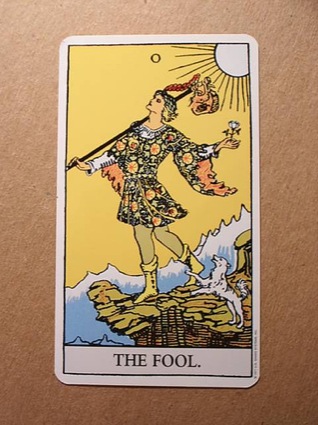
This particular novel centers around tarot cards. I must admit, I found the subject somewhat intriguing. Growing up, tarot cards were in the piled in with Ouiga boards and other contraband. I knew very little about these sorts of things as they were forbidden. William’s novel both gives them some legitimacy while at the same time revealing Christ at work in their midst (through the card with the image of The Fool), making a mockery of the card’s mysteries and showing himself to be Lord of the past, present, and future.

This is not unlike theories I’ve heard about how the Zodiac cycle used by astrologers actually tells the story of the redemption of mankind.

A few interesting facts about tarot cards:

  • Tarot cards were first created in the early 1300’s, with the oldest surviving set being from 1442.
  • The cards were apparently not used for divination or any kind of occult practices until the mid 1700s! They were just for playing games until then.
  • Tarot cards are popular in Europe (especially France and Italy) for various card games. Their use in divination really only shows up in English speaking countries like Britain and the U.S.
  • Tarot divination is loosely based on medieval alchemy and the Kabbalah of Jewish mysticism. That Kabbalah stuff seems to show up all over the occult. It includes, free of charge, all kinds of nifty diagrams to represent super-secret stuff.

William’s novel starts out interestingly enough, but about halfway through it takes a nosedive into dream-sequence mushiness. What a shame. Nothing disappoints like a bad ending.

I still haven’t written Williams off yet though. I’ve begun reading what HE thought to be his greatest work, his Arthurian cycle Taliessin through Logres, The Region of the Summer Stars.

I’ve also heard that The Decent into Hell is his best novel. After that maybe I’ll have a more informed opinion.

Photo credit

A blogging identity

This from a recent Times article that explored why people Twitter. I would include Facebook status updates and even a lot of blogging as being relevant to this passage:

The clinical psychologist Oliver James has his reservations. “Twittering stems from a lack of identity. It’s a constant update of who you are, what you are, where you are. Nobody would Twitter if they had a strong sense of identity.”

“We are the most narcissistic age ever,” agrees Dr David Lewis, a cognitive neuropsychologist and director of research based at the University of Sussex. “Using Twitter suggests a level of insecurity whereby, unless people recognize you, you cease to exist. It may stave off insecurity in the short term, but it won’t cure it.”

For Alain de Botton, author of Status Anxiety and the forthcoming The Pleasures and Sorrows of Work, Twitter represents “a way of making sure you are permanently connected to somebody and somebody is permanently connected to you, proving that you are alive. It’s like when a parent goes into a child’s room to check the child is still breathing. It is a giant baby monitor.”

Is this blog just me shouting at a wall that bounces my voice back to me? I mean, seriously, nobody reads it except my wife and a handful of friends on occasion. I tell myself it’s a scrapbook of ideas, a memory tool really. So much that I would like to remember, I forget entirely if I don’t write it down. I retain the blurry image that I can’t put my finger on. With this blog though, I CAN put my finger on it, at least part of the time.

I wonder, is it PART of my identity, or a compensation for my lack of identity? What about your blog?

Answer: Sometimes a little of both.

Mystery through spelling

Owen Barfield, in tracing the history of the word “genius” (from which comes “ingenious” and “engine”) notes that from it we also get the word “genie”. That’s the kind of genie that might live inside a magic lamp by the way.

He mentions in passing that using the Arabic spelling “djinn” can infuse it with the “deepened strength and mystery of the older word”. It harkens back to the root word’s supernatural origin (God-given skills), instead of the more contemporary, strictly intellectual meaning of the root. We process these kinds of subtle metaphors in language usually without thinking. There is so much wrapped up words. These are little clues into what makes poetry (and to a lesser extent prose) potent (or not).

Our meddling intellect

The poet Wordsworth get’s a lot of love from Owen Barfield. He is probably quoted and admired more than anyone frequently than anyone else I’ve seen so far in his writings.

…but perhaps the most brilliant, even epigrammatic, expression which has ever been given to the everlasting war between the unconscious, because creative, vital principle and the conscious, because destructive, calculating principle, is contained in four lines from a little peom of Wordsworth’s…

-Owen Barfield, History in English Words (Reader p. 42)

Here is that peom Barfield is talking about, with the pertinent verse in bold. (It’s a good one!)

The Tables Turned
by William Wordsworth

Up! up! my friend, and quit your books,
Or surely you’ll grow double.
Up! up! my friend, and clear your looks;
Why all this toil and trouble. . . .

Books! ’tis a dull and endless trifle:
Come, hear the woodland linnet,
How sweet his music! on my life,
There’s more of wisdom in it. . . .

One impulse from a vernal wood
May teach you more of man,
Of moral evil and of good,
Than all the sages can.

Sweet is the lore which Nature brings;
Our meddling intellect
Misshapes the beauteous forms of things–
We murder to dissect.

Enough of Science and of Art,
Close up those barren leaves;
Come forth, and bring with you a heart
That watches and receives.