
Metaphor changes language

This is one of the more lucid passages I discovered reading Owen Barfield:

Now apart from the actual invention of new words (an art in which many poets have excelled), the principal means by which this creation of meaning is achieved is – as has already been pointd out – metaphor. But it must be remembered that ANY specifically NEW use of a word or phrase is really a metaphor, since it attempts to arouse cognition of the unknown by suggestion from the known. I will take an example: the painter’s expression “point of view” was a metaphor the first time it was used with a psychological content. This content is today one of its accepted meanings – indeed, it is the most familiar one – but it could only have become so AFTER passing, explicity or implicityl, through the earlier stage of metaphor. In other words, either Coleridge or somebody else either said or thought (I am of course putting it a little crudely) ‘X is to the mind what “point of view” is to an observer of landscape’. And in so doing he enriched the content of the expression “point of view” just as Shakespeare enriched the content of ‘balm’ (and of ‘sleep’, too) when he called sleep the ‘balm of hurt minds’ (‘sleep is to hurt minds what balm is to hurt bodies’). Reflection will show that the ‘new’ use of an epithet – that is to say, its application to a substantive with which it has not hitherto been coupled – is also a concealed metaphor.

-Owen Barfield, Poetic Diction: The Making of Meaning, (Reader p.20)

Barfield goes on to explain in quite some detail how the word “ruin” evolved (via metaphor) to mean several different things over the course of history. This stuff is interesting, but Podictionary makes it more fun!

Owen lays the smack down!

Much of Barfield’s writing is spent systematically explaining his thinking, giving lots of examples. He rarely mentions other people’s work and doesn’t have a lot of footnotes and references. It’s mostly meat, with little time spent agreeing or disagreeing with other scholars.

But then, every once in a while, seemingly out of nowhere, he whips out his Kalashnikov and fills somebody full of lead. He first quotes this passage by Max Muller:

Spiritus in Latin meant originally blowing, or wind. But when the principle of life within man or animal had to be named, its outward sign, namely the breath of the mouth, was naturally chosen to express it. Hence in Sanskrit asu, breath and life; in Latin spiritus, breath of life. Again, when it was perceived that there was something else to be named, not the mere animal life, but that which was supported by this animal life, the same word was chosen, in the modern Latin dialects, to express the spiritual as opposed to the mere material or animal element in man. All this is a metaphor. We read in the Veda, ii. 3, 4: ‘Who saw the first-born when he who had no form (lit. bones) bore him that had form? Where was the breath (asuh), the blood (asrik), the self (atma) of the earth? Who went to ask this from any that knew it?” Here breath, blood, self are so many attempts at expression what we should now call ’cause’.

Now if you didn’t know much about linguistics (like myself), you might nod your head when reading this and say, “Um, OK. That makes sense.” Ah, but this is a big deal! Barfield goes nuts:

It would be difficult to conceive anything more perverse than this paragraph; there is, indeed , something painful in the spectacle of so catholic and enthusiastic a scholar as Max Muller seated so firmly on the saddle of etymology, with his face set so earnestly towards the tail of the beast.

He seems to have gone out of his way to seek for impossibly modern and abstract concepts to project into that luckless disbin of pseudo-scientific fantasies – the mind of primitive man. Not only ’cause’, we are to suppose, was within the range of his intellect, but ‘something’, ‘principle of life’, ‘outward sign’, ‘mere animal life’, ‘spiritual as opposed to mere material’, and heaven knows what else.

Perverse; and yet for that very reason useful; for it pushes to a conclusion as logical as it is absurd, a view of mental history, which, still implicit in much that passes muster as anthropology, psychology, etc. – even as ordinary common sense – might easily prejudice an understand of my meaning, if it were ignored without comment.

-Owen Barfield, Poetic Diction: Metaphor (Reader p.12)

This is like someone explaining how some bronze-age peasants put together a wagon and describing it like this:

“First, the ancient craftsman would select a building material for their wagon. Wanting to reduce their carbon footprint, they would likely choose wood for their cart instead of a steel or aluminum frame. They generally tried to find strong hard-woods for the spokes of the wheels, which enabled them to reduce the wheel width so as to make the cart more aerodynamic. Finally, the cart was left unpainted so their mode of transportation would properly accessorize their earth-tone inspired wardrobe.”

How silly. Contemporary material science and environmental conservation, physics, and even high-taste and fashion awareness projected onto ancient anthropology.

But is this really that much different than what Muller was doing? Contemporary psychology, modernist philosophical thought given as these ancient people’s clear motivation. Really? And making all kinds of assumptions about how their language developed to boot. What else would make a careful scholar fly off the handle?

How often do we buy silly explanations of things we know little about?

Good poetry -> “A felt change of consciousness”

This, from the introduction to the Owen Barfield reader:

Both as a writer and a thinker Barfield grounds his thought in language and literature. It is the subject of his earliest writing and remains throughout his career the seedbed from which his thinking grows. It was during his Oxford years that he realized that he had “very sharp” experiences in reading poetry and as a result began pondering intensely the nature of these experiences. He determined that they lay in “a felt change of consciousness” brought about by the way in which the language of poetry alters our awareness and ultimately our knowledge. This led to a concentrated study of the development of language and the nature of poetic diction. Such study led in turn to his interest in the nature of imagination,of meaning, of perception, and of the evolution of consciousness.

I find this very interesting. He read some poetry that he really liked one day and it stuck in his head. Now, most of us do this all the time. We hear some music we like, we read a story we love as a child, maybe we are accosted by something we see in a movie. And then we go on with life, maybe seeking out more things like it on occasion.

Barfield stopped and said, OK, there is something magical about this poetry. Why? Why the heck does it affect me in some strange way? He decided to dig deep into psychology and linguistics to come up with some kind of coherent answer.

Tolkien and Lewis were delighted to find they had the same peciliar feeling, when, as young men, they read the Matthew Arnold poem on the death of the norse god Balder. Later, when they read Barfield, they both declared, “Yes! That’s it. This explains what was going on.” His work and theories helped steer their own writing the rest of their lives.
Years of creative output

One things that strikes me about the Inklings is that many of them led short lives by our standards. Charles Williams died at 58, before retirement age. Same with Lewis, who passed away at 63. Tolkien finally expired at 81, but even that is not so long. Nearly all my grandparents have or will likely surpass them. My grandfather Walter died at 101.

Perhaps I still have time to make an impression on the world. As I approach the age of 30, I have to switch to older models. My standard so far has been Ralph Vaughn Williams, one of my favorite composers, who, notably, didn’t write anything good until he was about 32. This is rather unusual among musicians, who typically show signs of rocking the house by their late teens or earlier. See Mozart, Brahms, etc.

Only Owen Barfield stuck around long enough to see his friend’s names become famous, to be interviewed for documentaries about…himself. He far outlived the rest of them (1898-1997).

Darwin: The great face-saver of science

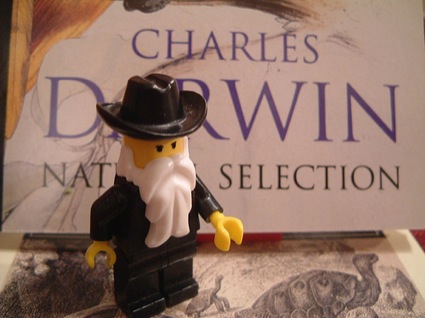
It was Charle’s Darwin’s 200th birthday recently. There were special events on campus, posters everywhere, etc. I encoded some video lectures about him at work to post on the web. Despite the fact that Darwin’s work was certainly interesting and can be helpful in explaining SOME things, I’m afraid the bulk of it is psuedo-science, his intellectual descendants now often engaged in conjecture of the silliest sort.

Owen Barfield, in exploring epistemology (the philosophy of knowledge), had this to say about Darwin:

There is no more striking example than the Darwinian theory of that borrowing from the experimental by the non-experimental sciences, to which I referred at the beginning of this chapter. It was found that the appearances on earth so much lack the regularity of the appearances in the sky that no systematic hypotheses will fit them. But astronomy and physics had taught me that the business of science is to find hypotheses to save the appearances. By a hypotheses, then, these earthly appearances must be saved; and saved they were by the hypotheses of – chance variation. Now the concept of chance is precisely what a hypotheses is devised to save us from. Chance, in fact, = no hypothesis. Yet so hypnotic, at this moment in history, was the influence of the idols and of the special mode of thought which had begotten them, that only a few – and their voices soon died away – were troubled by the fact that the impressive vocabulary of technological investigation was actually being used to denote its breakdown; as though, because it is something we can do with ourselves in the water, drowning should be included as one of the different ways of swimming.

-Owen Barfield, Saving the Appearances, (1957), (Owen Barfield Reader p.156)

You get that? I had to read it twice.

“Saving the Appearances” means to explain why something is one way, despite appearing to be another. Like explaining that the Sun does not circle the earth (despite the appearance that it does), or explaining that your sister isn’t ugly (despite the appearance that she is rather fat). In this case, it’s explaining that all life is derived from chance, despite the appearance that it is designed.

Barfield contends that Darwin was borrowing scientific ideas from astronomers, who (as far as I can tell), lacking the ability to really test much of what they saw, had to come up with hypothesis so as to save face, that is, not to look stupid.

Actually, Barfield’s commentary in this case is so good, I’m probably just digging myself in a hole by trying to talk about it. I’ll stop that now!

Photo credit

Confusing love poetry

I always thought it curious that someone should write love songs or poetry outside of their own experience. Tom Petty wrote a lot of standard rock material: break-ups, one night stands, etc. I remember being surprised that he had been married to the same gal for 20+ years. I shouldn’t have been surprised though. If all a songwriter had to explore was their own first-hand experiences, they would run out of material pretty quickly.

Charles Williams wrote 84 romantic sonnets for his wife:

She read them carefully. ‘So lovely they seemed,’ she said. But she also noted – and it puzzled her – that, thought they were addressed to her, their theme was the renunciation of love.

Why should he have consider renouncing love? In part it was simply his awareness that marriage with its many obligations and strains might destroy love: he was never easily optimistic. But, more than this, he was discontented about the very ordinariness of ‘being in love’. His mind was too subtle and self-aware, too capable of seeing endless possibilities in every human thought and action, for the state of loving to seem enough. He asked himself ‘whether love were not meant for something more than wantonness and child-bearing and the future that closes in death’. He meditated on the notion of achieving some spiritual advancement through renunciation, speculating in the sonnets he wrote for ‘Michal’ whether they might not ‘put off love for love’s sake’. And there was another possibility. Turning to his Christian beliefs, he considered the idea that love for another human being might be a step towards God – ‘the steep’, as he expressed it in the sonnet sequence, ‘whence I see God’.

-Humphrey Carpenter, The Inklings, p.79

Williams went on to find a lot in common with Dante and his love for Beatrice. Later in life he wrote about that extensively.

Tolkien on marriage

(I quote this passage on Tolkien’s relations in full from page 168 of The Inklings.)

Friendship with other men played as important a part in Tolkien’s life as it did in Lewis’s. Unlike Lewis, Tolkien encountered romantic love at an early age, for when he was sixteen he fell in love with a girl of nineteen, a fellow orphan who lived in his Birmingham lodging house. But he and Edith Bratt were soon separated by his guardian, and in late adolescence Tolkien was thrown back on friendship with others of his own sex, so much so that by the time he was reunited with her he had, as it were, lost touch with her, and had devoted the greater part of his deepest affections to his male friends.

He and Edith were eventually married and had four children, but family affairs (though of great interest and importance to Tolkien) seemed to him to be quite apart from his life with his male friends. This division of his life into water-tight compartments inevitably caused a strain, and Edith Tolkien resented the fact that such a large part of her husband’s affections were lavished on Lewis and other men friends, while Tolkien himself felt that time spent with the Inklings and in other male company could only be gained by a deliberate and almost ruthless exclusion of attention to his wife.

‘There are many things that a man feels are legitimate even though they cause a fuss,’ he wrote to a son who was about to be married. ‘Let him not lie about them to his wife or lover! Cut them out – or if worth a fight: just insist. Such matters may arise frequently – the glass of beer, the pipe, the non writing of letters, the other friend, etc. etc. If the other side’s claims really are unreasonable (as they are at times between the dearest lovers and most loving married folk) they are much better met by above board refusal and “fuss” than subterfuge.’

Edith Tolkien was capable of responding to this attitude with equal obstinacy, and as a result the atmosphere in the Tolkien household at Northmoor Road was sometimes as difficult as that in the Lewis-Moore menage at the Kilns.

Friendship thrives on questions, not answers

Tolkien and Lewis became close friends even though at the time they espoused greatly opposed philosophies. (Tolkien was a devout Catholic, Lewis a flaming atheist). However they shared a love for the same kind of literature. They found beauty and fascination in many of the same places. In The Four Loves, Lewis ascerted that:

“Friendship thrives not so much on agreeing about the answers as on agree what are the important questions.”

Incidentally, the local church may not be the best place to look for friends. Yes, we all largely agree on what the answers to certain questions are, but we all have a lot of questions of varied importance to each of us. It turns out this is not always fertile ground for friendship, despite the appearance that it SHOULD be.

Keeping the workplace interesting

The Inkling Charles Williams worked as an editor in a publishing house for most of his life. This could have been a rather dull job, but he was always spicing it up. In this account, he wrote a rather funny play for the office staff to perform. The “Olympics” from season two of The Office that we rented a few weeks ago comes to mind.

The Masque of the Manuscript, as it was named, delicately mocked the absurdities of the publishing business. It was a remarkable success. It created an extraordinary sense of delight in Amen House; for, by making the daily tasks of publishing into the stuff of poetry and ritual, Williams had transmuted a chore into something seemingly of wider significance. Nor did it end at the finish of the hour’s entertainment. In the months that followed, Williams continued to address his friends by their poetic names, so that they were caught up into a myth of his own devising. In the Library and on the staircase he would involve them in talk on a myriad of subjects, bringing out the best qualities in each of them. ‘He found the gold in all of us and made it shine,’ said one of them, Gerard Hopkins. ‘By sheer force of love and enthusiasm he created about him an atmosphere that must be unique in the history of business houses.

-Humphrey Carpenter, The Inklings, p.87

Man as sub-creator

Tolkien believed that in writing stories man was excercising his identity as a sub-creator, made in the image of God the creator. By doing so we reflect a bit of the face of God. All good stories do this. He explains this most thoroughly in his lecture on “Fairy-Stories” in 1939. He included this poem which he had written for Lewis:

Man, Sub-creator, the refracted Light
through whom is splintered from a single White
to many hues, and endlessly combined
in living shapes that move from mind to mind
Though all the crannies of the world we filled
With Elves and Goblins, though we dared to build
Gods and their houses out of dark and light,
and sowed the seed of dragons – ’twas our right
(used or misused), That right has not decayed:
we make still by the law in which we’re made.

-from Humphrey Carpenter, The Inklings, p.63