Leithart’s Challenge Round #4: John Calvin

See the original post to see what this is about.

Leithart says that the Bible speaks not only of spiritual things, but also hair, blood, sweat, entrails, menstruation, and genital emissions. Theologians on the other hand (except for perhaps Augustine) rarely make any mention of these. It’s a blanket statement intended to shock, of course, but is it true nonetheless? Are theologians from another planet? Let’s find out…

In this round: John Calvin (1509-1564)
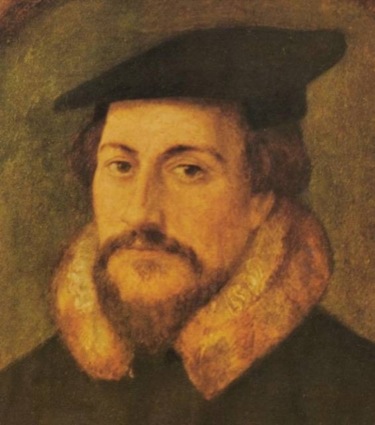
According to Google Books, these words occur X number of times in his printed works:

  • hair – 336
  • sweat – 95*
  • entrails – 19
  • menstruation – 6
  • genital emissions – 40

Wow, high numbers for Jean, but this is actually misleading. Apparently people who dig Calvin like to publish books, because there were 10x the amount of different editions in Google books as there were for most of the other theologians I looked into. So a lot of these references are redundant. Nevertheless, he does seem to have addressed everything on the list at least more than once.

Hair is mentioned often as he believes it important that men not wear it long, lest they project effeminancy. However, he certainly acknowledges that this is a cultural thing that changes with the times:

For long hair was not always regarded as a disgraceful thing in men. Historical works relate that long ago, i.e. in the earliest times, men wore long hair in every country. Thus the poets are in the habit of speaking about the ancients and applying to them the well-worn epitet ‘unshorn’.

John Calvin, Commentary on I Corinthians 11:14

He’s not afraid to use somewhat colorful language when describing sin:

For we know that men are so attached to their gold and silver that it grieves them to be torn from what thy so much love: no less than if you tore away their entrails.

John Calvin, Commentary on Ezekiel 7:19

Nor does he shy away from using these words in discussing some of the prophetic passages where they appear as imagery.

The prophet seems to be alluding to menstruation women who try to hid their uncleanness as much as they can; but heir efforts do not work, for nature must have its course. In short, the prophet intimates that the Jews had become so filthy that their uncleanness could be seen on their skirts.

John, Calvin, Commentary on Lamentation 1:9

And he doesn’t fall back on spiritual language when taking on critics of Christianity either:

He [Menno] argues that a man who ejaculates semen is said to be unclean, and he foolishly implies that an unclean flow has no relevance to women. By this reasoning, women would no have that innate uncleanness which only men were given circumcision to prevent.

John Calvin, Polemic against Menno

That sounds more like the real physical world Calvin is living in, and not an imaginary one. I was surprised to not find much in the way of anti-Platonism or anti-Gnosticism though. Apparently he had other favorite topics. (I’ve yet to ever read anything major by Calvin yet. Only excerpts.)
Leithart’s Challenge Round #3: Reinhold Niebuhr

See the original post to see what this is about.

Leithart says that the Bible speaks not only of spiritual things, but also hair, blood, sweat, entrails, menstruation, and genital emissions. Theologians on the other hand (except for perhaps Augustine) rarely make any mention of these. It’s a blanket statement intended to shock, of course, but is it true nonetheless? Are theologians from another planet? Let’s find out…

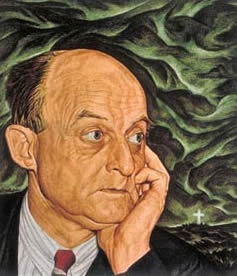
In this round: Reinhold Niebuhr (1892-1971)

According to Google Books, these words occur X number of times in his printed works:

  • hair – 7*
  • sweat – 10*
  • entrails – 1
  • menstruation – 0
  • genital emissions – 0

Niebuhr wrote quite a bit of theology and philosophy. His most frequent topic was “just war” theory. He doesn’t do well in our challenge though.

He has a few references to hair, but further examinations reveals these are all due to his frequent use of the phrase “hair’s breadth”, meaning “barely”. One time he mentions a hair shirt, but no real hair.

Sweat is the same story. Nearly all his uses of it are in direct quotes or references of either Genesis 3:19 (“By the sweat of his brow shall he eat bread…”) or Luke 22:44 (“His sweat was like drops of blood”).

He does use the word sweat to describe the effort the godless use to try and fix the problems in the world. This sounds to me like most modern socialism and the state of diplomacy in the middle east.

Thus the saints are tempted to continue in sin that grace may abound, while the sinners toil and sweat to make human relations a little ore tolerable and slightly more just.

-Reinhold Niebuhr, The Nature and Destiny of Man, p.197

He does take a noble swipe at Platonism at one point, knocking some of the silly gnostic notions about what creation was like before the fall.

In common with Platonism and Hellenic Christianity, Boehme believes that bisexuality is a consequence of sin. Furthermore, he thinks that Adam’s perfection must heave meant that he had a body which was “without intestines and witout stomach,” a rather vivid symbol of the mystic aversion to the physical basis of life.

-Reinhold Niebuhr, The Nature and Destiny of Man, p.91

There you go.

Leithart’s Challenge Round #2: Origen

See the original post to see what this is about.

Leithart says that the Bible speaks not only of spiritual things, but also hair, blood, sweat, entrails, menstruation, and genital emissions. Theologians on the other hand (except for perhaps Augustine) rarely make any mention of these. It’s a blanket statement intended to shock, of course, but is it true nonetheless? Are theologians from another planet? Let’s find out…

In this round: Origen Adamantius (185 – 254 AD)

According to Google Books, these words occur X number of times in his printed works:

  • hair -3
  • sweat -14*
  • entrails -5
  • menstruation – 1
  • genital emissions -2

Not very high for Origen, though he does make at least a passing reference to just about everything.

Hair is a built in clothing for animals, so they have no need to sew their own:

For the irrational animals have their food provided for them, because there is not in them even an impulse towards the invention of the arts. They have, besides, a natural covering; for they are provided either with hair, or wings, or scales, or shells. Let the above, then, be our answer to the assertions of Celsus, when he says that “we indeed by labour and suffering earn a scanty and toilsome subsistence, while all things are produced from them without their sowing and ploughing.”

-Origen, Contra Celsum, p.245

Origen mentions sweat a fair amount, but further investigation shows that when doing so he is always just quoting from Genesis 3:19:

In the sweat of your face shall you eat bread, till you return to the ground; for out of it were you taken: for dust you are, and to dust shall you return.

Entrails are ridiculed for their lack of fortune telling ability. Or more to the point, astrology is ridiculed for having the same track record as entrails:

If, therefore, it is known – conceding such knowledge for the sake of the argument – that events can occur because of the means by which they are known, why should they occur because of stars but not, say, because of birds, or because of sacrificed entrails or because of shooting stars? These arguments will suffice for the moment to refute the idea that the stars are responsible for human affairs.

-Origen, Commentary on Genesis

Finally, the only mention of private parts I could locate was part of an explanation of how the Greek myths that involved a “virgin” birth or incarnation were not really at all like the birth of Jesus. The Christian story of Christmas was not derived from them in the least.

…Apollo, free from an earthly body, passes into the so-called prophetess seated at the Pythian cave through her genitals. But we hold no such opinion about Jesus and his power; the body born of a virgin consisted of human substance, capable of suffering wounds and death like other men.

-Origin, Contra Celsum, p143

Well, that’s it for the first of our two early church fathers.

My wife says these posts are kind of disturbing. True! These don’t go over real well in casual discussion, and rightly so.

Leithart’s Challenge Round #1: Karl Barth

See the original post to see what this is about.

Leithart says that the Bible speaks not only of spiritual things, but also hair, blood, sweat, entrails, menstruation, and genital emissions. Theologians on the other hand (except for perhaps Augustine) rarely make any mention of these. It’s a blanket statement intended to shock, of course, but is it true nonetheless? Are theologians from another planet? Let’s find out…

In this round: Karl Barth (1886-1968)

According to Google Books, these words occur X number of times in his printed works:

  • hair – 64
  • sweat – 19
  • entrails – 0
  • menstruation – 1?
  • genital emissions – 11?

Despite some of the low scores, Barth actually does pretty well. He echos the same sentiment as Leithart, that God doesn’t just care about mystical, spiritual things, but also our bodies, the earth, and the whole of creation.

…we have the old Testament with so many tangible things, so that we see that the Gospel is not purely a spritual thing, merely for soul and heaven. Rather, it is for soul and BODY, heaven and EARTH, inward and OUTER life. There is no hair on my head that is not an interesting thing to God!

-Karl Barth, Table Talk, p.32

He rejects Platonism and gnosticism as detrimental to Christianity:

Eternal life as it is applied to man by this power is the declaration and pledge of his total life-exaltation, from which not a hair of his head or a breath that he draws can be excluded…and so the abstractly spritual life-exaltation at which they aim, omitting the outward aspect of man, his flesh and blood, either in neutrality or in scorn, can result only in self-deception as to the totality of his imprisonment in and with his actual life.

-Karl Barth, Church Dogmatics, Volume IV.2, p.317

He talks about how good Bible study is a lot of hard work:

True exegesis involves, of course, much sweat and many groans. Even so, the extent to which the commentator will be able to disclose the Spirit of Christ in his reading of Paul will not be everywhere the same.

-Karl Barth, The Epistle to the Romans, p.17

And mentions in passing that the sowing of seed is a better analogy for the kingdom of God than sex, since it doesn’t involve our own wills so directly. The seed growing in the ground is more hidden and mysterious. (This passage was long so I didn’t include it here. I came across it because he uses the word semen.)

Stay tuned for the straight dope on 6 other theologians and finally the canon itself!

Leithart’s Challenge (Attempt #1)

In Peter Leithart’s book Against Christianity, he has a chapter on theology where he proposes an experiment for you to try at home. Though making a volcano out of vinegar and baking soda would probably have been more fun, I decided to give it a shot.

9. Theology is a “Victorian” enterprise, neoclassically bright and neat and clean, nothing out of place. Wheras the Bible talks about hair, blood, sweat, entrails, menstruation and genital emissions.

10. Here’s an experiment you can do at any theological library. You even have my permission to try this at home.

Step 1: Check the indexes of any theologian you choose for any of the words mentioned in section 9 above. (Augustine does not count. Augustine’s theology is as big reality, or bigger.)

Step 2: Check the Bible concordance for the same words.

Step 3: Ponder these questions: Do theologians talk about the world the same way the Bible does? Do theologians talk about the same WORLD the Bible does?

The University of Idaho has several large shelves of theology. Unfortunately, I didn’t have more than a few minutes on my lunch break to thumb through hundreds of indexes. I decided to grab a few volumes from names that I recognized. These include:

  • Origen – Contra Celsum, (248 A.D.)
  • John Calvin – Institutes of the Christian Religion (abridged), (1536)
  • Reinhold Niebuhr – The Nature and Destiny of Man, (1941)
  • Karl Barth – Church Dogmatics, Volume II, The Doctrine of God, (1957)
  • Hans Kung – On Being a Christian, (1974)
  • Marcus Borg – Jesus, (1989)

and just to check on his other claim…

  • Augustine – Confessions, (398)

Now this isn’t a very scientific experiment. Barth wrote thousands of pages of high-caliber material and the volume I grabbed is only 600 pages of theology proper. Augustine’s City of God would probably be more likely to contain the words I’m looking for. Borg’s brief (and rather gnostic) book on Jesus is unlikely to talk much about sweat and entrails. But that’s the point, isn’t it?

I also decided to skip the word “blood”. I’m sure blood shows up a lot in all of these. However, the “blood of Jesus that covers our sins” is an entirely different thing than the blood that squirted out on the soldier Longinus when he pierced the side of the Lord. He had to send his robe to the laundry after that.

That being said, off we go!

Hair Sweat Entrails Menstruation Genitals
Origen 0 0 0 0 0
Calvin 0 0 0 0 0
Niebuhr 0 0 0 0 0
Barth 0 0 0 0 0
Kung 1 0 0 0 0
Borg 0 0 0 0 0
Augustine 0 0 0 0 0
The Bible 83 3 0 3 0

Wait a minute! What happened?

The only reference I found in ANY of these books was Kung exploring the theology of Broadway musicals, where he quotes from a song in the 1966 show Hair:

My Hair like Jesus wore His Hallelujah,
I like it Mary loved her Son,
Why doesn’t my mother love me?

I was almost sure I had found menstruation in Augustine, but it turned out to be mensuration, which has to do with geometry. Hmmm.

Finally, the Bible struck out on a lot of these. I was using Strong’s old concordance for the KJV. Wrong words.

Another problem was that of these 6 theology books, only the one by Augustine had an exhaustive index of words in the text. The others were only lists of subjects covered. That’s not playing fair compared to a linguistic concordance.

It sure seems like fun to crawl around the library studying, weighted down with olde tomes of wisdom. But I have realized my folly. Is my job in web and databases or not? Fool! I should have just used the search features in Google Books to discover all the answers! I’m going to try again tomorrow.

Bumper sticker musings

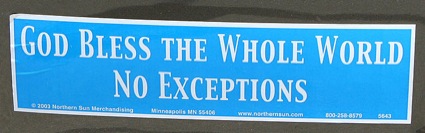
Last night, in the parking lot of the temple of organic food, I saw the following bumper sticker:

God Bless the Whole World, No Exceptions!

I’ve seen in before of course, but it only came to mind then what it really meant:

There probably isn’t a God, but even if there is, then there is still no sin.

Thus sayeth the driver of the green Subaru Outback in parking row #7. And perhaps President Obama, since his smiling face was on the bumper sticker right next to it.

I was thinking earlier about how all of us fallen human beings are really not that different from each other. We don’t like the effects of the fall (rightly so), and set out to do something about it.

The fundamentalist tries to get rid of sin by changing everyone’s behavior.

The liberal tries to get rid of sin by redefining sin so that it (almost) doesn’t exist.
Continue reading “Bumper sticker musings”

Man is like a tomato

Prolific American novelist John Updike passed away yesterday.

One of his best quotes?

“Of plants tomatoes seemed the most human, eager and fragile and prone to rot.”

-The Witches of Eastwick

No, I haven’t actually read any of his stuff. But enough people have told me that I should some time.

Abortion

My wife wrote a concise and well-thought-out post knocking down the most popular rational for why it’s entirely OK to terminate the lives of unborn children.

You can read it here.

Trouble allows for happiness

God teaches us in tribulations. The most unfortunate people in the world are those who know no tribulations. The most unhappy men are really the ones who are able to bribe their way out of suffering and tribulation, and to evade the issue, in pleasures, in wars…

-Thomas Merton, Secular Journal, p.167

Photo credit