We think we’re smarter than advertising

Merton on America and advertising:

Americans have always felt that they were protected against the advertising business by their own sophistication. If we only knew how naive our sophistication really is! It protects us against nothing. We love the things we pretend to laugh at…Sincerity becomes impossible in a world that is rules by a falsity that it thinks it is clever enough to detect. Propaganda is constantly held up to contempt, but in condemning it we come to love it after all. In the end we will not be able to get along without it.

-Thomas Merton, No Man is an Island, Ch.10 Sec.6

Photo credit

Can’t abstract love to “society”

Merton’s brilliant section of loving “society”:

Do not ask me to love my brother merely in the name of an abstraction – “society,” the “human race,” the “common good.” Do not tell me that I ought to love him because we are both “social animals.” These things are so much less than the good that is in us that they are not worthy to be invoked as motives of human love. You might as well ask me to love my mother because she speaks English.

We need abstractions, perhaps, in order to understand our relations with one another. But I may understand the principles of ethics and still hate other men. If I do not love other men, I will never discover the meaning of te “common good.” Love is, itself, the common good.

There are plenty of men who will give up their interests for the sake of “society,” but cannot stand any of the people they live with. As long as we regard other men as obstacles to our own happiness we are the enemies of society and we have only a very small capacity for sharing in the common good.

-Thomas Merton, No Man is an Island, (forgot the ref.)

Don’t watch yourself live

At the end of Merton’s long passage on happiness and contentment:

Happiness consists in finding out precisely what the “one thing necessary” may be, in our lives, and in gladly relinquishing all the rest. For then, by a divine paradox, we find that everything else is given us together with the one thing we needed.

It is useless to try to make peace with ourselves by being pleased with everything we have done. In order to settle down in the quiet of our own being we must learn to be detached from the results of our own activity. We must withdraw ourselves, to some extent, from effects that are beyond our control and be content with the good will and the work that are the quiet expression of our inner life. We must be content to live without watching ourselves live, to work without expecting an immediate reward, to love without an instantaneous satisfaction, and to exist without any special recognition.

-Thomas Merton, No Man is an Island, Ch.7 Sec.3

God made you special…blah blah blah (Actually, it’s true)

Merton on being defined by who you ARE, not what you DO. I don’t know if this problem bites women as hard, but it’s a serious problem for most men.

When a man constantly looks and looks at himself in the mirror of his own acts, his spiritual double vision splits him ijto two people. And if he strains his eyes hard enough, he forgets which one is real. In fact, reality is no longer found either in himself or in his shadow. The substance has gone out of itself into the shadow, and he has become two shadows instead of one real person.

Then the battle begins. Whereas one shadow was meant to praise the other, now one shadow accuses the other. The activity that was meant to exalt him, reproaches and condemns him. It is never real enough. Never active enough. The less he is able to be the more he has to do. He becomes his own slave driver-a shadow whipping a shadow to death, because it cannot produce reality, infinitely substantial reality, out of his own nonentity.

Then comes fear. The shadow becomes afraid of the shadow. He who “is not” becomes terrified at the things he cannot do. Whereas for a while he had illusions of infinite power, miraculous sanctity (which he was able to guess at in the mirror of his virtuous actions), now it has all changed. Tidal waves of nonentity, of powerlessness, of hopelessness surge up within him at every action he attempts.

Then the shadow judges and hates the shadow who is not a god, and who can do absolutely nothing. Self-contemplation leads to the most terrible despair: the despair of a god that hates himself to death.

-Thomas Merton, No Man is an Island, Ch.7 Sec.2

On finding your true vocation (hint: it’s probably not being a rock star)

Wow. Does this not describe myself and about half the people I know?

The value of our activity depends almost entirely on the humility to accept ourselves as we are. The reason why we do things so badly is that we are not content to do what we can. We insist on doing what is not asked of us, because we want to taste the success that belongs to somebody else. We never discover what it is like to make a success of our own work, because we do not want to undertake any work that is merely proportionate to our powers. Who is willing to be satisfied with a job that expresses all his limitations? He will accept such work only as a “means of livelihood” while he waits to discover his “true vocation.” The world is full of unsuccessful businessmen who still secretly believe they were meant to be artists or writers or actors in the movies.

-Thomas Merton, No Man is an Island, Ch.7 Sec.5

Concerning the last line, I think what we should rather shoot for is to be SUCCESSFUL businessmen who also still nurture our interest in music, art, and writing because we find joy in it regardless.

On technical excellence versus? spirituality

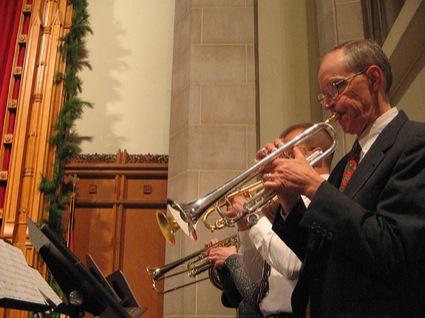
How many times have you heard really sincere, heartfelt music in church that was emotionally and spiritually significant to the one performing it… and it sounded awful. Then you visit a different worship service and the music is glorious, you see the heavens open up! But these guys are paid professionals. Heck, they’re not even from the same denomination and I think the bass player isn’t even a Christian. Anyone confused?

Merton mentions this in passing:

It is important, in the life of prayer, to be able to respond to such flashes of aesthetic intuition. Art and prayer have never been conceived by the Church as enemies, and where the Church has been austere it has only been because she meant to insist on the essential difference between art and entertainment…One can be at the same time a technical expert in chant and a man of prayer, but the moments of prayer and of technical criticism do not usually coincide.

-Thomas Merton, No Man is an Island, Ch.3 Sec. 7

Photo credit

Laughing at despair

On knowing if you’ve found your vocation:

We know when we are following our vocation when our soul is set free from preoccupation with itself and is able to seek God and even to find Him, even though it may not appear to find Him. Gratitude and confidence and freedom from ourselves: these are signs that we have found our vocation and are living up to it even though everything else may seem to have gone wrong. They give us peace in any suffering. They teach us to laugh at despair. And we may have to.

Thomas Merton, No Man is an Island, Ch.8 Sec.9

On conscience and law

The law is written on our hearts, that is, in our own conscience. Living by it frees us from the written law, since it is only an attempt to put the conscience the creator weaved for all of us down on paper. A perfect attempt of course, but still limited by the medium.

The conscience that is united to the Holy Spirit by faith, hope, and selfless charity becomes a mirror of God’s own interior law which is His charity. It become perfectly free. It becomes its own law because it is completely subject to the will of God and to His Spirit. In the perfection of its obedience it “tastes and sees that the Lord is sweet,” and knows the meaning of St. Paul’s statement that the “law is not made for the just man” (I Timothy 1:9)

-Thomas Merton, No Man is an Island, Ch.3 Sec. 10

Merton on listening to our subconscious (or not)

I do not say that we should try, without training or experience, to explore our own subconscious depths. But we ought to at least to admit that they exist, and that they are important, and we ought to have the humility to admit we do not know all about ourselves, that we are not experts at running our own lives. We ought to stop taking our conscious plans and decision with such infinite seriousness. It may well be that we are not the martyrs or the mystics or the apostles or the leaders or the lovers of God that we imagine ourselves to be.

-Thomas Merton, No Man is an Island, Ch.3 Sec. 8