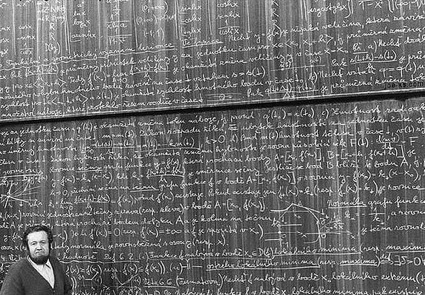
In mathematics you don’t understand things, you just get used to them.
-John von Neumann

A scrapbook of thoughts on arts, culture and the Christian life.
In mathematics you don’t understand things, you just get used to them.
-John von Neumann
This excellent comment on growing up by Billy Collins:
On Turning Ten
The whole idea of it makes me feel
like I’m coming down with something,
something worse than any stomach ache
or the headaches I get from reading in bad light-
a kind of measles of the spirit,
and mumps of the psyche,
a disfiguring chicken pox of the soul.
You tell me it is too early to be looking back,
but that is because you have forgotten
the perfect simplicity of being one
and the beautiful complexity introduced by two.
But I can lie on my bead and remember every digit.
At four I was an Arabian wizard.
I could make myself invisible
by drinking a glass of milk in a certain way.
At seven I was a soldier, at nine a prince.
But now I am mostly at the window
watching the late afternoon light.
Back then it never fell so solemnly
against the side of my tree house,
and my bicycle never leaned against the garage
as it does today,
all the dark blue speed drained out of it.
This is the beginning of sadness, I say to myself,
as I walk through the universe in my sneakers.
It is time to say good-bye to my imaginary friends,
time to turn the first big number.
It seems only yesterday I used to believe
there was nothing under my skin but light.
If you cut me I would shine.
But now when I fall upon the sidewalks of life,
I skin my knees, I bleed.
Before discussing a subject, Wright often begins by dealing with the potential pitfalls of contemporary linguistics:
This is where our word “belief” can be inadequate or even misleading. What the early Christians meant by “belief” included both believing that God had DONE certain things and believing IN the God who had done them. This is not belief that God exists, though clearly that is involved, too, but loving, grateful trust.
-N.T. Wright, Simply Christian, p.207
How is it exactly that God’s way our higher than our ways? (Isaiah 55:9)
[The religious leaders, as well as Jesus’ own disciples asked him many questions.] As was so often the case, Jesus didn’t answer their questions directly. Many of the questions we ask God can’t be answered directly, not because God doesn’t know the answers but because our questions don’t make sense. As C.S. Lewis once pointed out, many of our questions are, from God’s point of view, rather like someone asking, “Is yellow square or round?” or “How many hours are there in a mile?” Jesus gently puts off the question. “It isn’t for you,” he says, “to know the times and periods which the Father has set by his own authority. But you will receive power when the Holy Spirit has come upon you; and you will be my witnesses in Jerusalem, in all Judea and Samaria, and to the ends of the earth”.
– N.T. Wright, Simply Christian, p. 122
This comment a while back from Boar’s Head Tavern fellow The Scylding gets to the heart of my frustration with theology as it is typically discussed.
I worship Christ, not reason. And, contra the [Francis] Schaeffer types, that is NOT a 1-1 correlation. The desire to equate Christianity with reason comes from the surrender to Modernism. When it comes to debates and discussions on truth, tradition, sacramentology, ecclesiology and a mulitude of other and theological ‘ologies, the worship of Reason is the elephant in the room.

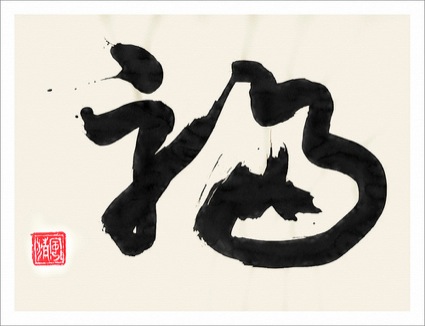
Sometimes Merton can digress, but at other times he is brilliant. I’m reading his work No Man is an Island and have had to bookmark virtually every page in the chapter Conscience, Freedom, and Prayer. In regards to our means of pursuing happiness (which is what we’re all doing), the nail is hit on the head. This passage is rich:
It is true, the freedom of my will is a great thing. But this freedom is not absolute self-sufficiency. If the essence of freedom were merely the act of choice, then the mere fact of making choices would perfect our freedom. But there are two difficulties here. First of all, our choices must really be free – that is to say they must perfect us in our own being. They must perfect us in our relation to other free beings. We must make the choices that enable us to fulfill the deepest capacities of our real selves. From this flows the second difficulty: we too easily assume that we ARE our real selves, and that our choices are really the ones we WANT to make when, in fact, our acts of free choice are (though morally imputable, no doubt) largely dictated by psychological compulsions, flowing from our inordinate ideas of our own importance. Our choices are too often dictated by our false selves.
Hence I do not find in myself the power to be happy merely by doing what I like. On the contrary, if I do nothing except what pleases my own fancy I will be miserable almost all the time.[!] This would never be so if my will had not been created to use its own freedom in the love of others.
Photo credit (Good luck and happiness)
Alright, so my wife tagged me with one of those “write 6 random things about yourself” chain-letter things. Here it goes!
Rules:
1. Post the rules on your blog.
2. Write six random things about yourself.
3. Tag six people at the end of your post.
4. If you are tagged, JUST DO IT, and pass the tag along.
Along those lines:
1. When I was three years old, I burnt the back of the left hand pretty badly on a hot garbage incinerator barrel behind the house. I have a noticeable scar across my knuckles.
2. Growing up, I always hated tomatoes. Tonight at dinner, I ate 4 fresh tomatoes in a salad my wife made for me. Not too shabby!
3. Last time I was at the One World Cafe coffee shop, someone had left a copy of The New Yorker on a table. I flipped through it and ended up spending the next 40 minutes reading a long feature on the serial imposter Frederic Bourdin. This guy knows a bunch of different languages and can change his appearance to look really young. He has posed as a troubled teen all over Europe and lived on handouts. He even assumed the identity of an American boy that had gone missing and was flown back to America to live with them. He even faked a tatoo the boy had and conned various government officials into getting the proper paperwork put through. Even the family and his own mother believed him! Or so it seemed. Eventually, he figured something was wrong. His disguise was working too well. It turns out someone in the family had murded the son and it was a big cover-up. It’s still an unsolved mystery. Interesting story.
4. In a junior high basketball game, I went up for a rebound and bumped into a player on the other team. He broke his leg in the process! Oops. But I wasn’t called for a foul. The next week, I fouled out of the game in only the first quarter. Oops.
5. Shortly after coming to college, I took on a freelance computer job and was paid with a $100 bill. I put it inside of a book for “safe keeping”. Then I lost it. I couldn’t remember which of my hundreds of books I put it in. I searched through my collection for a couple hours in vain. As far as I know, it’s still there now, a few feet away from me, cleverly concealed.
6. Speaking of missing money, when I visited New York in high school, the guys in the hotel room next to mine found $1500 in cash (dollars) and about $2000 in Russian rubles in the drawer in their room. Drug money or something. They decided to give it to charity. I just had a Gideon bible.
Tag six other people? Not sure. Hold that thought.
Most people would consider it pretty weird that Jay Leno owns over 100 fancy cars. Guitarist’s who can’t play their scales but have 40 different effects pedals are silly gear Nazi’s. It’s OK to collect stamps, but if you spend every weekend combing through old archives for goodies, you’re a nut job. Do you like Lost? That’s cool. So do a lot of other people. Own all 4 seasons on DVD? Must be a fan. Have a T-shirt, write fan-fiction on your blog and have Lost dress-up parties with your friends? Um. You’ve obsessed. Stay away!
Ah, but wait. Some things society gives us (or at least some of us) permission to be obsessive about. Even applauds it. Food and cooking is one of those areas right now:
Along these lines, a comment from specialty coffee buyer Peter Guiliano:
“Most of the people who payed $130 a pound for Geisha had access to coffee growing right next to the auction lot that cost $12.50 a pound. Why would they pay $130 a pound?
“This is an industry where the participants have constant permission to indulge in hedonistic pursuits. We are entrusted to pursue pleasurable things, and pleasure becomes the dominating force in our lives. the culture of coffee is exactly the same as the culture of chefs: society gives us permission to be obsessed. That’s what we think about all the time. I love the hedonism to a certain extend…love when we are comfortable experiencing the world through our senses, but it gets a little weird. Especially given the power structure. At origin, we are like rock stars. We are surrounded by people who want to spend time with us, who offer us every enticement imaginable. You are traveling for a long time, you are a young guy, and it is easy to get caught up in that and lose you footing.
“You’ve got to be off-kilter a little bit to get attracted to this business…By the time you are a little successful, you’ve been poor for a long time. A lot of these guys were social outcasts in the younger part of their lives…don’t have equipment to deal with some of this stuff.” – Peter Guiliano
-God in a Cup: The Obsessive Quest for the Perfect Coffee, p.232
Our local university has a well-established history of lamentable editorial cartoons. Lately though, things have improved!
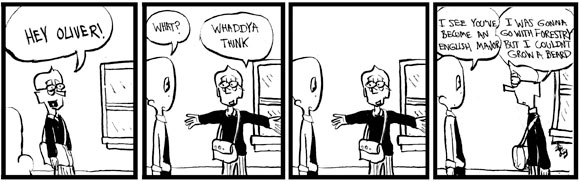
Can someone explain to me how that messenger bag is supposed to give you hipster street cred?
This, an excellent quote from coffee aficionado Peter Giuliano appears in God in a Cup: The Obsessive Quest for the Perfect Coffee:
“Fundamentally,” Peter told me, “my interest in coffee is aesthetic. My family is from Sicily,” he explained. “I was brought up by my grandmother, who didn’t speak English. I learned rom her that life is short, brutish, and cheap and that misery lies in wait for you. What interests me in coffee is the beauty of it. The beauty of the moment that coffee can create.” (p.234)
Throughout the hardest ups and downs of life in the past few years, coffee has been a consistant comfort. For a while I was afraid my love of coffee might simply a hedonistic pleasure or maybe even a chemical dependence. Though there surely a bit of both of those things involved, my heart said there was something more. A really good coffee is more like looking at a beautiful piece of art or reading a profound story. It’s like a piece of fallen creation that has been redeemed. It is a good thing in both the eyes of God and man. We as men just have refined techniques of preparing and brewing it. It is the Lord who made the fruit, beginning a long time ago somewhere in Africa. Like any of his creations, it has a purpose. Be amazed.
Along these lines, Doug Wilson has been posting a lot lately on creation and food, God and beauty in cooking. He mostly riffs of of Robert Capon’s quirky book, The Supper of the Lamb. Some of these are really worth reading.