Persistance

Persistence isn’t using the same tactics over and over.
That’s just annoying.
Persistence is having the same goal over and over.

Seth Godin


Don’t keep trying the same thing over and over again. If it’s not working, try something else. Don’t keep bashing your head into the wall over and over just to prove you’re not giving up. Maybe you can go around it, or over it. I’m just talking to myself here.

Calvinists and Emergents fighting over the same group of us guys

I find myself right in between two movements in Christianity right now: The so-called “emerging church” and the new resurgent Calvinists. They overlap in so many areas, it’s rather fascinating how they can be so opposed to each other at times. They both are moving AWAY from the deadness of “classical” American evangelicism, disillusioned with it’s mega-churches, worn-out revivalism, cheesy Left Behind eschatology, political culture war, CCM, and shallowness. They travel THROUGH largely opposing philosophies, but then surprisingly, arrive BACK at many of the same conclusions.

Both are often intellectual, focus on church planting, desire to return to older liturgies in worship, and spend much more time and money on charity and humanitarian aid then our parents and grandparents ever did. It’s just that the reasoning behind these conclusions come from very different corners. The “Emergents” travel through a mix of postmodern philosophy, the experience of hands-on philanthropy, liberalism, mysticism, and rediscovery of the ancient church. The “Resurgents” get there through renewed academic fervor, systematic theology (and the desire to really apply it), appreciation of the arts (acknowledging the beauty of creation), and more theology. Of course, I’m painting with broad strokes here, but I think these are useful descriptions nonetheless.

Unfortunately, because of their differences, these folks do end up fighting a lot. I don’t think the actual people on the ground fight much, but they certainly do so on the internet and in their rhetoric. A few days ago, Michael Spencer posed a question at the Boar’s Head Tavern about why the new Calvinists spend so much energy trying to squash the emergents. What follows I think offers some brilliant insight into the situation. I just had to repost (edited) snippits of the conversation:

Michael Spencer: Why are the Together for the Gospel Calvinists obsessed with the emerging church? I mean, it’s a never-ending obsession. Why? What’s the connection? Why isn’t it progressives? Lutherans? Atheists? Liberals? Not Really Reformed Calvinists? Baptist Fundamentalists? Why the angst over the EC and especially McLaren?

To which one of the Lutherans quips:

John Halton: I for one am deeply disappointed that Calvinists spend so little time these days attacking Lutherans. C’mon, guys! We believe the most ghastly stuff! Unbelievers get to eat Jesus, babies spring out of the font fully regenerated, Christ paid for all sins of all people… Good grief, all the emergents have done is grow goatees, wear heavy-rimmed glasses and use lower-case for the names of their churches!

Hmm, maybe I could meet in the middle and have a reformed gathering called something like “infusion” or “the storeHaus”.

And then, the nail is hit on the head:

Richard: Because they are both keenly interested in “reaching” the same demographic, viz. white, 20-30 years old, educated, culture-shaper types. That’s why we have a Calvinist book by two guys who“should be emergent but aren’t”. The crowds at Together for the Gospel and a typical Brian McLaren meeting don’t look very different, do they? Lots of young, white faces. The people at the Reformed meeting are a bit better dressed and groomed but they all grew up in the same suburbs, went to the same schools and graduated in the same classes.

Spike: I’m with Richard. As the new reformies see it, they and the emergents are the only two groups in the church that really count because they’re competing over the young male intellectuals. It’s a zero-sum game; any young male intellectual who starts quoting Doug Pagitt could have, should have been quoting John Piper. There aren’t enough resources in the denominational ecology for both of them to thrive.

That’s it. Demographics. I’ve said this before, though I have yet to develop the idea fully. Arguing about theology is often just a front for something else, even if the people talking theology don’t realize it.

Jason Blair: That’s an interesting observation, Spike. But if true, it would expose a flaw in their thinking. All they have to do to win the numbers game is encourage their team to have more babies than the other team. (kidding – kind of).

Kidding, kind of. Actually, I think this is true, though just one of many factors. On this front, the Calvinists probably have an upper hand since they are generally friendly to large families and the liberal-leaning emergents will have fewer goombas.

And on a different note…

Adam Omelianchuk: I’ve thought a lot about the ongoing debate between Emergents and Resurgents (my terminology) and have come to see it as a competition between two paradigms that are battling for the hearts and minds of the younger generation of evangelicals. In the wake of the soft and highly replaceable seeker-sensitive evangelism of the Willow Creek/Rick Warren era, the receding unifying figurehead of Billy Graham, and the disillusion caused by the Religious Right, a void has emerged that cries out for radical change in ministerial innovations, doctrinal education, and cultural engagement.

The Emergents seek to meet these problems with a wholesale rejection of whatever it deems “modern” (read: conservative, rationalistic, propositional, or whatever) and turns towards an Ancient/Future dichotomy that seeks the understanding of a Christian experience that ministers to the challenges presented by the postmodern ethos. The figureheads of the movement, such as Brian McLaren, Tony Jones, Doug Pagitt, and Rob Bell, seek a convention that buys into the idea that culture in an inescapable ingredient in theological formation and therefore should be embraced, albeit critically to varying degrees.

The Resurgents see this as nothing short of heresy and believe it is simply the repetition of the previous errors of Protestant Liberals who accommodated the faith to the tenets of modernity. They too see the unsatisfactory conditions left by the previous generation of evangelicals but stand in disbelief at the proposed solutions of the Emergents largely because they believe they are simply propounding the same philosophies that got the previous generation into trouble in the first place (starting with people’s “felt needs”) and extending them to approaches that can only lead to heresy (as observed historically with the liberals). Thus the need for something fixed, transcendent, confessional, and historically rooted, i.e. Calvinism.

Both groups flourish by way of the same means: conferences, websites, blogs, podcasts, and published books from a “cult of personality” leadership structure. Therefore, when they inevitably intersect we get lots of book reviews, conferences with speakers addressing one or the other, discussions over politics and theology and various answers to the question “What is the gospel?” that are utterly divergent.

In short, what we see today between the Emergents and Resurgents is an echo of an earlier era when Fundamentalism and Modernism clashed.

This is lamentable for several reasons, most of which are related to a false choice between extremes being presented to many young people. Any moderate voice coming from classical Arminians, Postconservatives, young Catholics, Anglicans, Methodists, Anabaptists, or those that authored the Evangelical Manifesto are met with an alien and confused look on the face.

The final comment by Adam is good. The refusal of people in both movements to hear the words of wise people still attached to the old institutions is a weakness of both movements. Christians of all flavours still have much to offer.

Photo credit

The same table, five years later

Not long ago, I had the opportunity to spend the evening reading at the big table in Bucer’s Coffeehouse Pub. It’s one of my favorites places and it’s difficult not to eavesdrop.

Many of the student’s at New Saint Andrews classical college study here in the evenings. This night was pretty typical I believe. To my left were two young men who spoke at length about how this Easter came very early this year because of the complicated formula used to determine what Sunday it should fall on. It was noted that the Orthodox church (and the Jews) still have Easter (or Passover) coming later this year due to the fact that their calendar isn’t accurate. Apparently it doesn’t have leap-years frequent enough to keep the equinox lined up correctly.

Across the table from me was a young man working on translating a cryptic Hebrew text for one of his classes. He occasionally joined in to the discussion about the church calendar with comments about how he had recently visited an Orthodox church on his trip to the Balkans where the daily scripture reading was recited in 10 different languages to cover all the people that might be attending.

To my right was a guy reading Peter Leithart’s new book Solomon Among the Postmoderns. Well, at least he started on it. He ended up spending most of the hour surfing Facebook.

About this time, I realized that exactly 5 years ago, it was me sitting in the same chair with my sheet music spread all over the huge table. I was analyzing a Miles Davis solo transcription as the final project for Theoretical Basis of Jazz at the university. My professor at the time, Dan Bukvich, recently marked his 30th year at the music school. My wife and I contributed a story to a memory book that was being compiled for him.  Wow, what a wonderful time. I miss school. Part of me envied all the guys around the table that evening.

Repeat after me: I am free

go to work, send your kids to school
follow fashion, act normal
walk on the pavement, watch T.V.
save for your old age, obey the law
Repeat after me: I am free

I’m not sure if this if the writer meant this to be cynical or an appeal to be content.

I read it as the latter.

Photo credit

Robot Drawing

My 3-year-old daughter has already absorbed many indispensable pieces of knowledge from her father. An awareness of the utter coolness of robots, I am proud to say, is top on the list. This morning, without any help or prodding, she drew a wicked robot for her mom:

Book Review: Simply Christian

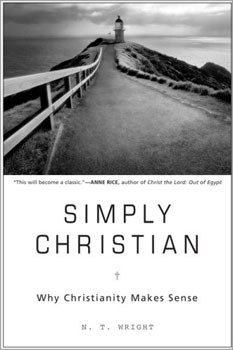
About a year ago, I heard a brilliant 1 hour interview with N.T. Wright about his new book Simply Christian. It’s meant to be a introduction to Christianity and a basic apologetic in the tradition of C.S. Lewis’s Mere Christianity. I’m not sure why I put this one off so long, but I finally got a hold of a copy and read through it this week.

My verdict is that Mere Christianity still quite a bit better, though Simply Christian has some very excellent sections. Just like Lewis, Wright approaches spirituality in general and then gradually brings in central Christian beliefs and finally church mechanics. In the middle section on Jesus, Lewis stays calm and concise where Wright gets a little bit too excited and tries to deal with too many things at once. Nevertheless, his chapters discussing our desire for beauty are a really excellent and an angle completely missing from Lewis’s work. His concise overview of scripture (The Book God Breathed) is also quite useful. He doesn’t get hung up on any details.

Anyway, the book is definitely worth reading, regardless of where you are on your journey to or in Christianity. It turns out all of the very best parts were quoted in the interview I originally listed to. Smart guy. This extended excerpt begins one of my favorite parts:

One day, rummaging through a dusty old attic in a small Austrian town, a collector comes across a faded manuscript containing many pages of music. It is written for the piano. Curious, he takes it to a dealer. The dealer phones a friend, who appears half an hour later. When he sees the music he becomes excited, then puzzled. This looks like the handwriting of Mozart himself, but it isn’t a well-known piece. In fact, he’s never heard it. More phone calls. More excitement. More consultations,. It really does seem to be Mozart. And, though some parts seem distantly familiar, it doesn’t correspond to anything already known in his works.

Before long, someone is sitting at a piano. The collector stands close by, not wanting to see his precious find damaged as the pianist turns the pages. But then comes a fresh surprise. Te music is wonderful. It’s just the sort of thing Mozart would have written. It’s energetic and elgiac by turns; it’s got subtle harmonic shifts, some splendid tunes, and a ringing finale. But it seems…incomplete. There are places where nothing much seems to be happening, where the piano is simply marking time. There are other places where the writing is faded and it isn’t quite clear, but it looks as though the composer has indicated, not just one or two bars rest, but a much longer pause.

Gradually the truth dawns on the excited little group. What they are looking at is indeed by Mozart. It is indeed beautiful. But it’s the piano part of a piece that involves another instrument, or perhaps other instruments. By itself it is frustratingly incomplete. A further search of the attic reveals nothing else that would provide a clue. The piano music is al there is, a signpost to something that was there once and mght still turn up one day. There must have been a complete work of art which would now, without additional sheet music, be almost impossible to reconstruct; they don’t know if the piano was to accompany an oboe or a bassoon, a violin or a cell, or perhaps a full string quartet or some other combination of instruments. If those other parts could be found, they would make complete sense of the incomplete beauty contained in the faded scribble of genius now before them.

This is the position we are in when confronted by beauty. The world is full of beauty, but the beauty is incomplete. Our puzzlement about what beauty is, what it means, and what (if anything) it is there FOR is the inevitable result of looking at one part of a larger whole. Beauty, in other words, is another echo of a voice – a voice which (from the evidence before us) might be saying one of several different things, but which, were we to hear it in all its fullness, would make sense of what we presently see ad hear and know and love and call “beautiful.”

…Beauty, like justice, slips through our fingers. We photograph the sunset, but all we get is the memory of the moment, not the moment itself. We buy the recording, but the symphony says something different when we listen to it at home. We climb the mountain, and though the view from the summit is indeed magnificent, it leaves us wanting more; even if we could build a house there and gaze all day at the scene, the itch wouldn’t go away. Indeed, the beauty sometimes seems to be in the itching itself, the sense of longing, the kind of pleasure which is exquisite and yet leaves us unsatisfied.

Wright goes on to explain how this unmet longing is actually the voice of our creator God calling to us. Goooooood stuff.

Beating up Plato

I’ve never read a philosophy book before. Really. I’ve skirted the subject with some of my interests in theology and psychology, but I’ve never jumped straight into one. With Rene Girard’s Things Hidden Since the Foundation of the World, I’ll be attempting just that.

I’ve once heard that virtually all western thought is simply a footnote to Plato, and I’m beginning to see what is meant by that quote. So much of modern thought has just assumed all these things that Plato said were true and it’s proponents start with that assumption. Unfortunately, Plato’s ideas were NOT Christian and certainly not trinitarian. The fact that we as Christians continue to hold on to his ideas about metaphysics is actually a huger barrier to our understanding the Bible.

The main Platonic idea I’m talking about of course is the idea that the soul and body are completely separate entities. The soul is immortal. Our body is dust. Our body is just a container for our soul. The soul is good, the flesh is fallen and passing away. Sound familiar? I think I’ve heard this in church before. Except that’s actually not in the Bible. Not at all. This is not the basis of a sound theology of heaven and life after death. This is not the basis for understanding the incarnation and who Jesus is. This is not the basis for our approach to the future and the end of the world. But we are so used to this idea, it’s very hard to part with it.

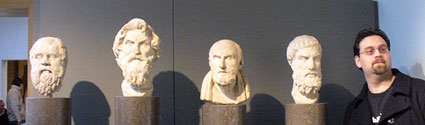
(Plato on the far left. Not me on the far right. Photo credit.)

In beginning this book, I’m struck by how much the author has in common with N.T. Wright. Both of them feel it necessary to beat up Plato with a big stick before they can move forward with their discussion. They see this faulty idea as being a key thing that is holding us back from growing in our understanding of eschatology and life after death (in Wright’s case) and in religion and social relations in general (in Girard’s case). Girard is also a Christian, but he approaches many of these deep theological from a completely different angle then I am used to hearing. He doesn’t start by exegeting verses from the New Testament, but instead attempts to articulate a more global theory of religion and then work gradually inside from that to Jesus and why he is such a big deal. I’m looking forward to working through this one.

Since the attempt to understand religion on the basis of philosophy has failed, we ought to try the reverse method and read philosophy in light of religion.

-Rene Girard

On Wine

Referenced from The Year of Living Biblically by A.J. Jacobs. Reviewed by BWIII here.

Daniel Whitfield has made an astoundingly exhaustive study of every alcohol reference in Scripture– all 247 of them. I quote here his findings:
On the negative side:

  • there are 17 warnings against abusing alcohol,
  • 19 examples of people abusing alcohol,
  • 3 references to selecting leaders,
  • and one verse advocating abstinence if drinking will cause a brother to stumble.
  • Total negative references 40, or 16%.

On the positive side:

  • there are 59 references to the commonly accepted practice of drinking wine (and strong drink) with meals,
  • 27 references to the abundance of wine as an example of God’s blessing,
  • 20 references to the loss of wine and strong drink as an example of God’s curse,
  • 25 references to the use of wine in offerings and sacrifices,
  • 9 references to wine being used as a gift, and
  • 5 metaphorical references to wine as a basis for a favorable comparison.
  • Total positive references: 145, or 59%.

“Neutral references make up the other 25%. If I could add only one observation to Whitfield’s study: There is also one reference to medicinal alcohol: ‘No longer drink only water, but use a little wine for the sake of yopur stomach and your frequent ailments (1 Timothy 5.23).

My long and deeply thought-out conclusions: Wine is yummy! Drink it with meals and by itself! Enjoy it, just not too much. It makes for a nice gift too. Apparently God has cursed the baptists. So sad.

Photo credit

Book Review: Travelling Mercies

I was originally drawn to reading something by Anne Lamott after seeing potent quotes from her referenced in other works. Things like:

“You can safely assume that you’ve created God in your own image when it turns out that God hates all the same people you do.”

So while I was in Boston for work a few months ago, I saw her memoir Travelling Mercies for only $2 at a really fine used bookstore just off of Harvard. Now, Lamott is like no one I had ever read before: A liberal, dread-lock wearing feminist activist. I’d spent most of my life growing up in the company of conservatives who wouldn’t touch an author like this with a ten-foot pole. So here is the part where I say my eyes were opened and I gained fascinating insight into a different perspective on faith… Except that I can’t say that. Actually, I wasn’t all that impressed. Lamott is a funny and ironic writer and some of her stories from the book were enjoyable to read. I think she clearly has a handle on the fundamentals of who Jesus is and the nature of grace. Nevertheless, I tired of her frequent detailed descriptions of how bad her drinking problem was before she found Jesus. I don’t think I need to write anymore about it since this one reviewer on Amazon described it very accurately:

About midway through the book, Lamott reads a review of a lecture of hers that described her as “narcissistic”, and that, I think, hits the nail pretty much on the head. It’s not that one cannot find inspiration here, or humor, or compassion; the main difficulty in Traveling Mercies is that the essays are so consistently self-absorbed as to miss many of the lessons she could have learned were she able to get beyond herself even a little bit. So we have her chalking up as a minor miracle her being able to play the `bon vivant’ with a fellow air-traveler who happens to be of a religious and political persuasion at which she would normally have sneered; it never seems to occur to her, however, that were the shoe on the other foot (as in: “I actually talked to a feminist today, and even though she’s spreading Satan’s lies, she really wasn’t all that bad!”), the essay would have read as intolerably patronizing.

Anyway, the next book like this that comes along will need to be a little more highly recommended. There is so much to read and so little time!