On blurring the lines of ‘work-life balance’

I can’t help but feel the hard line distinction between personal and professional is contrived and oppressive – as if they are sealed off from each other and we must have split personalities (and even multiple phone numbers, email addresses, clothes, jargon, etc. to operate in them.) In visiting Africa what I found was that nearly everyone I met ‘worked’ ~16 hours a day, every day of the week, but that the distinction between work and home life was often blurred beyond recognition. Mothers had their kids with them, from nursing babies to pre-teens, on the job. People constantly took breaks, sometimes for several hours at a time, to have coffee with friends. At a glance they might look like slackers, drifting down the slow river of Africa Time and going nowhere. But I didn’t meet a single person on my trip who wasn’t hard working, and many as competent and kind (or more) than any I’ve encountered in the West. I suspect one could squeeze a bit more GDP out of them by chaining them to a clock and punching in and out, but only at terrible cost.

This cost has been with us sharply for a good century like a cilice that’s been strapped on so long, we no longer feel the spikes. People from nearly every quarter have realized this is a problem and talk of “work-life balance” is frequent now. The problem with much of this talk is first, that it assumes the two things are finite and distinct, and second, that one has the ability to ‘balance’ these by an exertion of will. Probably the only thing that can abolish this toxic relationship between servant and master is trust – trust that can grow into friendship. This is still possible on a small scale today, but quickly become impossible when the masters are beholden to shadowy ‘shareholders’.

I could develop this some more, but I don’t have a particular place to go with it at the moment. I guess it will have to stand as an anecdote.

What is Love?

No, I’m not going to try to answer that one tonight. For an earlier attempt see here.

However, a really good place to start (or end!) could be this ancient Gaelic poem, translated here:

What is Love?

A love much-enduring through a year is my love,
It is grief in the heart,
It is stretching of strength beyond its bounds,
It is the four quarters of the world,
It is the highest height of heaven,
It is breaking of the neck,
It is battle with a spectre,
it is drowning with water,
It is a race against heaven,
It is champion-deeds beneath the sea,
It is wooing the echo
So is my love, and my passion
And my devotion to her to whom I gave them.

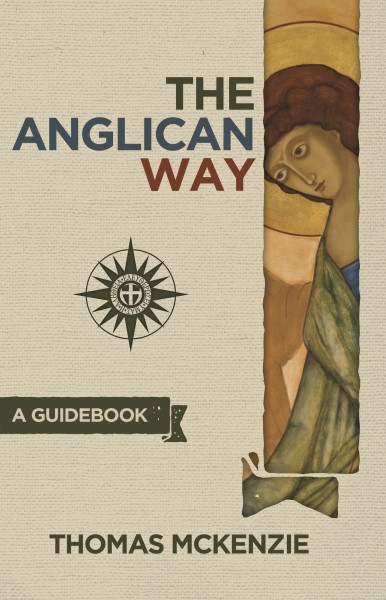
Some background as to why ‘The Anglican Way – A Guidebook’ is worth your time

About five years ago, Michael Spencer wrote a piece titled The Coming Evangelical Collapse that received national attention. In it he, articulated how the health of the evangelical church in America is utterly unsustainable and that its winter will quickly be upon us. Around the same time, he was also saying things like, “Come on evangelical Anglicans and Lutherans! This is your time to shine! You actually have a lot of what will fix all this right under your nose!” It was him who turned me on to Robert Webber, and N.T. Wright, but most of all to his own writings longing for an end to ‘circus’ ecclesiology, ‘wretched urgency revivalism’, and a connection to the worldwide historical church.

In the years since he was writing like this, before he tragically succumbed to cancer, I’ve seen many people walk these existing pathways out of the hyped-up American wasteland. We’ve seen a lot of people ‘swim the Tiber’ (a metaphor that is getting tired) and join the Roman Catholic church to find some rest. How many people? Enough that it is now a frequent concern on the minds of many Protestant pastors these days. Nobody saw that coming in the 1990s. Michael’s own wife was even compelled to do this. I’ve had friends ‘swim the Bosphorus’ (an even worse metaphor) to throw their lot in with Orthodoxy. I can’t blame them. They’re trying to find a way out of a form of Christian practice that is terminally ill.

A bit more visible has been the rise of the Neo-reformed. The same time Justin Timberlake was bringing Sexy back, Justin Taylor, Justin Holcomb, Matt Chandler, Mark Driscoll and friends were bringing heavy theology back to light-weight non-denoms. Now we have John Piper pushing Calvinism in-between sets at Passion music events. Whodathunk? The way I see it, this has patched up one major problem, but left others (liturgy, cult of personality, parish stability) largely untouched.

I’m still waiting for the evangelical Lutherans to get their act together. I hear they have in a few isolated cities. But who really DOES have a healthy and balanced church tradition, preaching Jesus clearly and presenting Word and Sacrament every week, right on the dot? The Anglicans. No, not your grandma’s Episcopal Church folks – stop and listen for a sec. This is the theologically orthodox, conservative, sometimes charismatic, evangelical, Anglican church. Never heard of them? Well there are over 50 million of them in Africa. In fact, some of them came over hear to help a new province get started. Since then the Anglican Church in North America has been successful in uniting a number of disparate Anglican denominations all over the U.S. and Canada under one banner. In addition to the ones they already had, they’ve planted over 700 (mostly small) churches in just the past few years.

Might you be interested in this movement, their orthodox yet Reformed theology, their ancient yet contemporary form of worship, and their charismatic fervor yet stable organization and leadership? Well, until now if you wanted to read something substantial on the topic, you’ve pretty much been out of luck. The handful of introductory books out there were often written to an audience of ex-Episcopalians or other people already largely familiar with the wider state of global Christianity. Someone coming from a Baptist church or Assemblies of God would just have to be thrown in the deep end or forget it. But now there is a much more excellent way.

AWCOVER2

My friend Thomas McKenzie has written a wonderful introductory guidebook to evangelical Anglicanism. It’s concise, easy to read, full of good examples, and aimed at an American audience that doesn’t need to know all the jargon. It’s also gracious and includes virtually no polemics while at the same time never being mushy about important contemporary issues. He makes it clear what the stance is on the historic resurrection of Christ, as well as the unacceptability of homosexual behavior. But when is the last time you read a book where the authors says, “Hey, if there isn’t an Anglican church where you live, go try out the Reformed or the Catholic church instead”? Who is deeply committed to their tradition but also ecumenical enough to say that? Not many, but Father Thomas is.

What’s all in here? Well rather than try and give a summary, I’ll copy down the table of contents:

  • Welcome to the Anglican Way
  • A Brief History of the Anglican Church
  • The Compass Rose
    • Anglicans are Evangelical
    • Anglicans are Catholic
    • Anglicans are Charismatic
    • Anglicans are Orthodox
    • Anglicans are Activist
    • Anglicans are Contemplative
    • Anglicans are Conservative and Liberal (old meaning of these words, not current loaded political definitions)
    • Anglicans are on a Mission
  • Walking the Anglican Way
    • The Four Hours
    • The Daily Office
    • The Anglican Home
    • Saturday Evening
    • Liturgies for the Four Hours
    • The Church Calendar
  • The Anglican Church
  • The Theology of the Church
    • The Sacraments
    • Sacramental Acts
    • Introducing the Eucharist
    • The Liturgy of the Word
    • The Liturgy of Communion
    • Organizing and Leading the Church
    • Who is a Priest?
  • Anglican Help Desk
    • Timeline of the Anglican Church
    • Anglican or Episcopal?
    • Finding a Church
    • Women in Clergy
    • The Catechism of the Anglican Church
    • A Glossary of Anglican Terms

So if you are from a non-denominational, baptist, or pentecostal tradition and are curious what this older and more traditional way of “doing church” and the Christian walk might look like, this book is for you. Alternately, if you grew up Roman Catholic but am feeling led by the Lord in a more evangelical direction, but you can’t stomach the worship rock band down the street, the guidebook might strike the right note with you. If you have been hanging with the neo-Reformed for the past decade but would like to be a part of something a bit more (but not too much of course) open-ended and ecumenical, then take a look. Also if you are a brand new believer but are wary of the bait-and-switch tactics frequently found in American churches – get the straight dope about this tradition up front. It’s a good one with a lot of potential and a lot of Jesus.

The book is available on Amazon and elsewhere, but the PDF version (under 300 pages) is available entirely for free online. Go here for a variety of options.

Disclaimer: I financially supported Thomas’s campaign to get this published.

The Islamic reversal of Christian gospel openness

As I drew attention to in this previous post, early on in the gospels and in Acts, we see barriers to the spread of salvation demolished in Christ and the apostles. The bloodline of Abraham is made irrelevant (God can raise them up out of rocks lying around.) The laws of the Torah are cast aside, making all food clean. Pentecost shows that no special language exists as the gospel crosses cultural and linguistic boundaries in many tongues at the drop of a hat. Even circumcision is rendered irrelevant. Along with this, we see the fear of the ocean taken away, opening up a straight highway and pushing the boundaries of the new Jerusalem to encompass all the earth.

In considering all this, it seems to me that Islam is largely a reversal of this at almost every point.

  • Islam claims a decendency from Abraham through Ishmael. Even if Muslims understand they may not technically be the genetic children of Ishmael, they are ‘adopted’ or ‘grafted’ into the family. In this way it is like Christianity, but the focus is on bringing men in, rather than spreading out.
  • The old food and worship laws are still very important. The details are debatable of course, but the underlying force is one of conformity to the rule, not freedom.
  • In high contrast to Pentecost and to the massive worldwide translation of the canon of scripture, the Koran is ONLY valid in old Arabic. Translations exist of course, but they are invalid for use in worship.
  • Circumcision is still a must and fully intact nethers are entirely unacceptable – even for women in some places.
  • A special geographic place, Mecca, is still at the heart of worship. Everyone must travel there if at all possible. It is the focal point and the House of Islam gathers people to its center, rather than send to the outer edges to stay.
  • Not a long-range sea-faring type, it has failed to ever spread far from it’s homeland in the near east. Muslim Indonesia could arguably be an exception to this, but after 1400 years, there is still no stronghold in the new world. It’s dynamic is wholly different.


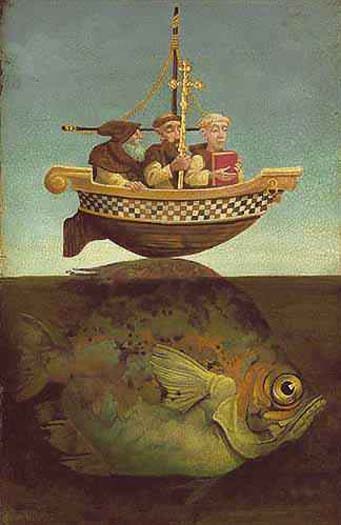
In ‘Christ the Fish’ the ocean becomes a highway

Here, Leithart legitimately wonders, “Where are the fish cherubim?”. Israel is a nation of land-lubbers and later the gospel goes to the sea-based gentiles. As the day of the Lord draws near though, we see reversals. Behold my amateur ad hoc attempt to interact with this idea:

Jesus walks on the water as if it were ground, and Peter yearns to do so too, though he falters. Jesus also causes fish to all but leap into Peter’s boat, bring them onto his “floating land-gardens”. A storm shipwrecks Paul – seemingly certain death, but instead not one sailor or passenger is lost. For old Israel, the depths of the ocean are to be feared (see many of the psalms), but for Jesus and the new Christians, they are a highway to be tread for the spread of the gospel, rather than a deadly barrier. Over the Atlantic it comes to Ireland before any could walk across France.

On all the seas, what more is to be feared than old Leviathan? Yet we are told his head is crushed and his body given to be food for the land-dwellers (Psalm 74:14). We could not draw him out with a hook (Job 41:1), but it turns out we don’t need to because our Lord has subdued him and calmed our anxieties. So much so that Saint Brendan even camped out on something like the old monster, now a toothless servant to it’s maker.

It seems that perhaps the waters were another constraint that had to be cast down to bring salvation to all mankind. Jesus demolished the requirement for the chosen people to be of the blood of Abraham. Then Peter is shown that “unclean” food is no obstacle, as well as circumcision. Pentecost blows any claim to a special language out of the water. Then the subjection of the sea is brought out of our fears and into our imaginations. Even though the motivations of Columbus were greatly tainted, he was nonetheless following in a long tradition of spreading the Word outward from Jerusalem to the ends of the earth in an adventuresome fashion.

brendan01

How summer camp taught me to love the church

Though I believe I am a Christian because God himself has laid out the way for me to follow and caused my steps to walk in that way, from an outside perspective, I’ve often told people that one of the main reasons I am a follower today can be traced back to a handful of highly influential summer camps. These were the camps up in the woods with chapel twice a day for an entire week with games of capture the flag every night. I was in a room of about 150 kids singing Shine Jesus Shine about a hundred times along with an overhead projector and some college guy with a guitar. Icy cold showers., foosball, and making new friends, some of them even girls (which was unprecedented for this awkward teen), and being surrounded by young adults who talked incessantly about Jesus, scripture, and missionary work rather than politics, cars, and the NBA playoffs – all these things were like living on another planet – a better planet.

Summer bible camp showed me a glimpse of what a vibrant community could look like, at least on a good day, and even on a bad day it was still better than anything else I typically experienced the rest of the year. Around the age of 14, I remember getting up early one day to go to the early prayer meeting that only some of the staff ever made it to. It was here I was first exposed to some of the back-channel chatter concerning how the camp was run. This didn’t disillusion me, but rather gave me a deep internal sense of ownership that was part of a growing love for the church, despite all it faults. I remember still loving camp even the year the music was bad, or the other year when the food was bad and the preacher was boring. Somehow it didn’t seem to upset me too much because this was MY camp, and besides, God was still the same whether being represented by cool people or dorks. Over time, some of this sense of ownership transferred back home.

A lot of folks, when they find out “how the sausage is made”, it’s a huge disappointment that causes them to seriously question their involvement. It makes sense. I’ve had negative experiences along these lines with regards to politics, as well as teaching in the public schools and some aspects of my career in computer programming. Somehow though, seeing the underbelly of the ecclesia at a formative age caused me to want to nurture and take care of it rather than dismiss it. Perhaps relatively early exposure to service, be it in playing music, leading bible studies, cleaning toilets, building projects and just plain old showing up without exception made a dent in my psyche somewhere.

Now, what I think about this most – as a hobby you could say – is not how to get out of church express my annoyance about this or that, but how to improve it’s health. The preaching is moralistic – how can we read and preach the bible to make the gospel clearer? The music is shallow – how can we deepen it without making it too hard on the congregation? Our counseling and pastoral care is sometimes lousy – how can we do a better job assuring people of Christ’s love in their despair? What can we learn from history and theology to help us with these things? How can we get along better with our brothers and sisters from other traditions?

This is why I stick with the institution of the church despite it’s numerous ongoing and various problems. In the end, Jesus is present there – where else can I go? You always hear people articulating why we should ditch traditional forms of parish ministry or religion entirely. Sure they have some good reasons. I’ve got some good reasons too. But I also don’t care. It’s mine.

Though the blossom on the fruit tree fails

In his opening statement in the Protestant Future debate/conversation last week, Carl Truman made this observation about Christianity in the west, especially in the United States.

Christianity, at least in its traditional, orthodox forms, is about to see itself politically and socially marginalized in America in a way unprecedented in history. Central to this is the way in which same sex marriage has come to function both culturally and legally. Recent judicial rulings and the appropriation of the idioms of the Civil Rights movement have effectively shut down intelligent discussion on the issue in the public square. This will change everything for Christians. It is one thing to be regarded as intellectually foolish for believing in the resurrection of the dead; it is quite another to be regarded as morally dangerous for believing that marriage is to be between one man and one woman. Societies generally tolerate idiots, allowing them to go about their daily business unhindered. Peddlers of hate typically have a harder time. Conservative American Christians must realize not simply that they are no longer kingmakers in election years; they might soon not even be regarded as legitimate members of society in many quarters.

Though this still has a ways to play out, I completely agree with his analysis. And what do times like this call for? Among many other things, they call for the psalter. They call for songs that do not shy away from trial and heartache in the seemingly forsaken land, time, and culture we live in. We’ve had plenty of stadium praise anthems produced in the last decade. As others have pointed out, we need songs of lament and songs of hope that come from a dark place, not a shiny and easy place.

As I’ve been contemplating this over the past week, I’ve been listening to a newer collection of worship music put together by Robin Mark. Many people are familiar with his successful Revival in Belfast album and songs from about 15 years ago, but he’s largely dropped off the map since then. So much so that after extensive Googling, I could not actually find the lyrics online to most of his newer songs. This one in particular, titled ‘At the Dawning’ is an especially good example of what I’m talking about. The chorus draws on Habakkuk 3 and declares trust in God and hope for the future in spite of apparent death around us.

At the dawning of the day
and when evening shadows fade
I’ll raise my song of praise

May you number me among
Those whose faith and hope were strong
and declare your name in trial

For you said these days would soon draw near
when the hearts of men would fade with fear
And you call your servants to stand firm
and gain eternal life

Though the blossom on the fruit tree fails
Though the fields and vines lie barren still
Yet will I rejoice in you oh God
For you are my delight

Hope when the fields are barren around you is something that doesn’t come from worldly wisdom or reasoning. It comes from the Holy Spirit. This is what we have and this is what we can ask for more of when it seems not enough. Things might not be so easy for us as Christians in the west in the coming years, but our hope is in the Lord, not in our own ability to affect change through our resources or cleverness. I think we as evangelicals will need more songs like this.

My favorite instrumental guitar piece

I was just listening to this again today. About eight years ago I fell in love with this piece, and this was the beginning of its writer and performer becoming a favorite of mine. This piece is SO GOOD. It has all the energy of an improvisation, but with as much compositional intricacy and development as any piece of classical music. It’s not quite accessible on the first take. Listen to it four times or so at least.

On homosexuality in the church, Alison, and Girard’s uphill battle

I wrote the following post over 4 years years ago, but then didn’t publish it because it contained some negative conjecture. My thoughts on this were not very well-developed back then. They still have a ways to go in fact, but I saw this gathering dust in the draft folder tonight and decided ‘what the heck?’

If you’ve been reading my posts for the last few weeks (early 2010), you might think that I really diggin’ James Alison’s theology. Well, this is true when it concerns his extension of Girard’s work. I’ve discovered a few other gems as well! Some of his other work though, such as his completely ridiculous handling of Romans 1 is enough for most people to throw out everything else he has written. This is so disappointing. For years Christians haven’t taken Girard seriously because he wasn’t a proper theologian (or megachurch pastor). Now they won’t take some of his best disciples seriously either because they are Catholic (Gil Baille), or gay (Alison), or don’t hang out it seminaries.  It’s an uphill battle.

I recently had the opportunity to speak to James on the phone. He graciously answered some questions I had about Raising Abel and gave some helpful suggestions and encouragement. I intend to read a lot more of his work. Frankly, the Girardian reading of scripture (that Alison does really, really well) is probably THE thing that is finally returning me to read and love the scriptures again after quite a few years of complete boredom with them.

Homosexual issues are hot, hot topics in the church these days. What is their relation to the latest abuse scandals bothering Rome? I saw that Christian musician Jennifer Knapp just came out as a lesbian yesterday. (Always liked her stuff. If she would sing blues instead of pop/country she could blow the paint of the walls). Last year, Ray Bolts (whose concert was the first I ever attended as a child and the first tape album I ever owned) did the same thing. The year before that, megachurch pastor Ted Haggard was humiliated and dethroned after messing around with a male, um, message therapist. Someone asked me the other day what I thought of same-sex unions. I’m not entirely sure. On one hand, I think calling it “marriage” is silly and undermining. Christians are right to point out that it is subversive. I’m not for institutionalizing a distortion of the created order, though we do it all the time. On the other hand, I have a libertarian bent and I don’t like the government telling everyone exactly how they are allowed to (for example) purchase health insurance. Why can’t I buy health insurance for anyone I want to? I can make a good case they are a dependent. So I’m of two minds about a lot of the particulars.

My friend Josh goes to an Episcopal church in Portland where gays are welcomed and nobody asks them to even consider changing. I can’t be in that crew for all kinds of reasons, but part of me is glad that those people have somewhere to go to meet Jesus. I know Machen said that Jesus isn’t really there in liberalism (and it can get pretty hokey at times), but I still think it’s a lot better than nothing. And that’s what we have to offer gay people in a lot of places: nothing. Sure we have the gospel, which rocks, but it gets too obscured. We have trouble stomaching the sin that we have no temptation to. We’re better at being graceful toward people with our own sorts of problems.

Doug Wilson talks a lot about how Sodomy and Infanticide are the two holy sacraments of the world. A lot of that rings true. What doesn’t sit will with me is – what then do you do with real people in the church? How do you still show them grace and not just hand them a heavy pack and send them on their way?

Alison uses some of Girard’s tools to justify an acceptance of homosexuality. It starts out really good, but he ends up taking it way too far. He is not coming at it from the traditional liberal position, which is rather interesting. He is still pretty darn conservative about a lot of things. He also draws a lot on the Pope’s encyclical Humanae Vitae, which most protestants don’t actually care about. I am not familiar with it enough to really discuss it. Yes, he (Alison) was kicked out of the Dominican order back in the early 90s. I’m still a big fan of his good stuff, and I am not really that interested in the weak stuff.

The deeper you get into scholarship, the more you are going to encounter people that you don’t agree with, but who need to be read anyway. I talked to two different pastors lately who admitted that, hands-down, the very best Old Testament scholarship out there is done by some Jewish guys. Remember, these guys completely reject Christ! But when it comes to old Hebrew, they are the smartest guys in the room. Ignore them at your own peril of ignorance.

For the past 100 years (and longer depending on where you are), a lot of protestants have been seriously allergic to anything Roman Catholic. And there are all kinds of reasons I’m not Catholic (the Marian dogmas for starters), but that’s OK. Some of the best _____ (fill in the blank) are RC. Some of the best books in my library are Merton and Chesterton. Where would we be without Augustine or St. Francis? I like Pope B16 too, for what it’s worth.

So I’m going to keep drawing what I can out of Alison. It loaded with good stuff. I haven’t gone Brian Mclaren on anybody. Just to prove it, see Orthocuban’s post on denying communion to church members facilitating abortion. I find little to add to this. It goes along with what I posted a couple days ago about grace.

Wright on reading all of scripture

Having somewhat moved on from my N.T. Wright fanboy stage (though his big books are some my most consulted works), I am not always on the lookout for his stuff anymore. But this means that he can still surprise me. Wright is remarkably concise at times, packing a lot of clear-headed analysis into a small space. That is the case in this excellent 7-minute video about reading all of scripture.