
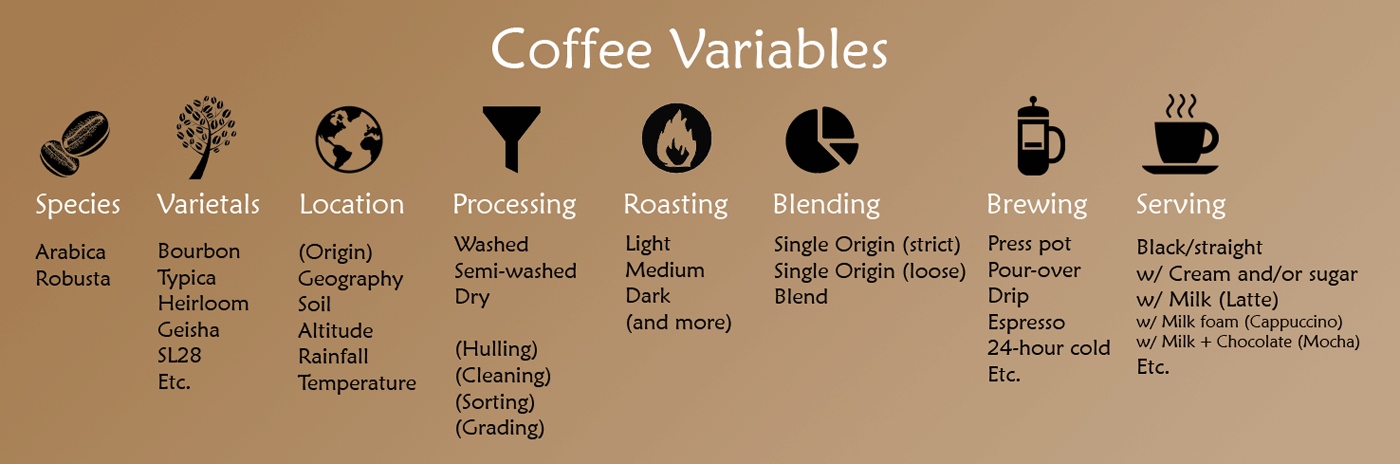
Coffee variables and packing meaning into one word

(Click the image for a large version.)

This a cross post of sorts from my other blog. A while back, I came up with this chart to display all the different variables that go into producing coffee. Using just the combinations listed here and assuming about 20 growing regions, you get 2 x 5 x 20 x 3 x 3 x 3 x 5 x 5, or 135,000 combinations! That’s a lot of variety in flavors. It really is just like wine. Maybe even more than wine.

Even if you are a veteran coffee drinker though, you may have never heard of some of the things on this list. Can you tell me what varietal is in the cup you are drinking right now? Typica? SL28? Do you know if it was dry processed? What grade of bean was used? OK. So you look on the package and see it’s called “House Blend”. What does that mean? Coffee nerds might know some of these terms. If you buy your beans from someone that charges $15 a pound or more (Stumptown for instance) some of these things might be printed on the label. At the grocery store or your local coffee shop though, what are you going to see? Most likely, the number one thing you are going to see on a label, even more than the roast, is the ORIGIN. Yes, the country of origin. Why? Well, because over the years, of all the things on the above list, this one has come to take on the most meaning. In fact, many of the other things on this list are actually implied from this one piece of information. There really aren’t 135,000 combinations. Not in the real world any way. Revealing the origin narrows things down the MOST.

Here are some examples (at least in the U.S.)

Ethiopia = Arabica species, Heirloom variety, wet processing, medium-dark roasting, single origin (loose), preferable brewed in a press pot, served black

Columbia = Arabica species, Typica variety, wet processing, dark roasting, blended with other stuff, drip, served with cream and sugar

Panama = Arabica, Geisha variety, wet processing, light roast, single origin (strict), pour-over brew, served black

India = Robusta, dry process, dark roast, blended 1/6, espresso (Italian style)

Sumatra = Arabica, Mandheling variety, wet processing, medium-dark roast, blended 1/3, espresso

These are generalizations of course, and there are plenty of exceptions. What I find fascinating is how much is rolled up into just ONE of these variables.

Naming the origin immediately introduces a bunch of constraints. Places with easy access to a lot of water will use wet process instead of dry. Places like Ethiopia that have been producing coffee for centuries have all kinds of crazy varieties growing there. Places that only began to be cultivated in the 20th century (El Salvador for example) will have farms growing entirely high-yield varieties put together by agriculture engineers in the 1950s. The soil of Indonesia is so radically different from other regions, it largely determines the flavor of the coffee AND it’s use as the sub woofer component in espresso blends. I could go on and on. The origin tells a story. The other variables do too, but the origin tells the longest tale.

It makes me think about the other words we pack full of meaning and implications. It’s what “stereotypes” are really. It’s too bad the word (and the idea itself) has so much stigma attached to it. It is just a natural outworking of our minds trying to categorize things in the mostĀ  efficient way possible.

Thoughts on what leads to our own mediocrity

Reading bad scholarship from Christians is infuriating. I guess it’s like listening to bad music. I have a lot of practice tuning that out and turning it off though. Forcing myself to read something with bad argumentation is just painful. Agony! Why are we so stupid AND so self-congratulatory at the same time? The book I was thinking of was covered with gushing blurbs and a couple “action” shots of the author in some public debate. The book is OK, but it’s not great. How come we have to be so mediocre? (People have been asking this about Christian pop music for some time now.)

Someone said that an evangelical can be defined as someone who says to a liberal, “I’ll call you a Christian if you’ll call me a scholar.”

What causes this sort of thing I wonder?

When our received feedback is to be hailed and congratulated in our own cultural ghetto, then we begin to believe our own immature position is sufficient and we have little to no need of refinement or growth. “Growth” is redefined as simply the achievement of a larger stage from which to shout the same thing we are already shouting now rather than always thinking about how we could be saying it better, smarter and wiser. This is why youthful success is so dangerous. We are highly susceptible to thinking that our foundations are established and we can now turn to cultivating our ambition for influence. In fact, we need to be learning something new EVERY day and continue to exercise our fundamentals.

Good musicians know this. A professional in an orchestra will spend half her practice time on scales. A high school student will likely spend the entire time on the piece itself, top to bottom. The former will define success as playing a passage with very accurate pitch and smooth bowing. The latter will satisfy herself with simply getting through the piece without getting lost. This is all well and natural. The problem is if the young student is rewarded and showered with praise for her modest springtime accomplishment. What is the next step she may ask? Spread my (already existing) awesomeness to a larger audience! Let’s take this show on the road! No no no no no. Have a show for sure, but keep it at the proper level. Then make yourself aware of what it COULD sound like by listening to older and wiser people play it. Then go back and work on the tricky spots and wood-shed the bowing in the fugue and hammer scales so the position shifts in the second movement always land in the right spot. Later you may, like the professional, have the opportunity to move up a notch. And when you are up there, you keep doing the same things that got you there – working patiently and steadily on the slow hard things.

The chief problem with celebrity pastors comes when they get surrounded by yes men at a young age. Seriously, men can’t HANDLE being surrounded by yes men until they are at least 40. Even then the praisers are dangerous, but at least could be mitigated by a wise and self-reflective leader. At 26? Terrible! You see this in the gossip columns with young Hollywood actors. The former teen sensations usually have by far the worst time adjusting to an adulthood that isn’t all roses – even if they retain their popularity and financial success (many do not). The actors that seem to have the most stable lives are the ones who worked their way up playing modest roles in television or on stage and finally were noticed as having a lot of chops. So now at 40 when everyone is fawning over them on the red carpet, they don’t lose their head after the award show and drive around town drunk (Lindsey Lohan), run around downtown with no clothes on (Britney Spears), sleep with their director (Kristen Stewart). Geesh, how come I can only come up with actresses? Guys do this stuff all the time too. Apparently they just get away with it more often. Or maybe it doesn’t get reported on as often? Unknown.

Now I’m not saying these guys don’t grow up or get better. Often they are very talented and have plenty of potential to increase in knowledge and leadership skill. Sometimes they do, but sometimes they just stay 26, but now at 50 they are in charge of a million-dollar organization and have a platform from which to pontificate about national politics. That’s bad. We need really wise people doing that, not talented 26 year-olds disguised as wise old men.

At the end of the day though, who am I criticizing? Most of the fingers are pointing back at myself. Going back to the two violin players, I have to honestly say that I never learned how to practice. Sure, I got it in my head. I’ve woodshedded (nice verb) enough things to know I CAN do it, but the WILL do it is truly uncommon. Mostly I just wing it on whatever skills I developed in junior high singing along with a lot of pop radio. That will get you somewhere, but if you want to go farther you have to put your nose to the grindstone and that I have been largely unwilling to do. Not just in practicing music, but in EVERYTHING. Relationships, parenting, work, learning, writing, car maintenance. You name it. Slowly I am learning. I don’t know if I can say each year is “better”. It doesn’t feel better, it feels awful. But I think it feels a little more normal. I still continue to let others down – my wife, my kids, sometimes my friends, etc. Ugg. It’s a good thing God hasn’t allowed me to become surrounded by yes men -what a walking disaster I would be. Still, I could sure use someone who believed in me regardless.

The Cathedral

Every once in a while, I hear a piece of music that I forgot existed. Maybe it’s been many years, maybe just one year, but I hear it and I suddenly remember how great it is. This sometimes happens on my way to the grocery store late at night while channel surfing on the radio. Most recently it was The Cathedral, by Augustine Barrios. Here is a good version.

On the radio though, they played the John Williams recording. (This is John Williams the Australian guitarist, no relation to the more famous movie composer.) Despite the big celebrity name, I’ve never liked his playing much. Tonight it figured out why. It’s not his technique, which is clearly very good. Rather, it is the recording technique. They must have put a ribbon mic about 2 inches away from the bridge and stuck him in a dead room. It’s SOOOOO dry. No reverb and you can hear every tiny little fret scrape and fingernail noise. It’s raw and pure and… completely distracting and sparse. Sure, having too much reverb (or even effects!) can quickly get you into syrupy New Age territory, but I think you have to have SOME. A little bit of acoustic sustain goes a LONG way to making music beautiful and connected, and a nylon string guitar playing a lot of notes quickly needs it desperately. Dry is bad and this particular recording on NPR was just so. Fortunately, the piece is pretty popular so there are lots of alternative versions to listen to, like the one in the video above.

Everyone always wants to play the fast third movement, but I think the slow prelude is really the best part.

Thinking about oral history

My wife does some work on the side as a research assistant for a local university professor. (Details and podcasts here!) She is helping her write an oral history book. That is, the source material is largely interviews, the relevant information having been rarely written down much. One question they wanted to ask going into it is, what does this sort of history book look like? When other people have tackled projects like this, what have they looked like when finished? What did the good authors do to expose their material and keep it interesting and integrated into a larger story? Is writing a book drawn largely from oral history different from ones based on old texts?

To answer this, they checked out several similar books from the library to poke around in. One of them was about folk music revivals in America and my wife wondered if I was interested in reading it. I decided on whim to do just that and (slightly, haphazardly) document my discoveries, not only about this corner of music history but specifically about the kind of writing and research involved in this sort of work.

First, before touching the book, I will write down a few preconceived ideas that I had about “oral histories” and their value.

It seems that when most people talk about oral history, it is in the context of some primitive non-writing people or culture. Where have I been exposed to it before? Interviewing native American Indian tribes people discussing their old customs and telling stories about their grandparents. The same goes for history of peoples in Africa where a written language either doesn’t exist or the bulk of the people involved do not write anything down. In this first case then, the knowledge is almost completely inaccessible except by talking to real people who may have transferred memory of the events, or digging around as an archeologist. Ethnomusicologists tramping aroundĀ Appalachia or Zimbabwe with tape recorders are doing work on this level as well.

The second way I’ve seen oral history approached is to use interviews to flesh out an event and fill it with personal anecdotes and insider details that may not be known in the widely known accounts. It’s not that there ISN’T a bunch of written material about the time or subject at hand – there is. But the written material may only show one viewpoint, or it may have been written to address a bigger story. The interviewer is trying to dig up more curious details and so render a higher-resolution picture of what happened. Many large facts are known, but the small facts have fallen through the cracks, despite their relevance.

The third way I’ve seen oral history used is through contemporary projects such as Story Core, heard on NPR. Some folks from the Smithsonian travel around the country in a trailer and listen in as one person (usually a friend or family member) gets another person to talk about their life or tell a story from their past. The best ones make it on the radio, but thousands of them are archived every year. I believe that searchable transcriptions are also made of everything. This is sort of a preemptive oral history – anticipating a loss of knowledge in the future. What if the most important things about our culture were not written down? Sure, we have Wikipedia, which is fantastic, but think of how many people DON’T ever contribute to it? It seems like the researcher’s goal is to give things a highly-person feel – relating each story to just one individual. Self-absorbed memoirs not withstanding, the fact is that most writing done today is going to be much more abstract than a personal interview. This is another way to enrich what we have in print.

So it seems to me that a writer working with a collection of oral history should endeavor to draw out smaller details and then fit them back into the large picture of what is known through writing. In this way, the existing story can be made much more potent (and even accurate) via the contribution of facets that were overlooked by the earlier distant writers. In particular, it seems likely that the most useful contribution is going to be from the types of folks who would never write anything down to begin with. It’s a case of the peasants verses the scribes. With a written history, you’ve got the scribes telling the story. With an oral history, you can also get the peasant’s take on it as well. Maybe their story was already well-represented by the empathetic and knowledgeable scribes, but maybe not.


Greed by osmosis

Both Tolkien and Lewis wrote stories where a powerful lust for treasure is transferred from dragons to people via physical contact.

In The Hobbit, even after Smaug is dead, his treasure still has an aura about it that “rubs off” on the dwarves. They are already disposed to love beautiful gold things, but the dragon’s recent presence amplifies their desire to hoard it. Thorin in particular becomes very grumpy and protective – unwilling to make a deal with the neighboring elves or men.

In The Voyage of the Dawn Treader, Eustace discovers an old dragon’s treasure stash and takes a nap upon the pile. In his sleep he is actually transformed into a dragon, such was it cursed. It is hinted that the previous dragon was also a man who suffered such a fate.

It appears that in both their minds, greed has an unhealthy effect both on the hoarder and the observer. Sounds like imitative desire to me – which has been proven to often seem “magical”.

The green great dragon

I first tried to write a story when I was about seven. It was about a dragon. I remember nothing about it except a philological fact. My mother said nothing about the dragon, but pointed out that one could not say ‘a green great dragon’, but had to say ‘a great green dragon’. I wondered why, and still do. The fact that I remember this is possibly significant, as I do not think I ever tried to write a story again for many years, and was taken up with language.

-Letters of J.R.R. Tolkien, #163 (to W.H. Auden), 7 June 1955

I still wonder the same thing.

I’ve been reading The Hobbit to the kids every night for a couple weeks. 2nd time through. We are nearly done. The questions they ask are so fun:

Daughter: Daddy! There are so many black birds. Black Birds, Ravens, Crows, the Thrush. They are all black.

Son: Daddy, what were those big things from before they went over the mountain? (Goblins?) No, no. There were three of them. (Oh, trolls. They were trolls) Yes. They are fat. (Yep. Usually.)

Daughter: Daddy, who is the guy (Bard) talking to? (He’s talking to his arrow, the Black Arrow.) Um, why is he talking to his arrow? (He’s talking about how cool it is and how he’s going to use it to kill the dragon.) Why? (To tell us about it, so we know how cool it is.) Hmmm, OK.

Youngest Daughter: Daddy Read Chappa! (Chapter)

Youngest Son: ROOOOAAAAARRRR!!!! (Are you a dragon?) YES!


The glue that holds us together

One of the foundation pillars of modern thought and contemporary Western identity is the myth of our hyper-individualist autonomy.

Let me say that another way. We think we are very special and unique and that we make all our own decisions about what we like and don’t like thank you very much.

Now, various theories try to put some constraints on that. Marxism and socialism phrase everything in terms of class warfare or some similar playing field. Still, the underlying assumption is that, except for how much money you have (or don’t have), you are pretty much autonomous. Break this one piece of the framework and all our “predestination” falls away and we are free. In this sense, Capitalists (via the free market) and Socialists (via wealth distribution) are trying to achieve the same sort of “freedom” through different means.

Except that this is all a silly story we tell ourselves. We are born into a myriad of constrains that shape who were are, how we think, and what we do for our years on earth. And these constraints are often a good thing – they are what keep us glued together. We NEED each other to survive. But what keeps us glued together? The very things that keep us glued in place and immovable.

One problem with sectarianism in the church (predominant in contemporary Protestantism, but showing up everywhere), is that it tries to use long creeds and confessions to build a “community of like-minded individuals”. You’ve probably heard that phrase before or something like it. But “a people held together by the relative homogeneity of their theology” is no way to build a family. You may say that this is decent indicator of other things since so much springs forth or is implied by theological distinctive, but I think the case for that is nearly always WAY overstated. Presbyterians are really not so different from Pentecostals or Roman Catholics as they insist. Sure, our theological distinctive keep some of us together, but there are so many other things, perhaps more powerful than that.

What keeps us stuck to each other in communities?

  • Proximity as glue (geography, space or lack of space, the great uniter)
  • Culture as glue (that’s kind of vague, sorry)
  • Formal theology as glue (creeds, confessions, institutions)
  • Folk theology as glue (“Jesus take the wheel”, pseudo-karma, “Believe in yourself”, etc.)
  • Visual likeness as glue? (race, faces, clothes, appearance. This glue is thinner than in past centuries.)
  • Promises as glue. (Marriage vows, church membership covenants(!), promises of care from parents to children)
  • Slave –> Master as glue? (Not much anymore. But very real when the New Testament was penned.)
  • Borrower –> Lender as glue. (This one is hugely dominant today and it usually feels like a cage.)
  • Language as glue. (So ubiquitous, it’s often forgotten. The words we use keep even the most bitter enemies so very close to each other.)

With so many different avenues, we ought to be able to find a hundred things to help us relate to people that are still very different from us in two or three areas. I’m arguing for a more holistic approach to relating to our Christian brothers and sisters. Don’t gloss over your formal theological distinctions – they are real and significant. But don’t inflate them into something larger than life. Doing so only serves to divide us from our neighbors – make them more difficult to love.

Photo credit

On not stretching the text too thin

Next month I’m supposed to preach on John 21. I’m undecided as to whether I want to deal with the passage directly (the appearance of the risen Jesus in Galilee and the reinstatement of Peter) or whether to just use it as an excuse to pull out a bunch of N.T. Wright’s material on the centrality of the resurrection. Hmmmm.

What is funny is that I’ve come across a lot of studies and commentary on John 21 – most of it focusing on the three “Do you love me?” questions that Jesus asks Peter. It turns out that different combinations of Greek words are used for the six occurrences of “love” in the conversation. Entire sermons are written around this fact, trying to dredge up some hidden significance to the use and timing of “agape” and “phileo”. At one point I went back to an old go-to source from my youth, the NIV Study Bible notes. What did they have to say? The scholars there briefly point out that John seems to use the two words interchangeably and that it’s probably just part of his writing style and has no deeper meaning. Ha ha! Oh no, we can’t have that. We’ve got to be expository preachers and yack about this verse for 40 minutes! Come on! There’s got to be something else there. Errr, maybe not. Let’s stop trying to stretch the text so thin all the time.

I think my favorite verse in the passage is where Peter asks about John and Jesus tells him to mind his own business (John 21:21). I think of this verse every time Aslan tells someone in Narnia that “no one is told any story but their own”. I am certain this is the passage Lewis had in mind then.

Back to the books. Hopefully I can come up with an outline soon that isn’t too wonkish.

A measure of psychological health

I have discovered that the Archive link sidebar in WordPress to be an interesting and accurate self-history of sorts. It shows the last six years, broken down by month with a number in parenthesis indicating how many blog posts I wrote during that ~30 day period. Some are in the high twenties. Those are usually months I was happy, excited about life, loving to learn, etc. Even if I wasn’t reading anything particularly good during those times, other thoughts just seemed to spill over regardless.

The bad months? When work is hard or being married is hard or being a father is hard or when adopting foreign child with special needs that can’t speak English is hard – on those months I can’ bring myself to write hardly a thing. My head can barely make it through the day. Ugg. What kind of month it was is marked right there on my blog, serving as a sort of psychological health history.

June 2008 – Moving the family to a new house, 3 posts.
June 2009 – Settled down, only 2 kids, read Humphrey Carpenter’s Inklings bio and more, 56 posts! (Yeah!)

October 2010 – Must have blotted whatever happened this month out of my memory, no idea, 1 post.
January 2011 – Wrote a bunch of poems out of nowhere, read some fantastic stuff, 18 posts!

March 2011 – African red tape purgatory, adoption paperwork hell, 6 posts.
October 2011 – Traveling to Ethiopia, 25 posts!

April 2012 – Child surgeries and attachment challenges, 1 post! (yikes)
July 2012 – 9 posts, things must be getting better

A curious metric. Who knows what blogging will look like after 20 years of this? You may be able to learn something by looking at others’ archive counters as well.

Golden ages and garbage

That Rocks and Minerals book I loved so much as a kid was from 1957. The Polya book I just read was from 1953. So many of the best Inklings works were from about then too. Lewis’s Narnia chronicles were written from 1950-57. The integrated circuit, to which I owe my career, was first successfully built in 1958. I could go on and on.

The 1950s were a pretty damn cool time for science and productivity, but they grew OUT of an earlier age which was then abandoned – their own children (the boomer generation) grew largely into philosophical and spiritual mushiness. What went wrong? Somehow, our parenting and catechism went to pot while we were paying attention to something else, or paying a lot of money for something else. We built a rocket to the moon, but our society was running on fumes. Now the gas is all gone. Our generation has to dig up all the treasure again. So many of the jewels got mistakenly taken out with the trash. The ancient texts and traditions are our landfill. Time to raise a golden city from the garbage.