Gemstone illustrations (better than photos?)

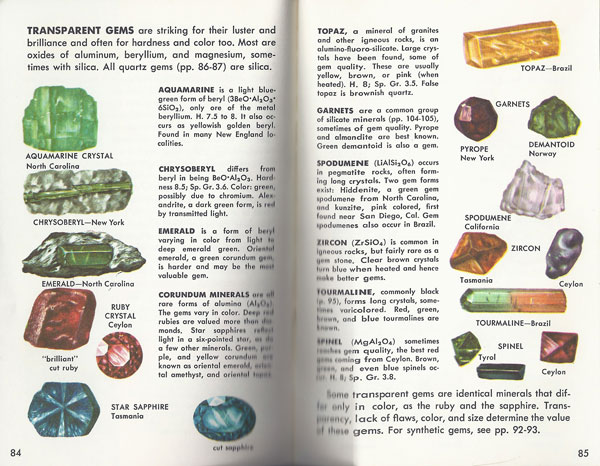
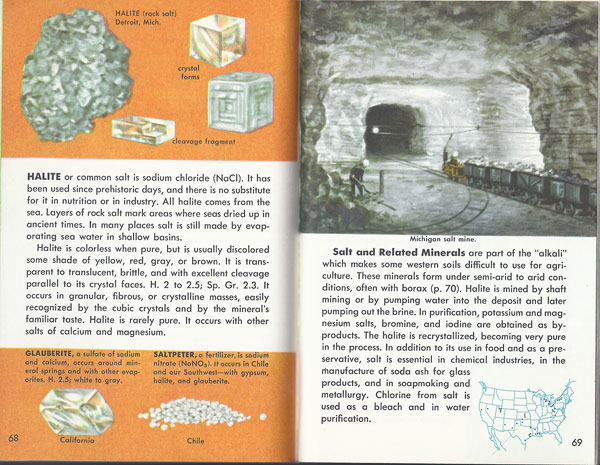
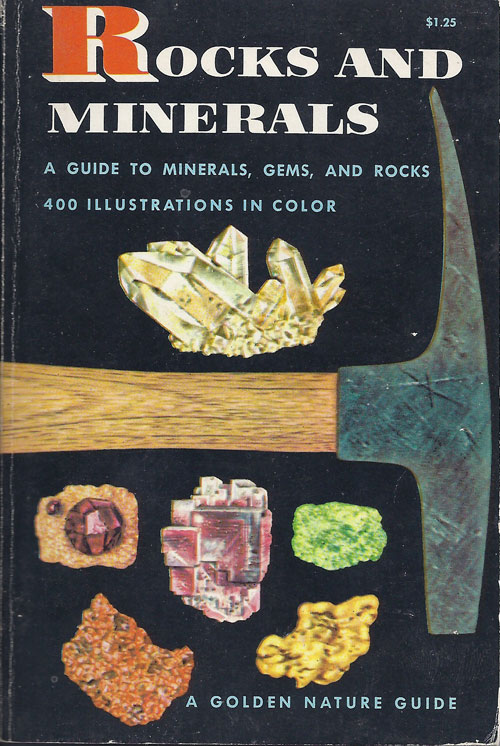
In the coffee shop recently I stumbled across an old copy of the Golden Nature Guide to Rocks and Minerals, a small pocket-sized handbook from the 1950s.

At some point, one of these was laying around the house when I was I was about 8 years old and I absolutely devoured it. Just like kids get interested in cowboys or ninjas or space or pirates, I went through a very serious gemstone phase. I begged my dad to take me opal hunting on one of the nearby mountains where there was a mine. He took me to the house of an acquaintance who was a rock hound. He was an old man with his own diamond blades for cutting gems and polishing stones. We also revived an ancient Geiger counter from the back of the shop and for a while I used to haul it around looking for Uranium. (I don’t think it actually worked anymore or it should have gone off in Pop Tart aisle in the grocery store, right?)

That was over 20 years ago. Looking back at the book though (I purchased the used copy on the shelf), I am amazed at how well-presented the information is. Is it just childhood nostalgia, or do they not make books quite like this anymore? I think the thing about this guide that REALLY sold me was how wonderful and artistic the pictures were. It contains no photographs. Everything is a watercolor illustration by a guy named Raymond Perlman. He spent his whole life drawing rocks and they don’t just look great, they look more than great. Through the artist’s eyes, they actually look way cooler than real rocks! Does that make the book inaccurate? Wouldn’t photo’s be more true? Maybe, but not for communicating the care and enthusiasm of the subject. For that, these work much better.

Whenever the next year I imagined the jewels on the hilts of Glamdring and Orcrist (from Tolkien’s Hobbit), these are what came to mind. Seeing the Star of India years later was probably still the highlight of my visit to the Smithsonian. It actually lived up to expectations.

I’ve included a few example pages I scanned in. This thing is old and out of print and not even in Google Books.


Remaining notes on Polya

The dregs of my notes on Polya’s Mathematics and Plausible Reasoning, Volume I:

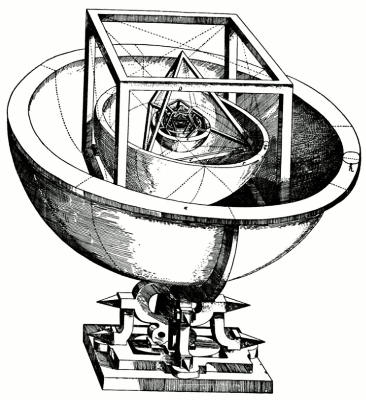
Polya discusses the 1595 work titled Mysterium Comographicum by the astronomer Johannes Kepler. Kepler believed that the orbits of the planets could be described as a series of standard solid geometic figures nested inside each other. It turns out that he was completely wrong, but his work and the way he TALKED about the problem was instrumental in leading others to the correct model later. He was in the middle (not the end) of breaking away from certain medieval ideas.

To modern eyes Kepler’s conjecture may look preposterous. We know many relations between observable facts and mathematical concepts, but these relations are of a quite different character. No useful relation is known to us which would have any appreciable analogy to Kepler’s conjecture. We find it most strange that Kepler could believe that there is anything deep hidden behind the number of the planets and could ask such a question : Why are there just six planets ?

We may be tempted to regard Kepler’s conjecture as a queer aberration. Yet we should consider the possibility that some theories which we are respectfully debating today may be considered as queer aberrations in a not far away future, if they are not completely forgotten. I think that Kepler’s conjecture is highly instructive. It shows with particular clarity a point that deserves to be borne in mind : the credence that we place in a conjecture is bound to depend on our whole background, on the whole scientific atmosphere of our time.

-p.198

This is good. This is an example of someone who looks at people in history and does not immediately assume they were behaving like a bunch of drooling idiots. They must have had good reasons for what they were doing. We just don’t understand their context. Perhaps our own context prevents us from seeing the silliness of our own ideas. What will people, especially scientists in our field a hundred years from now, think of what we are doing today?

If we examine a little the sequence of these numbers, we are almost driven to despair. We cannot hope to discover the least order.

-p.93

Geesh, that’s what I always feel when I look at a sequence of numbers that I’m supposed to find some secret pattern in. That stuff drives me nuts. I love patterns, but not in pure numbers. Give me context or give me death!

And since I must admit that I am not in a position to give it a rigorous demonstration, I will justify it by a sufficiently large number of examples.

-p.93

Again, an example of real intellectual honesty. Let’s have more of this and less B.S.

By the way, our example is quite rewarding (which is also typical). It leads to a curious relation between binomial coefficients.

-p.77

What? This interjection is in the middle of several thick pages explaining a number theory experiment (which I found utterly boring). It’s clear that he is finding delight in it! Different things float his boat than mine.

Do not ask unanswerable questions.

-p.70

Do you know what a “parallelepiped” is? I didn’t. You may know it by its name in the common tongue: a box.

Here is a hidden gem in the middle of a list of problems and examples for the reader to work through. The example discusses the probability of different eye colors appears in overlapping sets of girls.

You may try the experimental approach by looking into the eyes of several girls.

-p.120

(!!!)

Could be good advice to someone who reads too many books like this one.


More on problem solving, guessing, and descriptive language with Polya

Some further notes, a bit more miscellaneous this time, from George Polya’s Mathematics and Plausible Reasoning, Volume I:

Polya often uses the phrase “Patterns of …”. It sounds like he uses it in the same way Bukvich does when he says “In the style of …”. This is how you really learn stuff – hard work with an aim toward mixed imitation.

Flex you music composition muscles by rewriting this Telemann Sonata in the style of Theolonius Monk’s ‘Round Midnight. What are you waiting for? Go do it. Class dismissed.

Stuck on this engineering problem? Try manipulating it in the same way that Euler did when he hit upon such and such a useful trigonometric manipulation. You might discover something you hadn’t noticed before.

To be a good mathematician, or a good gambler, or good at anything, you must be a good guesser. In order to be a good guesser, you should be, I would think, naturally clever to begin with. Yet to be naturally clever is certainly not enough. You should examine your guesses, compare them with the facts, modify them if need be, and so acquire an extensive (and intensive) experience with guesses that failed and guesses that came true. With such an experience in your background, you may be able to judge more competently which guesses have a chance to turn out correct and which have not.

-p.111

I’m going to rewrite this paragraph for musicians.

To be a good pianist, or a good violinist, or a good trumpet player, you must be a critical listener. In order to be a critical listener, you should, I think, have naturally good pitch and rhythm differentiation to begin with. Yet, to have a naturally good ear is certainly not enough. You should examine what you hear, compare them with recordings and with what your teacher says, modify your expectations, and so acquire an extensive (and intensive) experience with listening and attempting to reproduce sounds. Sometimes you will fail sometimes you will succeed. With such an experience in your background, you may be able to judge more competently when you listen. You will have a better chance of being correct with rigorous practice.

Be careful with your analogies!

An analogous case. The problem is to design airplanes so that the danger of skull fractures in case of accident is minimized. A medical doctor, studying this problem, experiments with eggs which he smashes under various conditions. What is he doing? He has modified the original problem, and is studying now an auxiliary problem, the smashing of eggs instead of the smashing of skulls. The link between the two problems, the original and the auxiliary, is analogy. From a mechanical viewpoint, a man’s head and a hen’s egg are roughly analogous: each consists of a rigid, fragile shell containing gelatinous material.

-p.25

This immediately brought to mind a recent episode of MythBusters where our heroes were trying to simulate the smashing of a beer bottle on a person’s skull. They devised a type of plaster to stand in for the bone in the forehead. I kept thinking the entire episode that the plaster looked too fragile – real bone is probably tougher than that stuff. The same goes with eggs. You may learn something via the analogous experiment, but I would be careful not to infer TOO much. An egg shell is not so much the same as a head. To move an analogy in another direction, a psychological experiment involving a small sample set cannot be safely construed to a large population. This happens WAY too often.

I like this definition of what constitutes a “good” example:

A case is instructive if we can learn from it something applicable to other cases, and the more instructive the wider the range of possible applications.

-p.17

In a good novel, you can see yourself or someone you know in the characters. In a bad novel, they are utterly unique. (Hint: This is what is usually going on in bad sci-fi or fantasy literature.)

Against “genius”:

“He was a genius!”, some people will answer, and of course that is no explanation at all. Euler had shrewd reasons for trusting his discovery. We can understand his reasons with a little common sense, without any miraculous insight specific to genius.

-p.21

And now, for some genius anyway:

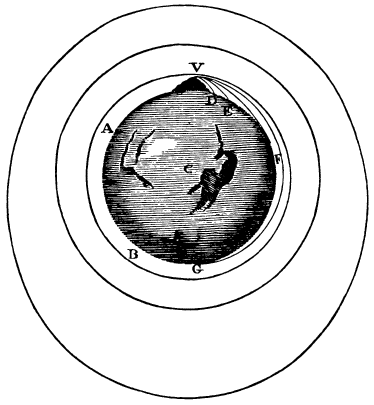
“… a stone that is projected is by the pressure of its own weight forced out of the rectilinear path, which by the initial projection alone it should have pursued, and made to describe a curved line in the and … at last brought down to the ground; and the greater the velocity is with which it is projected, the farther it goes before it falls to the earth. We may therefore suppose the velocity to be so increased, that it would describe an arc of 1, 2, 5, 10, 100, 1000 miles before it arrived at the earth, till at last, exceeding the limits of the earth, it should pass into space without touching it.”

-p.27

This quote is from Newton. It is stunning. Really! In a short space, he goes from throwing rocks over the hill to throwing rocks into deep space. In a tiny jump he discovers and describes what we call “escape velocity”. (This happens to be 25,000 MPH for earth.)

You should not forget, however, that there are two kinds of generalizations. One is cheap and the other is valuable. It is easy to generalize by diluting; it is important to generalize by condensing. To dilute a little wine with a lot of water is cheap and easy. To prepare a refined and condensed extract from several good ingredients is much more difficult, but valuable. Generalization by condensing compresses into one concept of wide scope several ideas which appeared widely scattered before. Thus, the Theory of Groups reduces to a common expression ideas which were dispersed before in Algebra, Theory of Numbers, Analysis, Geometry, Crystallography, and other domains. The other sort of generalization is more fashionable nowadays than it was formerly. It dilutes a little idea with a big terminology. The author usually prefers to take even that little idea from somebody else, refrains from adding any original observation, and avoids solving any problem except a few problems arising from the difficulties of his own terminology. It would be very easy to quote examples, but I don’t want to antagonize people.

-p.31

Ha ha! Fantastic. Everyone is required to read the previous paragraph over again.

A severe test. The last remark adds considerably to our confidence in our conjecture, but does not prove it, of course. What should we do ? Should we go on testing further particular cases ? Our conjecture seems to withstand simple tests fairly well. Therefore we should submit it to some severe, searching test that stands a good chance to refute it.

-p.39

A severe, searching test? Yes! People are always skipping this part! (Especially in economics?)

I goes into more detail in pages 78-79 on this. Always test extreme cases first. Get the nasty ones out of the way earlier to make sure your idea is worth pursuing.

This next passage is especially pertinent to journalists:

How strong is the evidence? Your question is incomplete. What do you mean by “strong”? The evidence is strong if it is convincing; it is convincing if it convinces somebody. Yet you did not say whom it should convince — me, or you, or Euler, or a beginner, or whom?

-p.68

What has all this work produced? It has changed the words we use – just a little bit – but the differential in meaning is huge.

Adaptation of the mind may be more or less the same thing as adaptation of the language; at any rate, one goes hand in hand with the other. The progress of science is marked by the progress of terminology. When the physicists started to talk about “electricity,” or the physicians about “contagion,” these terms were vague, obscure, muddled. The terms that the scientists use today, such as “electric charge,” “electric current,” “fungus infection,” “virus infection,” are incomparably clearer and more definite. Yet what a tremendous amount of observation, how many ingenious experiments lie between the two terminologies, and some great discoveries too. Induction changed the terminology, clarified the concepts.

-p.55

And remember, do not neglect vague analogies. Yet, if you wish them respectable, try to clarify them.

-p.15

Hooray for wild guesses! But don’t expect them to be “respectable” (taken seriously) without additional hard work.

On problem solving, with Polya

Here is what I came up with for what I ultimately learned from Polya’s book on plausible reasoning, combined with my own professional experiences over the past decade:

Real problem-solvers GUESS and then try SOMETHING. Non-problem-solvers repeatedly try to call in “experts” to solve the problem for them.

And now for some more good passages from Mathematics and Plausible Reasoning, Volume I, by George Polya:

“Many a guess has turned out to be wrong but nevertheless useful in leading to a better one.” “No idea is really bad, unless we are uncritical. What is really bad is to have no idea at all.”

-p.204 (from From How to Solve It, p.207)

Here we see the the “smallest testable case”, the key to debugging software (especially) and for fixing virtually all technology problems.

An extreme special case: Two men are seated at a table of usual rectangular shape. One places a penny on the table, then the other does the same, and so on, alternately. It is understood that each penny lies flat on the table and not on any penny previously placed. The player who puts the last coin on the table takes the money. Which player should win, provided that each plays the best possible game?

This is a time-honored but excellent puzzle. I once had the opportunity to watch a really distinguished mathematician when the puzzle was pro- posed to him. He started by saying, “Suppose that the table is so small that it is covered by one penny. Then, obviously, the first player must win.” That is, he started by picking out an extreme special case in which the solution is obvious.

-p.23

Great place to start!

This problem is important (why?) but not too easy. If you cannot solve it in full generality, solve it in significant special cases; put pertinent questions that could bring you nearer to its general solution; try to restate it; try to approach it in one way or the other.

-p.182

What do you do if you are stuck? Try solving a different problem. Make it more specific than the one at had. Give it more context. You may discover something about the GENERAL problem by solving some more SPECIFIC ones. If you are lost contemplating the forest, pick a tree or two to look at for a while.

Many problems may be easier than just one. We started out to solve a problem, that about the dissection of space by 5 planes. We have not yet solved it, but we set up many new problems. Each unfilled case of our table corresponds to an open question.

This procedure of heaping up new problems may seem foolish to the uninitiated. But some experience in solving problems may teach us that many problems together may be easier to solve than just one of them — if the many problems are well coordinated, and the one problem by itself is isolated. Our original problem appears now as one in an array of unsolved problems. But the point is that all these unsolved problems form an array : they are well disposed, grouped together, in close analogy with each other and with a few problems solved already. If we compare the present position of our question, well inserted into an array of analogous questions, with its original position, as it was still completely isolated, we are naturally inclined to believe that some progress has been made.

-p.47

This is one of the keys to Polya’s approach. If you get stuck, you either broaden your context, or shrink it. Your problem could be too general – fill in a bunch of the blanks (not all the blanks) and give it much more context. Make it more specific and then try to solve that. Above, he says that sometimes you have to do the opposite. Making the problem more vague could expand your imagination, but another great technique is to line up a bunch of specific problems and then start figuring out what they all have in common. This will often reveal the root issue. Compare a bunch of specific case studies and patterns emerge that were not apparent when just focusing on one thing.

On dead ends (from one of the example problem walkthroughs):

The information “C is not a circle” is “purely negative.” Could you characterize C more “positively” in some manner that would give you a foothold for tackling ex. 9?

Coming to a conclusion that is “purely negative” is usually of no for moving forward. It keeps you stuck. If you were looking for dead-ends, then maybe that is acceptable. Most of the time though, things are more complex. I think this is KEY to getting along with other people. If the person you are working with is a moron or a mortal enemy, then you are stuck. Can you try describing them in at least a mixed positive way? Stretch your imagination! They are human just like you. You can find something. That will give you a foothold to relate to them and keep some of the relationship intact. A conflict mediator can do this. It may in fact be their chief ability. I believe that as Christians we are called to do this as it is essential for learning to love.

We cannot live and we cannot solve problems without a modicum of optimism.

-p.194

A “modicum” is from the Latin for measure. It means a little bit. To have no optimism is suicide, both literal or on a smaller scale. Faith, Hope, and Love. They are as essential to our being as air, water, and blood.

Chance plays a role in discovery. Inductive discovery obviously depends on the observational material.

-p.53

A clever person with poor data is unlikely to make any meaningful discoveries. It isn’t his fault. A novice can find something great if he hits upon the right combination of things. Serendipity will always be worth mentioning when talking about problem solving.

It is instructive to compare two lines of inquiry which look so much alike at the outset, but one of which is wonderfully fruitful and the other almost completely barren.

-p.106

If one wants to understand problem solving, then need to also look at some counter examples and put their finger on what DIDN’T work.

Having solved a problem with real insight and interest, you acquire a precious possession: a pattern, a model, that you can imitate in solving similar problems. You develop this pattern if you try to follow it, if you score a success in following it, if you reflect upon the reasons of your success, upon the analogy of the problems solved, upon the relevant circumstances that make a problem accessible to this kind of solution, etc. Developing such a pattern, you may finally attain a real discovery. At any rate, you have a chance to acquire some well ordered and readily available knowledge.

p.121

The delight of learning – acquiring the “precious possession” described above!

First guess, then prove.

-p.84

And finally, a completely unrelated anecdote, just as an excuse to include a picture with this post, which is already so full of long excerpts that everyone has stopped reading already:

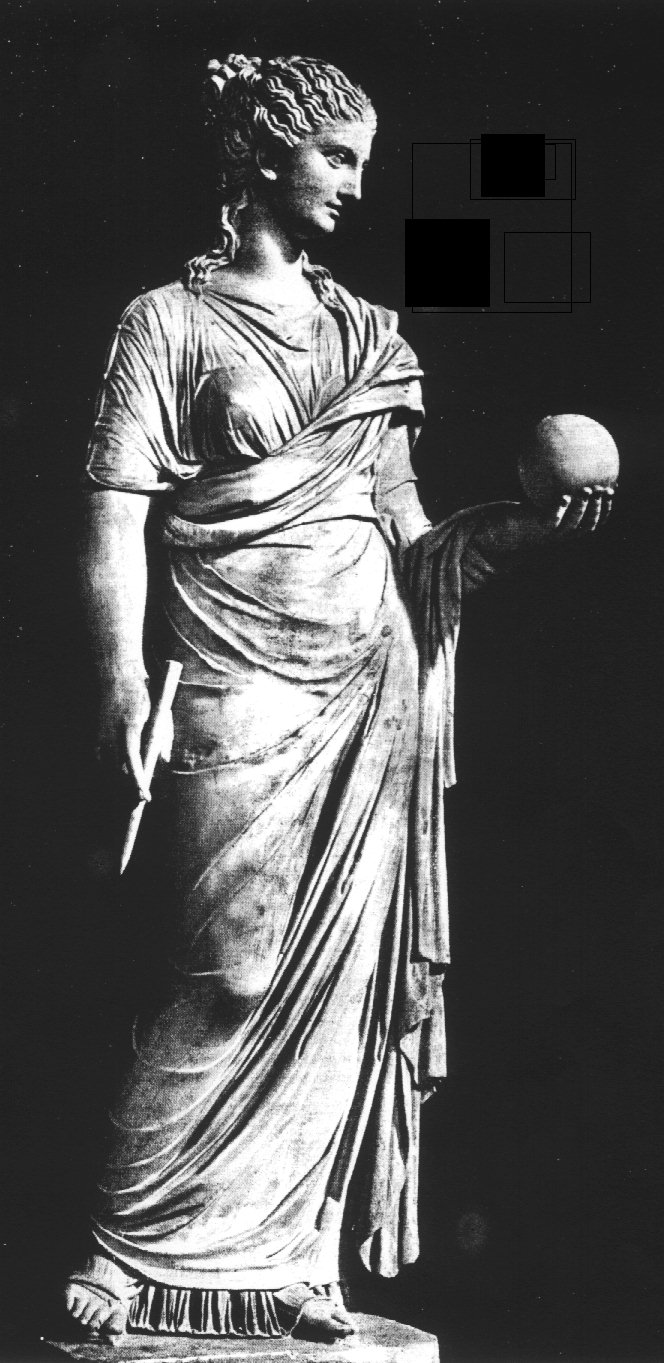
I presented this derivation [from Archimedes] several times in my classes and once I received a compliment I am proud of. After my usual “Are there any questions?” at the end of the derivation, a boy asked: “Who paid Archimedes for this research?” I must confess that I was not prompt enough to answer: “In those days such research was sponsored only by Urania, the Muse of Science.”

-p.158

Urania, more accurately, the muse of astronomy, usually depicted with a globe in her left hand. Oddly enough, Milton appeals to her in Paradise Lost.

Polya’s plausible reasoning

Heuristic: (adj.) Enabling a person to discover or learn something for themselves.

The next handful of blog posts will all be notes and observations from Mathematics and Plausible Reasoning, Volume I by the great math pedagogue George Polya. The book was lent to me by a good friend and mentor at work. Ironically, I spent two years working for a teaching lab named after Polya that (despite it’s other merits) didn’t actually follow Polya’s philosophy in nearly any regard.

This is also the first book I’ve ever read that is nearly 50% equations. Many of these I had to skim through as they involved higher math than I am not readily familiar with (differential calculus, analytical geometry, etc.). Some of the examples involving solid geometry and probability were more accessible. I didn’t care about the math though – I was interested in what Polya had to say about the nature of problem-solving in general. Fortunately, there was a lot to be gleaned from his examples. The bits of history sprinkled here and there were also fascinating. I was reminded of the Newton biography I read last year. My respect for Newton continues to soar.

I love a book that starts out by clarifying word definitions. This is what captivated me in N.T. Wright’s big books. It seems that in many of my favorite works, the introduction or preface is often the most helpful section of all. Polya begins with some great comments on the nature of explanations and conjecture:

Strictly speaking, all our knowledge outside mathematics and demonstrative logic (which is, in fact, a branch of mathematics) consists of conjectures. There are, of course, conjectures and conjectures. There are highly respectable and reliable conjectures as those expressed in certain general laws of physical science. There are other conjectures, neither reliable nor respectable, some of which may make you angry when you read them in a newspaper. And in between there are all sorts of conjectures, hunches, and guesses.

We secure our mathematical knowledge by demonstrative reasoning, but we support our conjectures by plausible reasoning. A mathematical proof is demonstrative reasoning, but the inductive evidence of the physicist, the circumstantial evidence of the lawyer, the documentary evidence of the historian, and the statistical evidence of the economist belong to plausible reasoning.

The difference between the two kinds of reasoning is great and manifold. Demonstrative reasoning is safe, beyond controversy, and final. Plausible reasoning is hazardous, controversial, and provisional. Demonstrative reasoning penetrates the sciences just as far as mathematics does, but it is in itself (as mathematics is in itself) incapable of yielding essentially new knowledge about the world around us. Anything new that we learn about the world involves plausible reasoning, which is the only kind of reasoning for which we care in everyday affairs. Demonstrative reasoning has rigid standards, codified and clarified by logic (formal or demonstrative logic), which is the theory of demonstrative reasoning. The standards of plausible reasoning are fluid, and there is no theory of such reasoning that could be compared to demonstrative logic in clarity or would command comparable consensus.

-George Polya, Mathematics and Plausible Reasoning, Volume I, p. v

Biologists, climatologists, archeologists, economists, psychologists and especially sociologists have got to stop pretending that what they do is rigid “demonstrative” reasoning. They imagine themselves to be hard scientists like physicists (to some degree) or mathematicians. It’s not the same. That’s OK, but be honest about it. The standards are fluid (ever changing!) and even the best work is riddled with guesses, some supported substantially and others not so much. Biologists often laugh at theologians for not being real scientists, but in reality they are both on exactly the same playing field.

I do not believe that there is a foolproof method to learn guessing. At any rate, if there is such a method, I do not know it, and quite certainly I do not pretend to offer it on the following pages. The efficient use of plausible reasoning is a practical skill and it is learned, as any other practical skill, by imitation and practice. I shall try to do my best for the reader who is anxious to learn plausible reasoning, but what I can offer are only examples for imitation and opportunity for practice.

In what follows, I shall often discuss mathematical discoveries, great and small. I cannot tell the true story how the discovery did happen, because nobody really knows that. Yet I shall try to make up a likely story how the discovery could have happened. I shall try to emphasize the motives underlying the discovery, the plausible inferences that led to it, in short, everything that deserves imitation. Of course, I shall try to impress the reader; this is my duty as teacher and author. Yet I shall be perfectly honest with the reader in the point that really matters: I shall try to impress him only with things which seem genuine and helpful to me.

p. vi

I have to come to really enjoy the way that authors humble themselves (or not!) in the first few pages of their books. The authors that do not are immediately suspect to me. Someone that can’t laugh at themselves or immediately recognize how large insignificant their work is are not, in my opinion, spiritually or psychologically healthy enough to be thinking clearly (or gracefully) about the topic at hand.

“I shall try to make up a likely story.” If only so many other books came with this much-needed disclaimer! I love it!

Most parts of this book have been presented in my lectures, some parts several times. In some parts and in some respects, I preserved the tone of oral presentation. I do not think that such a tone is advisable in printed presentation of mathematics in general, but in the present case it may be appropriate, or at least excusable.

-p.ix

I’m going to disagree a bit here. I think the oral tone IS acceptable in print. I have found it to frequently be a clear mode of writing. This is maybe because I am a slow reader that “reads aloud” to myself in my head. It may be inefficient, but I actually prefer it in many cases. Transcriptions of speeches can be messy and superfluous, but they can also be crystal clear and de-gunked in a way that unspoken prose cannot rise to.

The advanced reader who skips parts that appear to him too elementary may miss more than the less advanced reader who skips parts that appear to him too complex.

-p.xi

A good warning! (And encouraging to this reader, who definitely skipped some of the complex parts.)

Demystifying gangsta rap

Tonight, a few blocks from my house, early 90’s rap legend “Warren G” is singing at a small local bar. I suspect times aren’t as high for him as they used to be. In junior high, my friend Jeff used to listen to his “Regulate the G Funk” track constantly. Back then, I think I figured it was pretty tame since it didn’t have any swear words or anatomically descriptive sex references. Recently though, I discovered a hilarious dissection of the tune explaining each line of the song in straight-faced fashion. Wow. Did we really know what we were imbibing back then? (No. See below.)

On a cool, clear night (typical to Southern California) Warren G travels through his neighborhood, searching for women with whom he might initiate sexual intercourse. He has chosen to engage in this pursuit alone.

Nate Dogg, having just arrived in Long Beach, seeks Warren. On his way to find Warren, Nate passes a car full of women who are excited to see him. Regardless, he insists to the women that there is no cause for excitement.

Warren makes a left turn at 21st Street and Lewis Ave, in the East Hill/Salt Lake neighborhood, where he sees a group of young men enjoying a game of dice together. He parks his car and greets them. He is excited to find people to play with, but to his chagrin, he discovers they intend to relieve him of his material possessions. Once the hopeful robbers reveal their firearms, Warren realizes he is in a less than favorable predicament.

Meanwhile, Nate passes the women, as they are low on his list of priorities. His primary concern is locating Warren. After curtly casting away the strumpets (whose interest in Nate was such that they crashed their automobile), he serendipitously stumbles upon his friend, Warren G, being held up by the young miscreants.

Warren, unaware that Nate is surreptitiously observing the scene unfold, is in disbelief that he’s being robbed. The perpetrators have taken jewelry and a name brand designer watch from Warren, who is so incredulous that he asks what else the robbers intend to steal. This is most likely a rhetorical question.

Observing these unfortunate proceedings, Nate realizes that he may have to use his firearm to deliver his friend from harm.

The tension crescendos as the robbers point their guns to Warren’s head. Warren senses the gravity of his situation. He cannot believe the events unfolding could happen in his own neighborhood. As he imagines himself in a fantastical escape, he catches a glimpse of his friend, Nate.

Nate has seventeen cartridges to expend (sixteen residing in the pistol’s magazine, with a solitary round placed in the chamber and ready to be fired) on the group of robbers, and he uses many of them. Afterward, he generously shares the credit for neutralizing the situation with Warren, though it is clear that Nate did all of the difficult work. Putting congratulations aside, Nate quickly reminds himself that he has committed multiple homicides to save Warren before letting his friend know that there are females nearby if he wishes to fornicate with them.

Warren recalls that it was the promise of copulation that coaxed him away from his previous activities, and is thankful that Nate knows a way to satisfy these urges.

Nate quickly finds the women who earlier crashed their car on Nate’s account. He remarks to one that he is fond of her physical appeal. The woman, impressed by Nate’s singing ability, asks that he and Warren allow her and her friends to share transportation. Soon, both friends are driving with automobiles full of women to the East Side Motel, presumably to consummate their flirtation in an orgy.

The third verse is more expository, with Warren and Nate explaining their G Funk musical style. Nate displays his bravado by claiming that individuals with equivalent knowledge could not even attempt to approach his level of lyrical mastery. There follows a brief discussion of the genre’s musicological features, with special care taken to point out that in said milieu the rhythm is not in fact the rhythm, as one might assume, but actually the bass. Similarly the bass serves a purpose closer to that which the treble would in more traditional musical forms. Nate goes on to note that if any third party smokes as he does, they would find themselves in a state of intoxication daily (from Nate’s other works, it can be inferred that the substance referenced is marijuana). Nate concludes his delineation of the night by issuing a vague threat to “busters,” suggesting that he and Warren will further “regulate” any potential incidents in the future (presumably by engaging their enemies with small arms fire).

Some notes on Ecclesiastes

Though I have significant disagreements with some of Doug Wilson’s theology and even more so his rhetoric, nevertheless I would be kidding myself to say I don’t owe him quite a bit. A handful of blog posts about six years ago introduced me to Rene Girard (though Wilson has largely moved on to other things.) His sermons on worldview (talk about a word that has been unfortunately cheapened in the last decade!) have also been helpful as well as works like Fidelity.

When asked in an interview a while back though which one of his 30+ books was the most important or valuable, I was surprised to hear him answer that it was his commentary on Ecclesiastes. It was put together from a series of talks, one of which I actually heard myself as a student back in 1999. Joy at the End of the Tether is the book. I had it on my shelf amidst a stack of recently acquired used editions so I decided to read through it this week.

It’s very good and sides with Solomon in that it tries to make Ecclesiastes “fit” in with the gospel and the rest of scripture. I’ve seen more than a few teachers over the years really not know what to do with Ecclesiastes and its “life sucks and then you die” message. I’ve even heard people all but throw it out of the canon as some sort of uninspired depressing late-life moan piece.

I think in the end though, Solomon had his head on straight, even if his heart wasn’t always in the right place throughout mid-life. (Less so than his father David.) The point is that God is completely in control of everything, even all the bad stuff. It’s not some cosmic battle or violent turf war in your heart. He is the Alpha and Omega. From THAT, you can simply work hard and enjoy what you can here on earth. And when stuff doesn’t turn out how you wished, don’t sweat it. Oh well. God is still God. Nothing changed.

I copied down a few sections I especially liked:

Of course, wisdom is a pain in the neck. Within these boundaries, wisdom can only show that God has determined to trap us in a meaningless existence. So any intelligent investigation of the world and its pleasures will only multiply sorrows (1:18). The fool thinks he is chained to a dungeon wall; the intelligent knows that it is actually a labyrinth. Pleasures, delights, sensations, and all their cousins, will only send a man, first on this fool’s errand, and then on that one.

-p.23

I think life seems meaningless to us because of the curse of the fall. Our minds our darkened, our desires are confused. We can’t think our way back into communion with our creator. Good thing He intends to come take us there himself some day.

The commotion of the stock market reveals the hubris of man better than few other things. We believe we can pump up the Dow forever and make money at a fine clip forester…but we cannot. The cycles ordained by God for everything in this fallen and silly world will come around again, and many a millionaire will go white in disbelief. “How could this happen?” Friend, look at the world. How could it NOT?

-p.47

How could this NOT happen? That is what I think every time I hear some economist on NPR or CNN talk about how GDP always needs to be growing. Growth growth growth! Really? Do you guys ever read any history, ever? Bunch of morons.

Those who say that a holy God cannot wield a wicked tool have come to believe the authority of their own sophistries. The Bible tells us that God is HOLY, and the Bible tells us that God wields the wicked in His hand like an ax. God used the wicked Assyrians to judge the Jews; God used Herod, Pontious Pilate, and all the Jews to condemn His Son; God used Judas to betray the Lord; God used Absalom to sleep with David’s concubines. The list is much longer and much less pleasant than many Christians want.

-p.50

At the end of the day, it’s better to stick with a high view of the sovereignty of God and not try to dilute it with a list of complicated exceptions.

Man is built for community, and loneliness is a great evil. Working together is satisfying; it is fruitful, prevents harm, keeps you warm, defends, and keeps unity (4:9-12).

A man works hard to make a pile and doesn’t stop to ask a very basic question – why am I doing this He makes a stack of money but has no one to share it with. He can’t afford to marry or have children, because they would take hi away from his work. He cannot afford to have friends because all their motives would be suspect. He could buy dinner for everyone in the restaurant, but no one wants to sit with him. That’s all right, because he doesn’t want to sit with them either.

But companionship is dear. God created us for friendship, and a curse resides on all things which prevent men from forming friendships. One of the great culprits in this affair is the task of making big-time money. So the answer is that the gift of God BESTOWS COMPANIONSHIP.

-p.61

Really great stuff. Shockingly sounds likes Wendell Berry. (!)

The one who gives to the poor is in fact giving to the Lord. Thinking backwards can be fun sometimes. Some say that life is uncertain, so we should eat dessert first. Solomon says here that because life is uncertain we ought to give the dessert away.

Fantastic.

In which I pay tribute to the pop music of my youth

I am paralyzed. Can I write this with pop music blaring in my head? But I would rather listen to it than think. 1994 comes back to me in a blaze of color.

I was 13, on my first big Youth Group trip to the big city to watch a hockey game and then eat pizza and be talked into praying to God for salvation for the first time. Except I had already done that and the hockey game was only mildly interesting. What was far more captivating? Intensely so? The cute girl across the aisle on the bus. She had such big brown eyes. I think she must have been about 15 – a couple years older than I. She was from the next town over so I didn’t know her name. I finally caught it by the end of the trip, but never considered asking her for it myself. I didn’t know how. I was a star-struck observer, first of sight, but then to my surprise, of sound.

Even though it was supposed to be a sanitized Evangelical outing, the bus driver succumbed to requests to turn on the local top 40 radio. Three and a half minute excursions into love and love lost and love cranked up flooded my ears for the next 90 minutes. I was an innocent back-woods farmer’s son who had barely seen an hour of television beyond Saturday morning cartoons. The only radio I had ever heard was my mother’s adult contemporary Christian station that was half electric-piano ballads from Sandi Patti and Steve Green and half topical Bible Q&A shows. Over the airwaves now came dancable tunes like I had quite literally never imagined before. First and foremost that trip, played three times in it’s entirety on the bus ride there was “The Sign” by Swedish pop quartet Ace of Base. Holy smokes! The drum machine was so snappy, the bass line so slick and the vocals so full of life – I was struck dumb. What’s hilarious is that at the time I assumed the artist must be Whitney Houston since she was the only female pop artist I had *ever* heard of at the time. It took me several evenings of listening to the scratchy radio on my Walkman to catch the tune again on a station that announced the playlist. Pretty girl with the brown eyes was long gone and quickly forgotten, but my head-over-heals plunge into the world of sound and chords and timbre was just beginning.

Looking back now nearly twenty years later, I’m sure it’s hard to take early nineties synth pop very seriously. Contemporary acts are so much more hip and polished (and jaded), aren’t they? I’ve moved on of course, right? I’ve played Beethoven symphonies in orchestra. I’ve heard maybe the greatest guitarist alive today play twenty fantastic works just twenty feet away from me. The amount to explore is endless. Still, you never quite forget what first latched onto you, however awkward it may seem in hindsight.

I’m not embarrassed anymore though. Love it or ridicule it, this is the kind of stuff I’m made of. And so is all that other stuff and I’m not embarrassed by it either. All those hours of Bible Q&A shows with folks like Chuck Colson and Warren Wiersbe – an amazing amount of that stuck in my head. I didn’t rebel and toss it all out for the hell of it later. Those old Christian artists? Some of them were actually really great – Michael Card in particular is a consummate musician. I still want to be Michael Card when I grow up. Sort of. Another interesting fact is that it turns out Jenny Berggren, lead singer of Ace of Base was a rather serious Christian. Though the band sold 30 million records, she eventually became disenchanted with the fame and quit to live in her quiet home town and sing in church. I eventually married another pretty brown-eyed girl – one I met in a pit orchestra.

All that stuff my mother taught me back then was pretty sound too. I’m glad for all the hugs and love and spankings and everything else, even though she couldn’t stand the music I had discovered.

Which of you by taking thought can… (On worry and gifts)

The ESV calls it “being anxious”. Other translations say “worry”. The old KJV says something more generic, and maybe more truthful – “taking thought”.

Which of you by taking thought can add one cubit unto his stature? And why take ye thought for raiment? Consider the lilies of the field, how they grow; they toil not, neither do they spin: And yet I say unto you, That even Solomon in all his glory was not arrayed like one of these. Wherefore, if God so clothe the grass of the field, which to day is, and to morrow is cast into the oven, shall he not much more clothe you, O ye of little faith?

-Matthew 6:27-30

Who, by just THINKING about something can make anything happen? Can you make your hair grow longer if you concentrate really hard? No, it just grows. Can you attract success with the right attitude, ala Oprah and “The Secret”? Nonsense. We cannot make reality ex nihilo like our creator, or make our thoughts take shape before our eyes like a magician channeling manna. We only affect via a medium. We must work with our own hands and lips and that’s about all. We have so little – so much of what we have must just be a gift. Let us show gratitude for that.

“Consider the lilies of the field, how they grow; they toil not, neither do they spin: And yet I say unto you, That even Solomon in all his glory was not arrayed like one of these.”

Glory is an interesting idea, especially in scripture. Man, mankind, is the glory of God, and the woman is the glory, crown, of man. (1 Corinthians 11:7). Not just our clothes, like the glory of the lilies.

This passage about not worrying is nearly always phrased with regards to Maslow’s Hierarchy of Needs. Trust God to take care of your food and shelter. He doesn’t promise much more than that and even that can be a bit dicey if a trial is at hand. Remember though this is Jesus himself talking here, not an interpreter. I think he must mean more than just basic economics and survival.

Extend the words just a bit. If the glory of a husband is his wife, then in a sense Solomon was arrayed in glory with all his wives, not just his gold and nice kingly clothes. In the same way, who, by “taking thought” can change anything about his wife or comfort her, or change anything about his kids or really protect them? But God knows we lonely, creative, social humans need these things too – just like bread and water. And he promises to take care of these too. And then, when he does, whaddayaknow, it’s another gift, just like what the splendor the lilies of the field were arrayed in.

Missing Africa just a bit

I saw this picture the other day on a photo stream. It has so many of the classic Addis Ababa sights all in one angle – the red city buses with the lion on the side, the blue Toyota taxis, the car that won’t start (it’s actually illegal in Africa to have a car that starts), the rickety wooden scaffolding for a new cement building (top left), the shanties across the street made of corrugated aluminum, rocks, and dirt, the high altitude tropical trees, and a guy on the street with an Orthodox prayer staff. I hope I get to go back some day.