William James – Not assuming atheism

I’ve been reading some of William James’s (apparently) classic work The Varieties of Religious Experience.

It seems that James’s position is essentially that psychology as a science cannot prove or disprove the existence of God or the validity of religious experiences. The secularist acknowledges their social and existential impact but denies the external reality of any of kind of religious thoughts. They are all assumed from the start to be an illusion. An illusion with a a rock hard foundation, yes, but an illusion nonetheless. James will not surrender this point and assume atheism before beginning his investigations. In the end, he concludes with a sort of agnosticism, but one that treats religious belief positively. Because you can not come close to proving that religious experiences are illegitimate, you might as well assume the possibility that they are real as you discourse and investigate other aspects of psychology.

Further investigation shows that James’s guiding philosophy is pragmatism. Ugg. Oh well. At least it was nice to read a scientific approach to a topic without completely writing God off from the beginning. His observations are worth considering. On a side-note, his beliefs seem to me to be further proof that Catholics can get away with believing just about anything without ecclesiastical authorities giving them any crap about it.

Abstraction and leadership

I was at a “Process Improvement” workshop yesterday where all human work was described as “processes”, everything that was done was “value”, and time spent doing anything that didn’t add “value” was “waste”. Every piece of the discussion was abstracted and made as generic as possible. Now, the presenter, some human resources consultant, seemed to be a sharp guy. I am not going to criticize this approach directly as I don’t really have anything substantial to say. I do want to ask a few questions though.

Should an organization ever grow so large that this sort of language is necessary, or used at all? Abstraction is necessary to talk about large ideas. Abstraction in the chain of command is required to steer a big ship, such as a large corporation or especially a nation. Still, I am skeptical that this is really the way the conversation should be framed.

People respond to people close to them, people they love (care about). This circle can only grow so large before it is impossible for people to care or be affected positively in an organization. It seems to me that, to the degree that we can decentralize and empower individuals at the ground level, that is the degree we will be effective at really changing and improving the world.

In government, the equivalent would be more local and regional control, less state control, and dramatically less federal control. Sure, the next town over might do something you wouldn’t do yourself, but that’s the point. They do a hundred things differently than you would do and in the long run, it is better for them. The effect of their bad management or decisions is contained. The effect of their good management and laws is dramatically amplified because of the much tighter-knit community. This has far more potential than any good law or mandate coming from an emperor two thousand miles away or eight layers above the command chain.

I don’t know a ton about military history, but it seems to me that, though generals talk to the journalists, take the falls, and win the fame, the army rises or falls on good lieutenant commanders. The navy sinks or sails on good captains, not admirals. On a related note, this is why so much foolishness surrounds the operation of mega-churches. If any organization on earth needs to be kept relatively small and local to remain effectively, it is the church.

This all lines up with Girard’s theory than we learn only be imitating others. We acquire the desires of the leader only when the leader is a proper model. When the “vision” or “mission” or whatever you want to call it is too abstract, such that every sentence has words like “processes” and “value” in scare quotes, then the leader has ceased to be an effective model. He/she is no longer anthropological. Following the leader then is left up to the effectiveness of our imagination – which is often hit or miss.

Arise and work

It appears that immediately after waking is the best time to write – when your purpose is not already acquired. Acquired, you may continue on through the night, but not the other way around.

I myself am an effective night-owl, but only when continuing to work on something began much earlier. When I try to start something new late it’s pretty much guarenteed to fail. Might as well watch TV, or better yet, go to sleep. On the other hand, after several years or trying to write a bit on this blog, I have realized that the bulk of my best stuff was written early in the day. Sometimes very early, when I coudln’t go back to sleep after the baby began fussing.

“I write only when inspiration strikes. Fortunately it strikes every morning at nine o’clock sharp.” – W. Somerset Maugham.

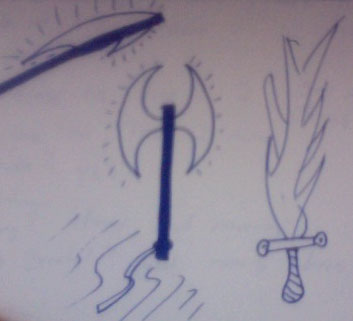
In other news, when I am completely and utterly lacking in creativity, the pages of my notebook end up looking like this.

Myst, Holodecks, Programming, and the joy of (some) intangible work

To contrast with all my posts lately about the psychological and social problems related to intangible work, I present this passage from The Mythical Man Month, by Frederick Brooks. Brooks is with me in that one of his favorite books of all time happens to be The Mind of the Maker, by Dorothy Sayers. He certainly draws on some of those ideas here.

When I find myself enjoying programming (or remembering why I got into it in the first place back when I was just a kid), these sorts of things are what come to the surface.

The Joys of the Craft

Why is programming fun? What delights may its practitioner expect as his reward?

First is the sheer joy of making things. As the child delights in his mud pie, so the adult enjoys building things, especially things of his own design. I think this delight must be an image of God’s delight in making things, a delight shown in the distinctness and newness of each leaf and each snowflake.

Second is the pleasure of making things that are useful to other people. Deep within, we want others to use our work and to find it helpful. In this respect the programming system is not essentially different from the child’s first clay pencil holder “for Daddy’s office.”

Third is the fascination of fashioning complex puzzle-like objects of interlocking moving parts and watching them work in subtle cycles, playing out the consequences of principles built in from the beginning. The programmed computer has all the fascination of the pinball machine or the jukebox mechanism, carried to the ultimate.

Fourth is the joy of always learning, which springs from the non-repairing nature of the task. In one way or another the problem is ever new, and its solver learns something: sometimes practical, sometimes theoretical, and sometimes both.

Finally, there is the delight of working in such a tractable medium. The programmer, like the poet, works only slightly removed from pure thought-stuff. He builds his castles in the air, from air, creating by exertion of the imagination. Few media of creation are so flexible, so easy to polish and rework, so readily capable of realizing grand conceptual structures. (As we shall see later, this very tractability has its own problems.)

Yet the program construct, unlike the poet’s words, is real in the sense that it moves and works, producing visible outputs separate from the construct itself. It prints results, draws pictures, produces sounds, moves arms. The magic of myth and legend has come true in our time. One types the correct incantation on a keyboard, and a display screen comes to life, showing things that never were nor could be.

Programming then is fun because it gratifies creative longings built deep within us and delights sensibilities we have in common with all men.

I shall rephrase his points with a few additional thoughts.

1. It’s fun to make things. My wife just made two six-foot-long benches in the shop behind the house for our dining room table. She had a blast. I have felt the same way about software many times. We make things because God makes things. We are like him in this way first of all.

2. We don’t want to make things in a vacuum. We want to see other people use our things. This is why music HAS to be shared for it to be complete as an art. All artists and craftsmen have a hole in their soul until they witness another human being interacting with or affected by their creation. We don’t just want to make nonsense works – we desire them to be used. Cathedrals are not just beautiful landmarks, but also great places to hold church services. In my own work, I have always gravitated toward producing tools where I can perceive who the immediate users are. I have not, at this point, gotten a lot out of contributing theoretical knowledge or abstract components to open-source projects. I can’t see whatever happens to them. I’m sure my work could help someone out there, but it can be difficult to go through the effort to repackage it in a “sharable” form and then send it into the void. Some people really dig doing this though.

3. We are fascinated by interlocking moving parts that move in cycles. Well, some of us are anyway. This aspect of the making process seems to be largely the domain of the male gender. A friend of mine recently commented that his son loves anything with wheels on it. He probably will his whole life. This is also why I love robots, but don’t like androids. One holds all the fascination of a machine, the other is too much like a twisted human being. For what it’s worth though, Data was still probably the best character on Star Trek.

4. The joy of always learning? I agree completely that there is a joy in learning. I love learning! This blog is little more than an attempt to get a bit more mileage out of my own learning. However, I have not always found myself excited to learn about software development, my discipline. If it will help me solve an immediate problem – yes, but otherwise no. This is why I dropped out of computer science in college. What a drag! I wasn’t learning anything I wanted to know. Everything I wanted to know I could learn on my own online. The same for everything I needed to know to do my job.

The quick and steady cycle of throwing technology in the garbage can and embracing the next new thing every couple of years was (and is) ultimately wearisome to me. I just can’t get excited about the newest version of (fill in the blank). I can get excited about learning new techniques when I have a goal in mind. I would dive into GPU controller code up to my neck in a second if I was motivated to write a cool 3D game. But if someone gave me a job documenting hundreds of pages of the same GPU code and paid me a salary to do it – somebody shoot me. This point needs a bit more nuance.

5. The medium of working on a computer is so flexible! You can create entire worlds, “castles in the air, from air” and design every aspect of how they function.

If you have ever played any of the old Myst video games, you know that the stories involve a family of people who possess a special magic for creating new worlds from scratch by writing books. Their writing craft is not easy though and the characters often lament the instability of the places they create. Some of the worlds are very dangerous to visit in the game because the laws of physics just aren’t working right. The good guys in the game try to create beautiful places for people the live. The evil ones want to make their own worlds and then lord over them likes gods. They both express frustration at the perilousness of their craft. There is a tension between their desire to settle down and have a family, like ordinary people, and their desire to keep experimenting with their creative writing magic.

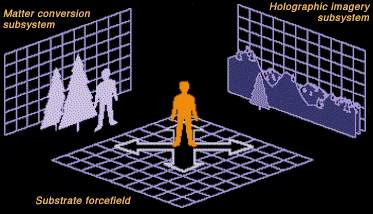
A similar profession mentioned a few times in the Star Trek universe is the craft of writing Holodeck programs and characters. It’s considered to be rather difficult to do well, as evidenced by the terrible results when some amateur characters on the show take a stab at it themselves. The parallel with writing software is even closer here.

We want to create worlds, just like God, but we can’t fathom how God thinks about things, really. So we have to imagine some sort of in-between material, a language of mediation. For the writers of the Myst books, it was written words on the page – careful descriptions mixed with spells. For the Holodeck programmer or the contemporary software developer, it is some sort of programming language – a special language for describing things and casting our own spells of sorts.

Just as it was easy for the Myst authors to get lost in their work and go crazy, it was a great temptation for Holodeck authors (and users) to become addicted to their creations and their creative processes and be lost and disconnected from their friends and reality too. In the same way, when we bury ourselves too deep in our creation, then we are divided from friends, family, and community. It isn’t healthy. We need these connections to remain intact to remain whole ourselves. They are the things that really matter. To the degree that we can do this today, then technology is no evil. Let us learn wisdom and self-restraint.

Christ as mediator between brothers

A few days ago, I was accused of blasphemy after posting the following on Facebook:

As much as I love Lewis, I must admit that the first chapter of Bonhoeffer’s Life Together is better than anything from The Four Loves.

I can hardly believe I said it myself. Nevertheless, I can’t help but cheer when I come across passages like this. It fits in very well with Girard’s model.

Without Christ we should not know God, we could not call upon Him, nor come to Him. But without Christ we also would not know our brother, nor could we come to him. The way is blocked by our own ego. Christ opened up the way to God and to our brother. Now Christians can live with one another in peace; they can love and serve one another; they can become one. But they can continue to do so only by way of Jesus Christ are we one, only through him are we bound together. To eternity he remains the one Mediator.

Dietrich Bonhoeffer, Life Together, p.23

Girard’s theory states that Jesus is not just a substitutionary sacrifice taking place in some heavenly temple, but unique and clean model of living as a non-rival with our brothers and sisters. He is completely free of the envy that divides us from our fellow human beings 100% of the time. What Bonhoeffer is saying here is the same thing. Christ is not just the mediator between us and God, but between us and everyone around us too. This is really the key to us getting along with each other in spiritual community – real community. It is the foundation of brotherly love, of love within the church. It is not that Christ’s work simply sanctifies us such that we are able to sustain being nice to each other for extended periods of time. No, he is THE mediator between us – the glue that holds us together.

A few misc notes on The Unsettling of America

It’s time to move on, but before I do I have a few more passages to mark from Wendell Berry.

On the difference between “good” and “bad” work.

There is work that is isolating, harsh, destructive, specialized or trivialized into meaninglessness. And there is work that is restorative, convivial, dignified and dignifying, and pleasing. Good work not just the maintenance of connections – as one is now said to work “for a living” or “to support a family” – but the ENACTMENT of connections. it IS living, and a way of living; it is not support for a family in the sense of an exterior brace or prop, but is one of the forms and acts of love.

p.139

On fidelity. (Fidelity as in sexual and marital faithfulness.) This section was especially good. Both non-religious and religious people alike fallen into this sort of sour moralism with regards to many things – myself included every day. I see bits of the gospel in here.

The idea of fidelity is perverted beyond redemption by understanding it as a grim, literal duty enforces only by willpower. This is the “religious” insanity of making a victim of the body as a victory of the soul. Self-restraint that is so purely negative is self-hatred. And one cannot be good, anyhow, just by not being bad. To be faithful merely out of duty is to be blinded to the possibility of a better faithfulness for better reasons.

It is reasonable to suppose, if fidelity is a virtue, that it is a virtue with a purpose. A purposeless virtue is a contradiction in terms. Virtue, like harmony, cannot exist alone; a virtue must lead to harmony between one creature and another. To be good for nothing is just that.

p.120

Back to the problem of specialists again. When sex is extracted from personal intimate relationships, family and spiritual life and put in it’s own little box, it becomes twisted and distorted.

A direct result of the disintegration of the household is the division of sexuality from fertility and their virtual takeover by specialists. The specialists of human sexuality are the sexual clinicians and the pornographers, both of whom subsist on the increasing possibility of sex between people who neither know nor care about each other. The specialists of human fertility are the evangelists, technicians, and salesmen of birth control, who subsist upon our failure to see any purpose or virtue in sexual discipline. In this, as in our use of every other kind of energy, our inability to contemplate any measure of restraint or forbearance has been ruinous. Here the impulse is characteristically that of a laboratory scientist: to encapsulate sexuality by separating it absolutely from the problems of fertility.

p.132

Here, he asks “Can we abstain from using power?” and presents the Amish as an example of a “yes”. The last line is particularly good and quite possibly the theme of his entire book. It’s affected me personally and directed my train of thoughts often as of late. We can flourish by embracing our humble position.

The only people among us that I know of who have answered this question convincingly in the affirmative are the Amish. They alone, as a community, have carefully restricted their use of machine-developed energy, and so have become the only true masters of technology. They are mostly farmers, and they do most of their farm work by hand and by the use of horses and mules. They are pacifists, they operate their own local schools, and in other ways hold themselves aloof from the ambitions of a machine-based society. And by doing so they have maintained the integrity of their families, their community, their religion, and their way of life. They have escaped the mainstream American life of distraction, haste, aimlessness, violence, and disintegration. Their life is not idly wasteful, or destructive. The Amish no doubt have their problems; I do not wish to imply that they are perfect. But it cannot be denied that they have mastered one of the fundamental paradoxes of our condition: we can make ourselves whole only by accepting our partiality by living within our limits, by being human – not by trying to be gods. By restraint they make themselves whole.

p.95

Berry on the “Identity crisis” as mythology

This passage, describing the “social myth” of the “identity crisis” is one of the best (and most snarky) passages from The Unsettling of America:

The so-called identity crisis, for instance, is a disease that seems to have become prevalent after the disconnection of body and soul and the other piecemealings of the modern period. One’s “identity” is apparently the immaterial part of one’s being—also known as psyche, soul, spirit, self, mind, etc. The dividing of this principle from the body and from any particular worldly locality would seem reason enough for a crisis. Treatment, it might be thought, would logically consist in the restoration of these connections: the lost identity would find itself by recognizing physical landmarks, by connecting itself responsibly to practical circumstances; it would learn to stay put in the body to which it belongs and in the place to which preference or history or accident has brought it; it would, in short, find itself in finding its work. But “finding yourself,” the pseudo-ritual by which the identity crisis is supposed to be resolved, makes use of no such immediate references. Leaving aside the obvious, and ancient, realities of doubt and self-doubt, as well as the authentic madness that is often the result of cultural disintegration, it seems likely that the identity crisis has become a sort of social myth, a genre of self-indulgence. It can be an excuse for irresponsibility or a fashionable mode of self-dramatization. It is the easiest form of self-flattery—a way to construe procrastination as a virtue—based on the romantic assumption that “who I really am” is better in some fundamental way than the available evidence proves.

The fashionable cure for this condition, if I understand the lore of it correctly, has nothing to do with the assumption of responsibilities or the renewal of connections. The cure is “autonomy,” another mythical condition, suggesting that the self can be self-determining and independent without regard for any determining circumstance or any of the obvious dependencies. This seems little more than a jargon term for indifference to the opinions and feelings of other people. There is, in practice, no such thing as autonomy. Practically, there is only a distinction between responsible and irresponsible dependence. Inevitably failing this impossible standard of autonomy, the modern self-seeker becomes a tourist of cures, submitting his quest to the guidance of one guru after another. The “cure” thus preserves the disease.

-p.111

Against specialization

We have oriented our job market and our universities to train people in doing one single thing very well, to the necessary exclusion of a hundred other important things. The generalist, the wise fox, is scorned and ignored for his lack of credentials, despite the fact that he may easily be the wisest or most clever person in the room.

“The fox knows many things, but the hedgehog knows one big thing.” – Archilochus, ~650 B.C.

Many of our public institutions are led, not by men of broad understanding or even business acumen, but by men whose only forte is their raw ability to schmooze potential donors. The army is not led by warrior, but by tactician-wonks. They can drop a laser-guided bomb down your chimney, but have outsourced bravery to the special forces and cultural understanding to the diplomats. But of course this is the best way, right? Flying a predator drone is very complicated and hard enough. The pilot can’t be expected to know anything about the people he is watching. He’ll leave that to the analysts.

Actually, talking about the military isn’t the best example. A better example would be to talk about the whole man – not just his work, but his family life, his faith, his community. The classic image of the socially-awkward computer nerd is rightfully worthy of ridicule. So he can write Python code in his sleep, but what kind of father is he? Equally, the socially-savvy Wall Street executive who is never at home? What kind of father is he? What kind of husband is he? Can he sing, dance? Write verse or write a letter to his mother? Is he a good Christian (or good Muslim, etc.), a good citizen? Or is his mostly just a coding machine or a money-making machine?

I think one my favorite passages from Wendell Berry is where he goes after vocational hyper-specialization. He wrote this in the seventies, and if anything, it’s far, far worse today

The disease of the modern character is specialization. Looked at from the standpoint of the social system, the aim of specialization may seem desirable enough. The aim is to see that the responsibilities of government, law, medicine, engineering, agriculture, education, etc., are given into the hands of the most skilled, best prepared people. The difficulties do not appear until we look at specialization from the opposite standpoint – that of individual persons. We then begin to see the grotesquery – indeed, the impossibility – of an idea of community wholeness that divorces itself from any idea of personal wholeness.

The first, and best known, hazard of the specialist system is that it produces specialists – people who are elaborately and expensively trained to do one thing. We get into absurdity very quickly here. There are, for instance, educators who have nothing to teach, communicators who have nothing to say, medical doctors skilled at expensive cures for diseases that they have no skill, and no interest, in preventing. More common, and more damaging, are the inventors, manufacturers, and salesmen of devices who have no concern for the possible effects of those devices. Specialization is thus seen to be a way of institutionalizing, justifying, and paying highly for a calamitous disintegration and scattering-out of the various functions of character: workmanship, care, conscience, responsibility.

-Wendell Berry, The Unsettling of America, p.12

It’s not just the instructional side of higher ed that has been unbalanced in this fashion. The research side has mutated as well. I hadn’t heard of this before, but it’s really interesting and makes a lot of sense. Thanks to John H. for mentioning this in some comments about Zizek.

This ties in with a point Slavoj Zizek made in his lecture yesterday concerning how most major advances in knowledge are made “inadvertently”: you set out to investigate one thing, but then discover something far more significant that you weren’t expecting. He argued that modern academic funding relies too strongly on researchers finding exactly what they set out to find, and has no space for the accidental or contingent discovery “on the side”, as it were.

All that research grant money has rules tied to it that dictate exactly what you must try to figure out. Unexpected or valuable discoveries that may cross disciplines are choked off. Some companies, like Google, have tried to explicitly remedy this situation by letting employees spend 10% of their time on hobby side-projects of their own creation. This has ultimately led to the invention of some of their best and most innovative new products and services. We need more of this in higher ed, which is to say, we need fewer specialists and more renaissance men – more foxes and fewer hedgehogs.

“You’d be crazy to work in a school today. You don’t get to do what you want. You don’t get to pick your books, your curriculum. You get to teach one narrow specialization. Who would ever want to do that?”

-Steve Jobs (from an interview with Wired magazine)

The philosophy of modernity that has largely been driving this change is pragmatism. Pragmatism says that if it works, then it must be true. This drives technology. The technology advocate will always take an isolated case where the “new thing” can be proven to “work” better than the old thing. He implies that it is superior in the context of life and humanity, ignoring the fact that the new technology’s superiority was demonstrated in a vacuum. Eugenics works amazingly well – when you don’t consider any of it’s social side-effects. Out-sourcing your customer support to India is also a no-brainer – if you you are adept at missing the forest for the trees. The cheap plastic product will save you money today, but not later after it wears out quickly. “Teaching to the test” will give your students a better score on that state-mandated multiple-choice marathon, but they will grow to become more shrewd thinkers for having studied the classics (that weren’t on the test). Pragmatism is specialization in action. Powerful but nearly always short-sighted.

Why am I even writing this? Because I believe the dream of the reniassance man is REAL – not the famous astound-the-world renaissance man like Da Vinci, but the average Joe everyday type. Learning skills are NOT a zero-sum game. You don’t have to choose between being great soccer player and playing the violin, seeing each hour of the day as finite and unrecoverable. You do not need to forsake your wife and family to be an effective artist or CEO. You do not have to be a monk or a pastor to be a holy man (or woman). Your brain isn’t a bucket that only holds a fixed amount of knowledge – it is a muscle that grows in strength as you exercise it.

The work you do in EVERYTHING in life, even areas that are seemingly unrelated, will strengthen you as a whole, as a person. Learning to be patient with your children will make you a better manager at work then any MBA program. Learning to play the French horn will make you a better programmer. Reading literature will make you a better construction worker. Go to church, and you may hear the good news that all your pitiful efforts will not save you, but that, never fear, you’ve been saved already.

Neglecting an area of health (physical, mental, spiritual) has great negative implications for the other parts. The hyper-specialization of our vocations has made this the accepted norm. Recovering a respect for the generalist, and learning to follow in his footsteps, will ultimately stand to strengthen, enrich, and wisen our culture and society again.

Poem: Sons

Born to become men,
they harrow their fathers
for years until they learn to stay their fists
and bridle their cunning.
Some never do,
but the ones who do,
learn when given light lashes,
quickly when they deserve it.

Born of women,
they harrow their mothers
for years until they learn to give.
Some never do,
but the ones who do,
learn best by being given to,
when they least deserve it.

Getting off scot-free

This is so good, I’m just going to steal it wholesale from the Mockingbird Blog:

Grace is wildly irreligious stuff.  It’s more than enough to get God kicked out of the God union that the theologians have formed to keep him on his divine toes so he won’t let the riffraff off scot-free. Sensible people, of course, should need only about thirty seconds of careful thought to realize that getting off scot-free is the only way any of us is going to get off at all. But if all we can think of is God as the Eternal Bookkeeper putting down black marks against sinners–or God as the Celestial Mother-in-Law giving a crystal vase as a present and then inspecting it for chips every time she comes for a visit…well, any serious doctrine of grace is going to scare the rockers right off our little theological hobbyhorses.

-Robert Capon, The Romance of the Word, p.11