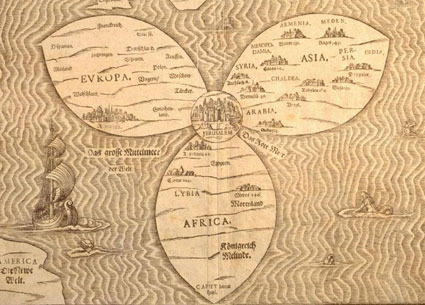
Historically, Christians faced the issue of whether to speak and think in the language of their anti-Christian rulers. If they refused to accommodate, they were accepting utter marginality, and cutting themselves off from any participation in a thriving society. Yet accepting the dominant language and culture accelerated the already strong tendency to assimilate to the ruling culture, even if the process took generations. Although a comparable linguistic gulf does not separate modern Western churches from the secular world, Christians still face the dilemma of speaking the languages of power, of presenting their ideas in the conceptual framework of modern physics and biology, of social and behavioral science. To take one example, when churches view sin as dysfunction, an issue for therapy rather than prayer, Christians are indeed able to participate in national discourse, but they do not necessarily have anything to offer that is distinctive. Nor is there any obvious reason why believers should retain their attachment to a religious body that in its language and thought differs not at all from the secular mainstream. Too little adaptation means irrelevance; too much leads to assimilation and, often, disappearance.
-Philip Jenkins, The Lost History of Christianity, p.245
Sometime in late spring, my wife and I will by traveling to Addis Ababa, the capital of Ethiopia. There at an orphanage, we will be adopting a young girl who will become our fourth child. I’m very excited about the trip!
In reading about Ethiopia, I discovered that the capital is nearly 8000 feet in elevation. That will probably be high enough that the air will seem thin to us. Why is it so high I wondered? Just yesterday I discovered the answer in my reading on church history:
In Africa, low-lying Christian Nubia succumbed to Muslim assaults [in the 1300s)]. Ethiopia survived, but only after relocating its capital and main territories into its mountainous heartland.
-Philip Jenkins, The Lost History of Christianity, p.238
Head for the hills! In the 14th century, Muslims conquered much of the Christian world, including all of northern Africa. Ethiopia is the one exception. In fact, it’s been more or less continuously Christian longer than anywhere else on earth.
Ethiopia was a potent ally for Egypt’s Christians, when they fell under Muslim rule: as late as the fourteenth century, Ethiopia tried to prevent the ongoing persecution in Egypt by threatening to dam the Nile.
-p.56
Dam the Nile. That would throw a monkey wrench in somebody’s day for sure.
I just finished reading what is, admittedly, my first proper history book. It is The Lost History of Christianity, by Philip Jenkins. Lest you see the title and immediately assume it has something to do with the fruity gnostic gospels that have been all the rage this past decade, the subtitle of the book should clarify things: The Thousand-Year Golden Age of the Church in the Middle East, Africa, and Asia – and How It Died.
So to condense the whole book into just a sentence or two: The Roman Catholic church has never been the only game in town. Large prominent networks of Christian churches existed in the middle east, northern Africa, and in India from very early on (200 A.D.). They even still flourished after the rise of Islam. But then, in the 1300’s…. POOF! Now, we in the west barely even remember they ever existed.
In the final chapter he draws some conclusions. In some places, the church dissolved amazingly fast when persecuted. In other places, it holds on even today. What was the difference?
The difference was how grass-roots the Jesus movement became. In old Morocco and Algeria, cathedrals were built and the church had lots of real estate, political influence, and upper-class followers in the cities. If you read Augustine’s letters, you can see that he was very focused on his one metropolitan center. Christianity never penetrated the many outlying villages and folk cultures. The bible stayed in Latin and was not translated into the vernacular. When the Muslims invaded and the government changed hands, the Christians vanished. Everyone who was left found it easy to convert to Islam since their Christian roots did not go deep.
In neighboring Egypt however, the scriptures were translated into the local language (what we call Coptic) very early on. The whole culture, from the learned to the peasant was steeped in Christianity for hundreds of years. The church was not near as dependent on the hierarchy of bishops. When the ecclesiastic framework collapsed under Muslim oppression, the people remained Christian, even influencing their captor’s own religion in turn.
In the sixth century, some five hundred bishops operated in this region; by the eighth century, it is hard to find any. Ironically, one of the paladins of North African Christianity in the third century had been the prophetic church father Tertullian, who wrote the famous line about the blood of martyrs being the seed of te church; yet some centuries later, this very church all but vanished before the Muslim invaders. In this case, seemingly, the seed had falled on stony ground.
In Egypt, by contrast, which has been under Muslim rule since 640, not only does native Christianity survive to this day, but the Coptic Church has often exercised social and political infulence. Even in the twentieth century, it probably still retained the loyalty of 10 percent of Egyptians.
The key difference making for survival is rather how deep a church planted its roots in a particular community, and how far the religion became part of the air that ordinary people breathed. While the Egyptians put the Christian faith in the language of the ordinay people, from city dewellers through peasants, the Africans concentrated only on certain categories, certain races. Egyptian Christianity became native,; its African counterpart was colonial.
-Philip Jenkins, The Lost History of Christianity, p.34,35
Jenkin’s does a very good job of playing neutral in his conclusions, but it’s impossible for him to not take a jab at the prosperity gospel. Tying our faith to worldly success and wealth is, historically speaking, a sure-fire way to lose all your converts as soon as times get tough. If material wealth and political power are preached as a sign of favor with God, then when the economy tanks or war comes (and it will!) then many will lose faith, or switch faith.
He sees the protestant reformation, with it’s printing press and the placing of Bibles in every hand as a huge step toward making Christianity ultimately conquest-proof, despite the internal strife and factions that it created, and still feeds today.
The phrase “Climate Change” is nearly always used as a code-word for global-warming politics, but the phrase CAN be used (after the fact, if honest) more literally to describe long-term weather patterns. The “little ice-age”, Jenkin’s argues, was a critical ingredient in the downfall of Christianity in the near east.
Around the world, in fact, the years around 1300 produced an appalling trend toward religious and ethnic intolerance, a movement that must be explained in terms of global factors, rather than merely local. The aftereffects of the Mongol invasions certainly played their part, by terrifying Muslims and others with the prospect of a direct threat to their social and religious power. Climatic factors were also critical, as the world entered a period of rapid cooling, precipitating bad harvests and shrinking trade routes: a frightened and impoverished world looks for scapegoats. For whatever reasons, Muslim regimes and mobs now delivered near-fatal blows to weakened Christian churches. Even today, jihadi extremists look back to the hard-line Muslim scholars of this very era as their role models in challenging the infidel world.
-Philip Jenkins, The Lost History of Christianity, p.33
Around 1300, the world was changing, and definitely for the worse.
If we seek a common factor that might explain this simultaneous scapegoating of vulnerable minorities, by far the best candidate is climate change, which was responsible for many economic changes in these years, and which increased poverty and desperation across the globe. Populations had swelled during the warming period between the eleventh and thirteenth centuries. Europe’s population more than doubled during these prosperous times, forcing settlers to swarm onto marginal lands. In the late thirteenth century, however, Europe and the Middle Easter entered what was described as the Little Ice Age, as pack ice grew in the oceans, and trade routes became more difficult both by land and sea. Summers became cooler and wetter, and as harvests deteriorated, people starved.
-p.135
Desert also reclaimed much farm-land in the middle-east. The fact that irrigation infrastructure had recently been trashed by the Mongols didn’t help anything either.
Against this social background, states foundered, kings were murdered, and popular revolts and uprisings became commonplace. (This age of crisis is the backdrop to the Scottish national revolution portrayed in the film Braveheart.) Whatever the religious coloring of particular societies, this was a world that directly attributed changes in weather or harvest to the divine will, and it seemed natural to blame catastrophes on the misdeeds of deviant minorities who angered God. Bitter experience taught governments of all faiths not to try to stem the rage of mobs against hated minority grounds. The anti-Christian persecution in Egypt in 1354 followed shortly after the visitation of the Black Death, which killed a third of the residents of Cairo.
-p.136
Even when the Muslim’s conquered much of the middle east and north Africa in the 7th century, they largely let the Christian communities survive. There was some oppression, but not genocide. Large portions of the population was still Christian. This went on for hundreds of years, but it all changed dramatically in the 1300s. This is an excellent example of what Girard calls “the escalation to extremes” and the confusion of acts of God with acts of man. The classic time for a minority to be oppressed or expelled from society is in the wake of a plague (like the Black Death) or a natural disaster such as a devastating earthquake or famine. The society is unified against the innocent victim.
With Satan working behind the scenes in every man’s heart, it is astonishing how EASY it is for people to blame _______ (fill in the blank with minority group of your choice) for all the terrible things happening and rise up in murderous wrath against them. Once the scapegoat has been expelled (or killed) and the people have “let off steam”, then things return to normal, for a while at least. Probably for that generation.
The advance of the gospel, as well as the advance of science has made this sort of scapegoating and hatred ridiculously obvious to us. But we can fall back into it at a moments notice if we’re not careful.
Everyone and their dog wants to emulate the “New Testament Church”. Many movements in fact claim to be doing just that, especially ones on the communal living side of things. We have church planting networks named things like “Acts 29” to invoke the same ideas. As I’ve mentioned before though, despite many whole books be written on the subject, the fact is we really don’t know much about what the early church looked like, not enough to even begin to emulate it or to decide what about it was worth emulating. Jenkin’s here mentions how the annihilation of the near eastern church is Syria cut off what was our last legitimate link to the very first Christians.
Throughout the history of the faith, Christians have used the primitive church as an idealized standard by which to judge their own days, and have tried as far as possible to construct their own faith and practice according to the tenets of New Testament Christianity. Yet the better we understand the authentic worlds of the Christian East, the harder it becomes to contemplate any such vision of a “return to basics.” Timothy [Bishop Timothy of the Eastern Church, 780 A.D.] and his contemporaries genuinely did live in a world that had a recognizable continuity from the earliest church, a pattern of organic development in terms of social and economic arrangements, of language, culture, and geography. We can debate how far that world represented authentic primitive Christianity, but it is quite certain that no later ages could possibly replicate the apostolic world anything like as faithfully. The loss of continuity – the loss of the core – makes moot later efforts to enforce culture-specific regulations of the earliest Christian communities.
-Philip Jenkins, The Lost History of Christianity, p.26
Composer Henry Gorecki died a couple days ago. While a serialist with plenty of heavy avant-garde works under his belt, he will be forever remembered for his beautiful (and very tonal) Symphony #3 (Symphony of Sorrowful Songs). It was commercially successful, received a lot of radio play in 1992 and made him famous.
Predictably, the critics generally hated it.
A musician friend of mine commented today:
I was surprised by the many obituaries, not dismissing, but playing down his 3rd Symphony in favor of his earlier 12-tone/serial/aserial era…
Big ‘C’ Classical music is a fickle bunch – 🙂
To which I was inclined to reply and rant:
Classical musicians are either pragmatic folks who just love music (yeah!), OR, they are snooty ivory-tower dwellers whose only requirement for criticism be that it appear to be as “original” as possible This necessitates that it highlight or applaud an artist’s least visible work, which is USUALLY (though not always) his worst work. So it is no surprise that our fickle music critics claim to dig Gorecki’s early forays into serialism. To mention anything else would risk throwing in their lot with the bumpkins. (After which, they put down their pen, go home and listen to Jefferson Airplane.)
So in short, how come critics (music critics, film critics, etc.) predictably give such high praise to things that are clearly crap?
They have to. Just like Girard says, they are defined by the Other, which ever way they go. The listener can either jump on the bandwagon and buy the new Lady Gaga CD like everyone else. Or, (and this is more prominent in academic circles), they can go out of their way NOT to embrace the same thing as the next guy. Eventually, in the quest to be unique and not appear to be imitating anyone, you are left with only the art in the garbage can. There is a reason it was put there in the first place.
Both people are still being defined by the Other. One embracing, one rebelling.
Look at the story arc of every “indie” rock band. They are cool until they become popular. Then they are accused of being sell-outs and their original fervent fans move on to the next indie band. The next even more cringe-inducing than the last, so as to further conceal their imitation. (For a great analysis of this, from a similar angle, I refer you to this post from an old classmate.)
I don’t think you need much else to go on to “understand” modern art, whether is be sculpture, painting, music, film, dance, or even fashion.
You may protest and say, “Oh! But there is so much more going on then just that. These deep and rich arts cannot be reduced to this Girardian psychological feature!”
Of course not! There is a ton of interesting things in these arts – creativity coming from many directions and taking exciting forms.
All I’m saying at the end is that any theory of aesthetics that does NOT take this psychological phenomenon (mimetic theory) into account is going to quickly drive off the road, go over the ditch, through the fence, and tear through the field, running over cows.
Is something really beautiful or not? Where should the critic start? Aristotle or Thomas Aquinas would be a better (more fundamental) place to start than (unconsciously) comparing/contrasting the work with its peers.
I had coffee today with a friend of mine who is a computer programmer like myself. It’s always fun to talk shop.
It turns out that our histories have some interesting parallels.
I got into programming when I was 10 years old with the sole intent of becoming a video game creator. My friend Patrick and I even wrote a primitive side-scroller for the Commodore 64 title Mutated Samurai Slugs. The Teenage Mutant Ninja Turtles were all the rage that year. I remember later cutting my teeth in development hell trying to get the Direct X binaries to compile under Borland C++. My goal was to remake the Legend of Zelda. I got as far as the map screen. I wasn’t even allowed to own a Nintendo as my parents were certain it would rot my brain, but all I wanted to do was make games after leaving home.
When I went to college in the fall of ’99, I declared a major of computer engineering for this very purpose. I was quickly derailed by God. Maybe. It would probably be more accurate to say I was derailed by the people of God. I came to the conclusion that a career connected to the “entertainment industry” was a much too worldly endeavor and that to be more pleasing to my Lord Jesus (which I very much wished to do and STILL wish to do), I should choose a redeeming career. Being a missionary to Africa or a pastor was of course the best, but if you couldn’t cut the mustard for that sort of devotion, then being a teacher was considered fairly acceptable. That’s how I eventually ended up with a music degree – with the intent to teach. I threw my enthusiasm for path-finding algorithms, adaptive enemy AI, and my pirated copy of SoftImage in the trash. Gaming was bad for the kingdom of God. Or at least very suspect. Kind of like beer.
My friend worked at Microsoft during much of the late 1990’s developing Office products. When the new XBox team was forming (later to be very successful) he had the opportunity to join them. It would have been much more exciting than working on Outlook. Are you kidding? But no. He ultimately declined for similar reasons as mine.
Fast-forward ten years to today. He’s working on a software driver for an electrical engineering company. The device in question will be used to transmit data for several new U.S. military satellites. As he put it today, “I’m helping to make sure we can more accurately kill people.” His work is very respectable. Nobody would raise an eyebrow as if he had run off to Hollywood.
Myself? I’m also a programmer, though I work mostly with databases and websites. If I do my job well, more people will decide to borrow money chasing after the increasingly dubious rewards of higher education. If they can be convinced to go into even more debt, it’s called “enrollment retention”. Of course my job is very respectable as well.
Looking at the situation, we both asked ourselves, “Are we really any better off now?” We traded helping people kill each other’s spaceships with fake bombs in a fantasy world for helping them kill real people in a not-so-distant desert. We traded spending digital gold doubloons in a pirate adventure or even just Monopoly money for being an accessory to bankrupting our neighbors. Was the gaming “entertainment industry” really that much more evil? One thing is certain: The programming and problem solving was much more fun!
(The picture above is called “Trapped!” from a wonderful and whimsical collection of work by artist Daniel Lieske.)
My wife took this picture the other day, looking out the window on the side of the house.
Seasons change. Right now, we are both working overtime on adoption paperwork and extra jobs. There’s been no time for reading and blogging has come to a stand-still.
This will pass at some point. For now, it’s likely that the only thing I’ll get a chance to read in the next month is Charles Williams All Hallows Eve. It’s the next selection for my friends’ book club and I don’t want to let them down. For our January meeting we’ll finally get to my selection (Girard of course!). Last night I stopped for a second to re-read the chapter where he compares “The Terrible Miracle of Apollonius of Tyana” to record of Jesus refusing to stone the woman caught in adultery. Amazing, amazing stuff.
Alright, so one problem that nearly everyone who reads much Girard has is that they start to see mimetic theory everywhere.
I’ve been listening to a lot of U2 lately and it seems that several of their lyrics can be read in this manner without any stretch of imagination!
We fight all the time
You and I… that’s alright
We’re the same soul
I don’t need… I don’t need to hear you say
That if we weren’t so alike
You’d like me a whole lot more
-from “Sometimes You Can’t Make It On Your Own”
I was going to copy down a couple other examples too, but now they’ve slipped my mind. Perhaps next time.