
The Genesis of Desire

In my effort to devour everything the library has related to Girard, I switched gears to psychology and picked up The Genesis of Desire by Frenchman Jean-Michel Oughourlian.
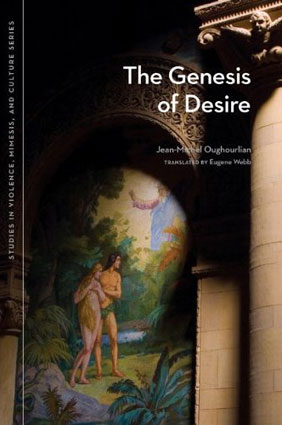
As I mentioned earlier, the book is equal parts awesome and ridiculous.

He begins by giving desire a broad definition: desire is psychological movement. Every movement requires energy, a driving force. The stuff going on inside our head (at least a lot of it anyway) is driven by desire.

At the heart of the book is a long and rather fascinating reading of the Genesis creation narrative.

I was going to say I don’t have time summarize it all here but the truth is I don’t want to put forth the effort! I’m tired and relaxing with a beer after the kids are in bed.

On the downside, his reading is too friendly to evolution to my liking (but that’s not really important) and his treatment of Satan is probably one of the weaker parts. Does Satan stir up mimetic rivalry in man? Absolutely. Does he start off by driving the man and woman apart? Definitely. Is there a model here for marriage and relationship problems? Yes and yes and to the degree that he follows these paths, he makes a lot of sense. I still reject the idea that Satan IS, ontologically, mimetic rivalry. Just as I reject the Satan that is from Milton and not the Bible, I also reject the Satan that is an imaginary devil that suddenly ceases to exist at all after a bit of philosophical hand-waving.

I like his conclusion about the topic that titles the book. You think desire is evil and comes from Satan? Nope. He is not the “unmoved mover” of our thoughts, good and evil. No, it’s God. God desires and we are made in his image. He gives us the breath of life. He gave our minds that first PUSH that makes us different from all the other creatures. I can make this sync with Sayer’s The Mind of the Maker and also Tolkien’s theology of sub-creation. Awesome.

He spends another chapter (there are only 5 chapters, all of them rather long) discussing the discovery of what some neuroscientists are calling “mirror neurons”. These apparently can be observed firing when we desire and even when we perceive another person desiring (the important part). This part might make a good hour on the Discovery channel if it had some good visuals, but just talking about it and summarizing the data is not particularly convincing. I don’t care about this part much though I’m assuming this stuff is mostly true.

His section on how marriage relationships both gather their romantic momentum AND derive their conflict from mimetic rivalry between the couple is really quite good. It describes in different language what Larry Crabb describes in his “I Love You –> I Need You –> I Hate You” explanation of close relationship problems. Some time I really want to synthesize these two explanations. I think they can both benefit from each other. It gives Crabb’s work a more solid footing to stand on. Oughourlian could use a bit less abstraction.

Along these lines he throws out a funny quote by Groucho Marx:

“Never trust couples who hold hands: if they won’t let go of each other, it’s because they’re afraid they might kill each other.”

Going back to the Genesis narrative for a second, I was struck by this passage on the tree of knowledge of good and evil. I am often delighted when I find an old traditional theology that I’ve held on to from childhood replaced by something that makes WAY more sense. What is amazing is that you will often find it backed up by the church father’s too. Check this out:

What IS the “knowledge of good and evil”? It is not a form of objective knowledge or knowledge of how to do something: Adam knows his way around his world perfectly; the garden is his domain, and it is he who, in verses 19 and 20, gives names to all the animals that God parades before him. Nor is that knowledge a form of moral discernment or a capacity for judgment: Adam already has that, otherwise God’s counsel or warning would convey no meaning to him.

You got that? It’s not moral discernment. “Oh my gosh! This over here is good and that over there is evil. Holy crud! I never knew!” Adam already understands that. God gave him the command earlier to not eat the fruit. Eve knows this too and knows to resist the temptation even, at first. So what is the knowledge of good and evil?

According to the tradition of Saint Augustine and Saint Thomas Aquinas, the “knowledge of good and evil” has to do with a claim to moral autonomy: to eat of the fruit of this tree is to appropriate the knowing of good and evil to oneself, to set oneself up as the judge of what is good and what is evil. It is therefore an attempt to overturn the divine order.

That is one interesting way to read it. Even more interesting from my point of view is that suggested in the commentary of Josy Eisenberg:

“This tree is the place where Good and Evil are confused together. To speak of fusion is to speak also of confusion…this is the new situation with which Adam is confronted: there exists a tree – a world – where Good and Evil are in a mixed state.”

And further on, Eisenberg adds:

The mixture of God and Evil in all things is itself, according to Jewish mysticism, the dominant characteristic of the human story.”

Developing this idea, I propose to show that if the forbidden tree gives rise to desire, it is mimetic desire that makes good and evil spring from ths prohibition and, with the, all the relative, subjective, and generative differences of rivalry.

-p.49

Later he goes on to explain how all relationships are mimetic. We imitate each other. The one exception being our relationship with God, who does not change. We imitate Christ, but Christ remains unstained by rivalry. In him alone can we find peace.

At the beginning and end of the book he uses some specific stories or case studies involving his own clients. I wish he had done this more. As Mary Dupree (one of my best professors) always said, “Be specific. Use examples!”.

I must say, I found his stories of torrid romances and affairs really rather out of control. My initial thought was that, marriage, if nothing else, puts a damper on the kind of crazy emotional trouble some of his subjects have put themselves through. Strengthening just the institution of marriage alone, even if it does not deal with the underlying problems of mimetic rivalry, will still go a LONG way toward softening the damage people do to their friends, family, and especially children. But we live in a world where our lovers may come and go relatively easily and rapidly. Are we the happier for it? Quite the contrary.

On a side note, another example of stuff in the book that I didn’t find helpful was his regular discussion of hypnosis. I guess I don’t know very much about it, but I find it impossible to take seriously.

All in all, good stuff lurking in here and it definitely props up some of the Girard-based ideas I’ve been working out lately.

Why so few posts of late?

1. My laptop broke and was in the shop getting the motherboard replaced. Apparently 2007 Mac Books have a defect in the video card.

2. The kids have been as crazy busy as ever. Crazier and busier as evererer.

3. I read the collection of essays, For Rene Girard. Lots of interesting stuff in there, but not much that makes for good blog posts. I will be posting a few notes from this soon though.

4. I read Jean-Michel Oughourlian’s The Genesis of Desire. It was about equal parts awesome and ridiculous. It definitely gives me some paths to explore for combining the work of Girard and Larry Crabb though.

5. I read Robert Alter’s The Art of Biblical Narrative. (See how much reading I get done when I don’t have my computer!) I finally understand where Peter Leithart is coming from now with some of his analysis. Much of it is in the same vein as this. I was previously pretty unfamiliar with this form of Bible scholarship.

6. I’m beginning to realize that my note-taking method isn’t working anymore. All the thoughts and ideas I want to get down on paper are increasingly becoming to long to describe in a paragraph. Most of the supporting material I’ve been digging up on Girard requires too much context to communicate. I think I need to move to some sort of running commentary/outline method of notetaking instead of just marking and jotting down interesting quotes.

7. And finally, I purchased a video game for the first time in many years. Yes, what a terrible and irresponsible thing to do, right?

John Henry Newman quotes

Gil Bailie, in his recent contribution to a collection of essay’s honoring Rene Girard, throws out some great quotes by early 17th century Anglican (and later RC theologian) John Henry Newman. They all come from a set of sermons titled “Chiefly on the Theory of Religious Belief”.

This is the best:

Nothing is so easy as to be religious on paper

And here we find him intuitively citing the mechanics of mimetic rivalry:

The warfare between Error and Truth is necessarily advantageous to the former.

So fighting about something is rigged, from the beginning to at least favor error! How about a much more powerful alternative to reasoned argument?

Men persuade themselves, with little difficulty, to scoff at principles, to ridicule books, to make sport of the names of good men; but they cannot bear their presence: it is holiness embodied in personal form, which they cannot steadily confront and bear down: so that the silent conduct of a conscientious man secures for him from beholders a feeling different in kind from any which is created by the mere versatile and garrulous Reason.

Good stuff.

Jenkins

Peter Leithart, via his blog, has turned me on to the work of Philip Jenkins. I’ve poked around a read a few interview in the past couple days. This guy’s work on church history is blowin’ my mind. Rockin’!

Misc notes on Young Man Luther

It’s been several months ago since I read Erik Erikson’s Young Man Luther. If I don’t blog about something right away, I sometimes forget exactly why I found a certain passage of interest. So I’m just going to dump the rest of my notes here with a few comments. Keep in mind that Erikson is a secular author and many of his ideas are not exactly friendly to orthodoxy. Nevertheless, I appreciate some of the psychological insights.

On indoctrination and why some monks are great men and other monks really pathetic.

Any indoctrination worth its ideological salt also harbors dangers, which bring about the unmaking of some and the supreme transcendence of others.

-p.150

On how the central organized  core of a movement can always disavow responsibility for the fringe elements. Think the Taliban vs. most Islamic states or the Christians who murder abortion doctors. The disavowments don’t do anything to make the fringe go away though. They don’t reach below the surface.

As in the case of all terror, the central agency can always claim not to be responsible for the excessive fervor of its operatives; in fact, it may claim it has dissuaded its terrorists by making periodic energetic pronouncements. These, however, never reach the lowly places where life in the raw drives people into being each others’ persecutors, beginning with the indoctrination of children.

-p.182

On the demise of the Roman Catholic church’s dominance due to many, many things. Luther was only a small part of the puzzle.

The masses could participate only as onlookers, as the recipients of a reflection of a reflection. This parasitic ceremonial identity lost much of its psychological power when the excessive stylization of the ruling classes proved to be a brittle defense against the era’s increasing dangers; the plague and syphilis, the Turks, and the discord of popes and princes. At the same time, the established order of material and psychological warfare (always so reassuring a factor in man’s sense of borrowed godliness) was radicaly overthrown by the invention of gunpowder and of the printing press.

-p.186

On why monasticism is probably not the best thing for a young person.

Some monastic methods systematically descend to the frontiers where all ego dangers mut be facd in the raw – were an overweening conscience is appeased through prayer, drives tamed by asceticism, and the pressure of reality is itself defeated by the self’s systematic abandonment of its identity. But true monasticism is a later development and is possible only to a mature ego. Luther knew why he later said that nobody under thirty years of age should definitely commit himself to it.

-p.218

On how life is different for the young person whose thoughts are dominated by theology. I can raise my hand to some of this. It makes childhood shorter for sure.

This integrity crisis, last in the lives of ordinary men, is a lifelong and chronic crisis in a homo religiousus. He is always older, or in early years suddenly becomes older, than his playmates or even his parents and teachers, and focuses in a precocious way on what it takes others a lifetime to gain a mere inkling of: the questions of how to escape corruption in living and how in death to give meaning to life. Because he experiences a breakthrough to the last problems so early in his life maybe such a man had better become a martyr and seal his message with an early death; or else become a hermit in a solitude which anticipates the Beyond. We know little of Jesus of Nazareth as a young man, but we certainly cannot even begin to imagine him as middle-aged.

-p.261

Maybe.

From the oldest Zen poem to the most recent psychological formulation, it is clear that “the conflict between right and wrong is the sickness of the mind.”

-Quoted from Seng-ts’an, Hsin-hsin, Ming, p.263

I loved the last paragraph of this book where the author suddenly brings us into his study overlooking a town in Mexico:

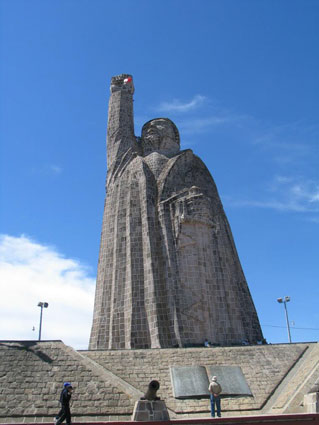
The area of nearby Lake Patzcuaro is dominated by an enormous statue erected on a fisherman’s island. The statue depicts the revolutionary hero Morelos, an erstwhile monk, his right arm raised in a gesture much like Luther’s when he spoke at Worms. In its clean linear stockiness and stubborn puritanism the statue could be somewhere in a Nordic land; and if, in its other hand, it held a mighty book instead of the handle of a stony sword, it could, for all the world, be Luther.

-p.267

Our need to personify beliefs

All realism, in the medieval sense, leads to anthropomorphism. Having attributed a real existence to an idea, the mind wants to see this idea alive, and can only effect this by personifying it. In this way allegory is born. It is not the same thing as symbolism. Symbolism expresses a mysterious connection between two ideas, allegory gives a visible form to the conception of such a connection. Symbolism is a very profound function of the mind, allegory is a superficial one. It aids symbolic thought to express itself, but endangers it at the same time by substituting a figure for a living idea. The force of the symbol is easily list in the allegory.

The Church, it is true, has always explicitly taught that sin is not a thing or an entity. But how could it have prevented the error, when everything concurred to insinuate it into men’s minds? The primitive instinct which sees sin as stuff which soils or corrupts, which one should, therefore, wash away, or destroy, was strengthened by the extreme systematizing of sins, by their figurative representation, and even by the penitentiary technique of the Church itself. In vain did Denis the Carthusian remind the people that it was but for the sake of comparison that he calls sin a fever, a cold and corrupted humour – popular thought undoubtedly lost sight of the restrictions of dogmatists.

-Erik Erikson quoting Huizinga, p.187, The Waning of the Middle Ages

I’d love to explore this stuff further at some point. I think Girard could be bought it in to assist with some mimetic theory. The benefit would be a combing through theology to make sure we aren’t falling into this psychological trap. Or, perhaps, from the other end, a combing through theology so as to make it more incarnation. As far as our need for anthropomorphism goes, God was definitely throwing us a bone when he sent Jesus Christ. Cool.

Be an apocalyptic hero!

This should be my last note on Battling to the End.

My big excuse is eschatology. Is eschatology compatible, as you would like it to be, with heroic resistance to the course of events?

Stop and digest that one. “Heroic resistance to the course of events”. This is essentially striving to “change the world for the better”. When Sam says (in the movie, NOT the book) “There’s some good in this world. And it’s worth fighting for!” Is this just a sham? No Girard says it’s worth it:

Yes, in so far as it can produce examples that can be imitated, but they will always remain “invisible to the eyes of flesh,” as Pascal says. No man is a prophet in his own land.

When asked in a recent interview what we can do, his answer was: “We can behave like Christians.”

We are mimetic. We cannot transcend this. What can be done? We can find good models to imitate. This begins with the imitation of Christ. We can also BE good models, first to our children and then to our neighbors.

…why was there no eschatology in the Christianity of the seventeenth century? It is very interesting to wonder about the various contexts that Christianity has had. In the Middle Ages, it had apocalyptic periods in which Christians realized they were in the process of completely failing. However, Christianity has always been too young for eschatology. Perhaps it is ready now, for what is threatening us has become tangible.

-Rene Girard, Battling to the End, p.106

It’s true that theologians of all stripes have cared more about the apocalypse in the last 50 years than in seeminly all of human history. Whatever their reasons, perhaps the time is finally ripe. Not necessarily ripe to happen as we think, but a ripe time to consider it. It will languish on the back shelf no longer.

Peace as holiness

Sin consists in thinking that something good could come from violence. We all think this because we are all mimetic, and we stick to our beloved duel.

-Rene Girard, Battling to the End, p.105

Christ is not a soothsayer but a prophet

This is as close as Girard ever gets to talking directly about the apocalypse in the fashion that most authors spend hundreds of pages doing.

For there will be great distress on the earth and wrath against this people; they will fall by the edge of the word and be taken away as captives among all nations; and Jerusalem will be trampled on by the Gentiles, until the times of the Gentiles are fulfilled. (Luke 21:23-24)

All the exegetes want to see this as an allusion to the destruction of the Temple by Titus in A.D. 70, and they conclude from this that Luke’s text is later than the three others. These theories are completely uninteresting because the fall of Jerusalem does not mean only A.D. 70, but also 587 B.C. The Evangelists were continuing the Jewish prophetic tradition, which was attentive to “signs of the times.” Here too human history is caught within that of God. The fall of Jerusalem is thus primarily an apocalyptic theme: Christ is not a soothsayer but a prophet. One of the wonders of the texts is that they make it impossible to know whether or not they are speaking of Titus. However, historians mix everything up without even realizing that the mixture is part of what they are talking about, and that what they are talking about could not care less about them.

There is no doubt that the apocalyptic passages refer to a real event that will follow the Passion, but in the Gospels they were placed before it. The “time of the Gentiles” is thus, like the seventy years of servitude to the King of Babylon in Jeremiah, an indefinite amount of time between two apocalypses, two revelations. If we put the statements back into an evangelical perspective, this can only mean that  the time of the Gentiles, in other words, the time when Gentiles will refuse to hear the word of God, is a limited time. Between Christ’s Passion and his Second Coming, the Last Judgment, if you prefer, there will be this indefinite time which is ours, a time of increasingly uncontrolled violence, of refusal to hear, of growing blindness. This is the meaning of Luke’s writings, and this shows their relevance. In the respect, Pascal says at the end of the twelfth Provincial Letter that “violence has only a certain course to run, limited by the appointment of Heaven.”

-Rene Girard, Battling to the End, p.111

I think we end up using a too-generic definition of prophet when talking about figures in the bible. They didn’t know the future like someone gazing into a crystal ball and surfing the internet news sites for next year. Instead, they had specific messages to deliver, to warn the people to forsake their violence and idolatry. John the Baptist, and then Jesus Christ, (when he talks about the future) is still doing the same thing. I’m sure someone has developed this idea more somewhere else, but I’m not sure where.

As or what this says about the mechanics of the apocalypse, I guess Girard can be placed in the “getting worse before it gets better” camp which would seem at odds with post-millennialism, but perhaps the two can still be reconciled.

“The time when Gentiles will refuse to hear the word of God, is a limited time” is certainly a hopeful statement.