Virtuosic front

I’m not going to quote the passage here (from p.143) because it’s too wrapped up on context. However, what I took away from it is this:

When we are imitating someone, or wishing we could be like them or possess what they have, their skills or wealth, one way that we hide this rivalry is by explaining them as a virtuoso. This is something we can appreciate. It makes them no longer threatening to us personally. It puts us the right distance apart from the other. On one hand, this is good, but it could also be a way that we are covering up a rivalry or hatred that still exists.

Given the extent of its growing control, escaping from mimetism is something only geniuses and saints can do.

-Rene Girard, Battling to the End, p.133

Apocalypse and “the failure of historical Christianity”

No man is a prophet in his own land because no land wants to hear the truth about its own violence. It will always try to hide it in order to have peace, but the best way to have peace is to make war. This is why Christ suffered the fate of prophets. He came close to humans by throwing their violence into a panic, by showing it naked to all. In a way, he was doomed to failure. The Holy Spirit, however, is continuing his work. It s the Holy Spirit that teaches us that historical Christianity has failed and that the apocalyptic texts will now speak to us more than they ever have before.

-Rene Girard, Battling to the End, p.103

Yet more stumbling blocks for Christians taking Girard seriously. Too bad. It’s easy to read this sort of thing and make a funny face. “Historical Christianity has failed?” What are you smoking?

The language can be confusing at times. He is only talking about one specific aspect of Jesus’ impact on the world. This discussion has nothing to do with the nature of Christ, or with the atonement, or any of that. Jesus didn’t “fail” in any possible sense. What has “failed” is that Jesus’ exposition of violence was not enough to convince us to lay down our swords. Like the words of any true prophet, we refused to listen to them. The Holy Spirit stays on perpetuating the truth though. It is like a tiny bit of yeast working it’s way through the loaf of history.

My big question, both before and after reading this book, and listening to several interviews with Girard, his how to reconcile this with post-millenialism.

I have a lot of post-millenialism friends. In fact, I see much of Girard’s work as propping up post-millenialism. The yeast keeps working it’s way through the loaf until the Kingdom come in full. This could easily take another thousand years.

On the other hand:

Idealogical wars, monstrous justifications of violence, have led humanity to the stage beyond war where we are today. The West is going to exhaust itself in its fight against Islamic terrorism, which Western arrogance has undeniably kindled. Clausewitz thought violence would continue to erupt in international conflicts in the nineteenth century. Nations existed to contain the revolutionary contagion. In 1815, the Congress of Vienna was still able to put an end to the War of the Sixth Coalition That [whole] era is over Violence can no longer be checked. From this point of view, we can say that the apocalypse has begun.

-p.210

I’m not sure what kind of cake Girard is baking. I don’t have any good answers on this yet.

When asked in an interview what we could do to turn this around, he answered “start behaving like Christians”. I suppose my post-millenialist friends would answer, “start by reforming worship”.

Struggling with intuition

Girard makes an interesting statement in discussing Clausewitz’s book On War.

We can suggest that, on one hand, Clausewitz is a man of the Enlightenment and that, on the other hand, at the level of his deep thought, he is not. I tend to think that the reason why he could not finish his book, and was constantly rewriting it until his death is because of that: he could not bridge the gap between his rationalist side and the intuition that he did not completely describe, but that haunts him. If you describe the intuition in too much detail, you might go too far. Or perhaps it cannot be thought about directly and is FOR THAT VERY REASON interesting. This is the mystery in his book, and perhaps also its hidden profundity.

-Rene Girard, Battling to the End, p.81

Clausewitz was unable to use his enlightenment tools to describe the deep intuitive thought that would not let him go.

To do that would require either a poet or a God who is not always rational.

For this reason, Girard insists that all of his books are indirectly apologetics for Christianity. It is the only framework where you can make everything fit.

On a side not, this phenomenon about describing intuition can be used to explain why so many very good men have written a stack of lousy books. It’s the same reason that many of the world’s greatest musicians are awful teachers. There are unable to take others along with them because they are unable to break it down and understand how THEY got there in the first place. To do this properly is a gift.

No god is even more confusing

God is confusing, yes. But the image of man without God is even more so.

The knot of our condition takes its twists and turns in this abyss, so that man is more unintelligible without this mystery than this mystery is unintelligible to man.

-Blaise Pascal, Pensees, 37

Girard quotes Pascal a lot. He sees Pascal as intuitively confirming many parts of mimetic theory, even though he was not able to systematically explain it then.

We want to hear the truth less and less

In descriptions of extreme duels, of which there are many in medieval literature, you always find a hint of a kind of love, passion. This is the contradiction that is so difficult to describe. It is said that analyzing mimetic mechanisms is obsessive, but no one admits that the obstinacy comes from the fact that people do not want to read, except through the prisms of infinitely more opaque systems. Apologetics, especially when apocalyptic, has no purpose other than to open the eyes of those who do not want to see, and what we do not want to see is precisely that reconciliation is the flip side of violence, the possibility that violence does not want to see.

People do not want to be told that they are not autonomous, that others are acting through them. Indeed, that they are not autonomous, that others are acting through them. Indeed, they want to hear it less and less, and are therefore more and more violent. Christ caused a scandal because he said this and revealed to humanity that the Kingdom is approaching at the same time that humanity’s madness is growing.

-Rene Girard, Battling to the End, p.72

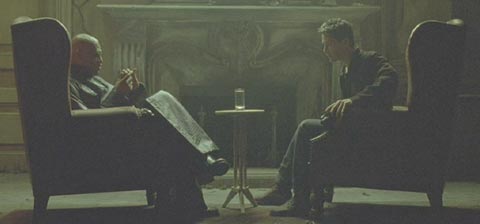
Morpheus: I see it in your eyes. You have the look of a man who accepts what he sees because he is expecting to wake up. Ironically, that’s not far from the truth. Do you believe in fate, Neo?

Neo: No.

Morpheus: Why not?

Neo: Because I don’t like the idea that I’m not in control of my life.

Morpheus: I know *exactly* what you mean.

On great texts

The virtue of great texts is that they survive different interpretations, and always have new things to tell us. We have not finished being surprised.

-Rene Girard, Battling to the End, p.61

Girard’s test of a prophet

The false prophet will want people to imitate him. The true prophet will have absolutely none of that. They only point the way.

Christ warns us in turn about the dangers of the Antichrists, in other words, those who want to be imitated. The aspect of Christ that has to be imitated is his withdrawal. Holderlin made this dramatic discovery. This is why in the Bible we never find a fight to the death like that of the prophets of Thebes, for example, Tiresias and Oedipus. A fight to the death is impossible because in the Bible the point is precisely to give up claims to difference. There is thus something anonymous and impersonal in the Songs, even though the Servant sometimes speaks on his own behalf and sometimes on behalf of the community that condemned him and that later understood what it had done.

An unambiguous answer is now possible to the question of what distinguishes true prophecy from false: true prophetic words are rooted in the truth of the consenting scapegoat. The consenting scapegoat does not claim to incarnate that truth; he says that truth is other and that it is more specifically there, outside of the system. However, the prophet is not truth, for otherwise other “prophets” would want to seize it. The prophet bears witness to it, announces it, precedes it and in a sense follows it.

-Rene Girard, Battling to the End, p. 51

Who passes this test? John the Baptist. Quite a few of the catholic saints. Martin Luther on a good day. Paul on a good day (imitate me as I imitate Christ).

Who utterly fails the imitation test? David Koresh. Joseph Smith. Muhammad. Nothing made them happier than to reproduce themselves in their followers. Pointing to God was a front.

We are stuck in the middle of history ourselves

You cannot view [history] from above or get an eagle-eye view of the events. I myself though that was possible when I was writing Things Hidden since the Foundation of the World (1978), in which I imagined Christianity provided the point of view from which we could judge violence. However, there is neither non-sacrificial space, nor “true history”.

I’ll admit that when I read Things Hidden I found his passages on the “non-sacrificial” view of history completely confusing. It is pleasant to discover that he has now thrown most of this out.

I reread my analysis of St. Paul’s Epistle to the Hebrews, which was my last “modern” and “anti-Christian” argument. The criticism of an “historical Christianity” and argument in favor of a kind of “essential Christianity,” which I thought I had grasped in a Hegelian manner,m was absurd. On the contrary, we have to think of Christianity as essentially historical, and Clausewitz helps us do so. Solomon’s judgment explains everything on this score: there is the sacrifice of the other, and self-sacrifice; archaic sacrifice and Christian sacrifice. However, it is all sacrifice.

We are immersed in mimetism and have to find a way around the pitfalls of our desire, which is always desire for what the other possesses. I repeat, absolute knowledge is not possible. We are forced to remain at the heart of history and to act at the heart of violence because we are always gaining a better understanding of its mechanisms. Will we ever be able to elude them? I doubt it.

-Rene Girard, Battling to the End, p.35

A communion of saints

Many of Girard’s books are written in the form of a conversation with one of his friends or colleges. Indeed, sometimes they are only slightly edited transcripts.

He mentions this in the introduction.

Conversation’s blessings include surprises and new connections. Little by little, we came to see that various authors, poets and exceptional people were crucial to our discussion. A whole constellation of writers and thinkers finally merged with our thinking. I consider this a little like the communion of saints.

-Rene Girard, Battling to the End, p.xvii

I have not encountered this before. It can be a bit meandering, but pleasantly unpredictable as well. I am accustomed to reading essays that are highly polished, with all the blemishes of the author under wraps. It is fun to find passages like the following.

Girard’s conversation partner, Benoit Chantre asks about an idea that was just brought up and suggests that a lot may be gained by comparing it to the philosophy of Hegel. Girard replies:

You are asking me to take to its logical conclusion an intuition that came to me while we were speaking. That would require philosophical knowledge that I lack.

If everyone is certain of guilt, watch out

A sacrificial resolution is no longer feasible [to resolve our social conflicts]. Sacrifice no longer works now that Christianity has revealed the mechanism of unanimity. Archaic religions were based on a complete absence of criticism regarding this unanimity.

Even though Jesus Chris is the chief way that Satan’s scapegoat mechanism is revealed, the Jews were givin this revelation throughout their history as well, though it is not as pronounced. Still, there were able to see it operating clearly at times.

This is why in one of his Talmudic readings Levinas says that if everyone agrees that an accused should be convicted, then he should be released right away, for he must be innocent.[!!]

-Rene Girard, Battling to the End, p.23