Our trivial selves

With tongue firmly planted in cheek…

When one considers our culture’s devotion to acquisition, celebrity, distraction, and therapy, it is hard not to think that perhaps our vision as a people has narrowed to the smaller preoccupations and desires of individual selves, and that our whole political, social, and economic existence is oriented toward that reality.

On the other hand, perhaps that is simply what happens when human beings are liberated from want and worry, and we should therefore gratefully embrace the triviality of a world that revolves around television, shopping, and the internet as a kind of blessedness that our ancestors, oppressed by miseries we can scarcely now imagine, never even hoped to enjoy in this world.

-David Bently Hart, Atheist Delusions: The Christian Revolution and its Fashionable Enemies, p.230

Hart and Girard: Unworldy tenderness sown in human consciences

Several times while reading Hart’s book on Christian history I found myself saying, “He should totally cite Rene Girard here! That would totally beef up his argument”. Alas, the Frenchman is nowhere to be found. Hart has come to some of the same conclusions though.

“Christendom” was only the outward, sometimes majestic, but always defective form of the iteration between the gospel and the intractable stuff of human habit.

The more vital and essential victory of Christianity lay in the strange, impractical, altogether unworldly tenderness of the moral intuitions it succeeded in sowing in human consciences.

If we find ourselves occasionally shocked by how casually ancient men and women destroyed or ignored lives we would think ineffably precious, we would do well to reflect that theirs was – in purely pragmatic terms – a more “natural” disposition toward reality.

-David Bently Hart, Atheist Delusions: The Christian Revolution and its Fashionable Enemies, p.213

The unworldly tenderness sowed in human consciences. The heart of Girard’s theory is explaining the mechanism for exactly how this happened. After Jesus, there is just no going back to the way things were. Ever. The deep lie that allowed us to ignore innocent victims has been permanently unmasked.

The only true revolution in the history of the west

More good stuff on how modern unbelief is essentially post-Christian. That is, it is defined throughout by Christian ideas and morals.

Much of modernity should be understood not as a grand revolt against the tyranny of faith, not as a movement of human liberation and progress, but as a counterrevolution, a reactionary rejection of a freedom which it no longer understands, but upon which it remains parasitic.

Even when modern persons turn away from Christian conviction, there are any number of paths that have been irrevocably closed to them – either because they lead toward philosophical positions that Christianity has assumed successfully into its own story, or because they lead toward forms of “superstition” that Christianity has rendered utterly incredible to modern minds.

A post-Christian unbeliever is still, most definitely. for good or for ill, post-CHRISTIAN. We live in a world transformed by an ancient revolution – social, intellectual, metaphysical, moral, spiritual – the immensity of which we often only barely grasp…It is perhaps the only true revolution in the history of the West.

-David Bently Hart, Atheist Delusions: The Christian Revolution and its Fashionable Enemies, p.108

Pay special attention to “philosophical positions that Christianity has assumed successfully into its own story”. That is the redemption of all culture right there!

Christianity was more of a revolution than we realize

Some historians say that any old cult could have taken over the western world had the emporer just enforced it’s practice. Christianity just happened to win the lotto. That’s more baloney though. We lose sight of how incredible it was since we are 1700+ years removed from it. We don’t realize how special Christianity really was back then and still is now, besides repeated attempts by modernism to write it off as just some slightly interesting psychological phenomenon. As Hart puts it in several places, Christianity may be the only true revolution the western world has ever experienced.

What is beyond debate is that by the time of the last great persecution and of Constantine’s ascent to the purple, Christians may have been a minority in the empire, but they were a strong minority, large enough to seem both a treat and a credible alternative to the ancient customs of the pagan world. Whatever might have happened had imperial history taken another turn…what did happen – what had been happening by that point for centuries – was that untold thousands of pagans chose to abandon the ways of their ancestors and to embrace a faith of so radically different a nature that they were obliged to leave almost everything proper to their old religious identities behind. This required not merely a change of habits but a total conversion of will, imagination, and desire. Why, then, did it happen? What made the new faith, and even the risks that attended it, so very preferable to a world of beliefs and practices that had endured with profuse and solemn majesty for millennia?

-David Bently Hart, Atheist Delusions: The Christian Revolution and its Fashionable Enemies, p128

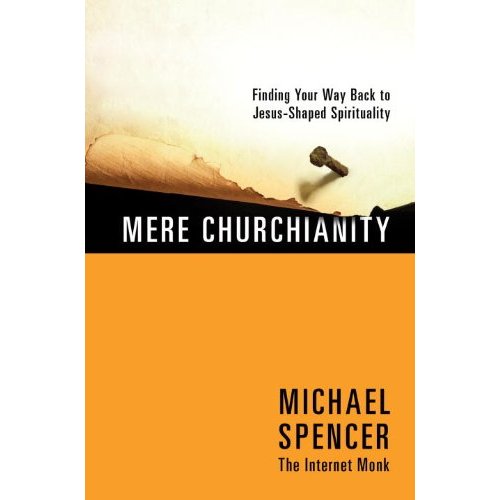
Pre-order Mere Churchianity, Michael Spencer’s new book

I think Michael’s writing at InternetMonk.com has been by far the most helpful thing for my Christian walk the past four years. I quite seriously don’t know where I’d be without his guidance and that of some of the rest of the community that blog in the general vicinity. His first book is coming out this September and it is now available to pre-order from Amazon.

Michael’s also been diagnosed with cancer and is in rough shape. Get a copy, or else.

I just ordered two.

This is going to be a good one folks.

Perhaps the ultimate anti-fundy quote

Reformed theologian Bavinck on how the Catholic doctrine of justification by works is superior to Protestant doctrine of justification by correct doctrine:

[W]e must remind ourselves that the Catholic righteousness by good works is vastly preferable to a protestant righteousness by good doctrine. At least righteousness by good works benefits one’s neighbor, whereas righteousness by good doctrine only produces lovelessness and pride. Furthermore, we must not blind ourselves to the tremendous faith, genuine repentance, complete surrender and the fervent love for God and neighbor evident in the lives and work of many Catholic Christians. The Christian life is so rich that it develops its full glory not just in a single form or within the walls of one church.

Via Bob Myers at the BHT

It’s good to be human

Wright on not being a soul trapped in an evil material body:

Being human is good; being an embodied human is good; what is bad is being a rebellious human, a decaying human, a human dishonoured through bodily sin and bodily death. What Paul desires, to take his terminology at face value, is not to let the soul fly free to a supposed astral home, but to stop the ‘soul’, the psyche, from being the animating principle for the body. Precisely because the soul is not, for him, the immortal fiery substance it is for Plato, he sees that the true solution to the human plight is to replace the ‘soul’ as the animating principle of the body with the ‘spirit’ or rather, the Spirit.

-N.T. Wright, The Resurrection of the Son of God, p.346

Wright on our future in the gospels

Our theology of resurrection and eschatology is informed more in the epistles, but if you JUST read the gospels what do you get?

…the significant thing to notice here is this: neither ‘going to heaven when you die’, ‘life after death’, ‘eternal life’, nor even ‘the resurrection of all Christ’s people’, is so much as mention in the four canonical resurrection stories. If Matthew, Mark, Luke, and John wanted to tell stories whose import was ‘Jesus is risen, therefore you will be too’, they have done a remarkably bad job of it. Instead, we find a sense of open-ended commission within the present world: ‘Jesus is risen, therefore you have work ahead of you.’

-N.T. Wright, The Resurrection of the Son of God, p.603

Interesting.

The myth of how bad medieval war was

Those terrible dark ages with their religious crusades… compared to what? The twentieth century?

The European wars of the sixteenth and seventeenth centuries were something altogether different [than anything before]. They inaugurated a new age of nationalist strife and state violence, prosecuted on a scale and with a degree of ferocity without any precedent in medieval history: wars of unification, revolutions, imperial adventures, colonialism, the rebirth of chattel slavery, endless irredentism, ideologically inspired frenzies of mass murder, nationalist cults, political terrorism, world wars – in short, the entire glorious record of European politics in the aftermath of a united Christendom.

Far from the secular nation-state rescuing Western humanity from the chaos and butchery of sectarian strife, those wars were the birth pans of the modern state and its limitless license to murder. And religious allegiances, anxieties, and hatred were used by regional princes merely as pretexts for conflicts whose causes, effects, and alliances had very little to do with faith or confessional loyalties.

-David Bently Hart, Atheist Delusions: The Christian Revolution and its Fashionable Enemies, p. 89

And continuing later:

Part of the enthralling promise of an age of reason was, at least at first, the prospect of a genuinely rational ethics, not bound to the local or tribal customs of this people or that, not limited to the moral precepts of any particular creed, but available to all reasoning minds regardless of culture and – when recognized – immediately compelling to the rational will.

Was there ever a more desperate fantasy than this?

We live now in the wake of the most monstrously violent century in human history, during which the secular order (on both the political right and the political left), freed from the authority of religion, showed itself willing to kill on an unprecedented scale and with an ease of conscience worse that merely depraved. If ever an age deserved to be thought an age of darkness, it is surely ours.

-p.106

More materialistic magic

This is great stuff. It reinforces what I wrote earlier about the New Age movement being just another expression of selfish hedonism and materialism – not anything resembling a religious movement.

In truth, the rise of modern science and the early modern obsession with sorcery were not merely contemporaneous currents within Western society but were two closely allied manifestation of the development of a new post-Christian sense of human mastery over the world. There is nothing especially outrageous in such a claim. After all, magic is essentially a species of materialism; if it invokes any agencies beyond the visible sphere, they are not supernatural – n the theological sense of “transcendent” – but at most preternatural: they are merely, tat is to say, subtler, more potent aspects of the physical cosmos, the instrumental subjection of nature to humanity, and the constant increase of human power.

Hence, there was not really any late modern triumph of science over magic, so much as there wa a ntural dissolution of the latter into the former, as the power of science to accomplish what magic could only adumbrate became progressively more obvious.

-David Bently Hart, Atheist Delusions: The Christian Revolution and its Fashionable Enemies, p.82

This also fits in nicely with my interest in how the post-enlightenment attraction to magic sees it as more of a “natural” phenomenon, a branch of science, than something that might actually interact with God and/or REAL angels and demons. Science didn’t really conquer magic. It overshadowed it and consumed it, but the will of man didn’t change.