
Alright so this brings back some memories, some not so long ago:
“Romans Road, Evangelism Explosion, The Four Spiritual Laws, The Bridge – approach the “lost person” from a position of power. They come to the lost person with a prepackaged message that assumes one gospel fits all. They assume the questions to be asked and the answers that shall be given before we have even listened. (intellectually, and more important attitudinally – we are saying with our posture that we already know what you need, what your problem is, and we’re right and you’re wrong – none-Christians come away feeling like “I’m one of your ‘cases’”). I contend this is contrary to the gospel. For the gospel always comes incarnationally: i.e. humbly, entering in to hear each person/ culture in its own language. The one message fits all implies that everyone has the same problem. Only in Christendom, where everyone was already pre-initiated and where the cultural problems are homogeneous, would this make sense..”
–David Fitch, When They Will Not Come, (via the BHT, via Next Reformation)
I remember being show the Roman’s Road in sermon’s and gospel presentations all growing up. One of my earliest memories of church was being about six years old and playing some sort of Pictionary game in Sunday School that revealed various verses from Romans for this. W…Sounds like… (a picture of a cage). The WAGES of sin is death. OK I get it.
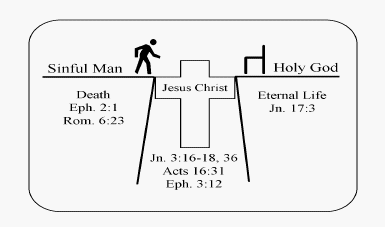
I’ve seen the bridge illustration many times. I remember by father drawing it on scraps of paper, with his trademark “Beaky Bird” characters instead of stick people. During a particularly boring sermon here and there, I’d read the bulletin though four times and then fumble with the tracts that were always on the table at the back of the church. An illustration of the bridge figured prominently in one of them.
Oddly enough, I had never really heard of the Four Spiritual Laws. That particular one wasn’t as prominent in the circles I grew up in I guess.
When I came to college, I was struck by hit head-on by something entirely different: friendship evangelism. It seemed so superior to these canned gospel presentations – investing time and energy into someone until they actually cared what you thought, then telling them gradually how Jesus had changed your life. Make them WANT what you have. The charismatic church I attended in college had this down pat. And really, there are a lot of good things to say about the approach. It builds community (even though my “friend” disappeared after the first year, I had found lots of others). There are problems with it too (besides the one I just mentioned), but I’m not going to go into that now.
So, meanwhile back at the friendship evangelism church, I signed up for a class on evangelism, taught by the cool college pastor. The first day of class, our notebooks were handed out. I was shocked. The curriculum? “Evangelism Explosion”. Memorize Roman’s Road. Cheesy 70’s cartoon illustrations. Canned question and answer. Door to door. Intellectual assault (minus the underlying scholarship). Wait a minute…
Over the next several years, I did a little bit of all that. I went door to door. I completed the assignments to accost people on campus and share the gospel with them. The Mormon guys do this every day for two years when they are in their early twenties. I’m sure it must get comfortable after a while, but for me (and most of my fellow classmates and friends) it was hell.
Why hell? Just personality weakness? Just being sinfully self-conscience and cowardly? I’ll be the first to say I wish I were braver sometimes. But it goes way deeper than that. I just didn’t believe it worked. That it was really true. Now don’t get me wrong. I believed ALL of it was TRUE. The Gospel contained in these methods didn’t contain any untrue statements about God or the Bible. But they were truncated. They left things out. They always made me feel icky. The pastor telling us we should “win souls” for the Lord by whipping these out on the person waiting in front of us in the grocery line – I just could never buy it. I remember feeling uncomfortable about them when I was young, though I couldn’t put my finger on it.
Doug Wilson (a local pastor and author) has written a ton of helpful and well-thought-out books on Christian living, education, parenting, ecclesiology, etc. However one of his earlier books on evangelism, Persuasions, is nothing I could get very excited about. It’s more of the same:
I, the brilliant Christian have the divine rhetoric to smack down your (fill in the blank: paganism, materialism, legalism, post-modernism, fondness for light beer). Come back when you’ve seen the light of my Biblical, Reformation-upgraded, presuppositional answers (with the Holy Spirit’s help of course) and we’ll hook you up.
And hey, I’m ALL for knowing WHY Christianity gives paganism a noogie. The rhetoric has a place too. Is that our evangelism though? That’s our main shtick to help redeem the world? I’m not convinced. Wilson and co. are not convinced either actually. They take a post-millennial-church-subverting-the-culture approach that makes a lot more sense on a lot of levels. Again. Somewhat off-topic. I guess I’m talking about evangelism proper.
Back to the quote from Fitch. From the introduction to his series of posts:
When They Will Not Come” (WTWNC) names the social dilemma of the church in post Christendom when we can no longer assume non-Christians will come to church even when they are seeking God.
Man, how quickly does the REACTION to this gospel-in-a-can dispensing fall into the ditch of liberal “don’t impose your views on other people” wishy-washyness? Long before you can pronounce all five syllables of “Proselytizing”. Ewww, that sort of relativistic mush is no good news at all.
So what to do?
A friend of mine is hoping to move to Romania soon to plant a church. An inlaw is planting one in the next town south of where I live. I’ve been intrigued by the AMiA (Anglican Mission in America’s) church planting efforts. I’ve been thinking about church planing a lot lately and that naturally leads to thoughts of evangelism proper. But what if proper as we know it is a silly invention Jesus would have rolled his eyes at? I don’t have answers to any of this stuff. A few ideas. Mostly just more wrestling ahead.