
I know folks who believe that a particular scientific reading of Genesis is a hill to die on – something that should practically be in the creed right next to the God-Man.
I disagree. I think Genesis is the opening of the story and history of God and man. What tidbits of information you can glean about geology and astronomy are not even close to being enough to build a comprehensive theory on. They aren’t meant to be.
Growing up I was mostly exposed to Young Earth Creationism. While I appreciate some of what these folks are trying to do, I have to say that I think an old earth is much more plausible. Why? It’s just a much simpler explanation, AND I don’t see it as being at odds with the Genesis story of creation at all. The number of linguistic and exegetical hoops you have to jump through to keep the old-earth theory alive is WAY fewer than the number of hoops to get to young earth.
There are two different angles to take in explaining (or believing) young earth creationism: scientific and “un-scientific”. Here, the ever helpful Fearsome Lutheran lends a hand:
“Scientific” YEC does not say that things like deep layers of volcanic sediment, fossils, the Grand Canyon, and distant nebulae are hoaxes. They simply labor to find some quasi-scientific explanation for how they can be what they are and yet the universe is 6000 years old–it doesn’t hurt to come up with some theory on how scientists are hiding the real evidence, either. “Non-scientific” YEC admits that the evidence is there, and that it does point to an old universe, but that it was all faked by God either at the Creation itself, or perhaps after the Fall in order to hide his own existence.
The difference between “scientific” and “unscientific” YEC is then that the former seeks to figure out how the evidence is consistent with a young universe, whereas the latter seeks to figure out why God put such misleading evidence all over the place.
Now, when an astronomer looks through his telescope and sees a star that, as best as anyone can figure out, is 1 billion light years away, that means that the light from that star took a heck of a long time to get here. The scientific YEC person will point to theoretical physicists who propose some sort of “expanding universe” theory to explain how that light actually only took 6000 years to get here (since that MUST be how old the universe is since the Bible says so). The “unscientific” YEC person will say that God really did create that star really far away, but he also created all the light in between us and the star so it would LOOK like it’s really old, but it’s not. Also, when we find rocks deep in the earth that seem to be really old? God put them there to fool us, but if we just read Genesis narrative more concretely, we’ll have the inside scoop that that rock is really only 6000 years old.
Does anybody else get the feeling that both ways assume too high an opinion of us? Why does the creation of the entire universe HAVE to correspond with the beginning of human civilization? We say that by reading YEC into Genesis were focussing hard on the word of God, but I think were just focussing harder on ourselves. We are the center of our own little world where every galaxy across space is just scenery for our little pocket of beings made in the image of God.
My theory? God made the universe to be unbelievably vast. We are one tiny speck in a sea of galaxies. He could have made it all a trillion years ago. We on earth are just one of his special projects. Yes, special because he filled our planet with life and even with beings made in his own image. That’s pretty incredible. But who says he doesn’t have other projects all over the place? Maybe other creatures not made in his image, but just for his pleasure? Maybe a race of people who never fell into sin? Aliens? Sure, why not. But I don’t think we need to concern ourselves with them. They could be a billion light-years away. If any of these other life projects he has going on were important to our civilization on earth, he might have mentioned them. He doesn’t. So who cares? Jesus is all about cementing the relationships between the creator and us, his special creation right here. Space is the final frontier but one we aren’t likely to explore, except for the portion in our own back-yard.
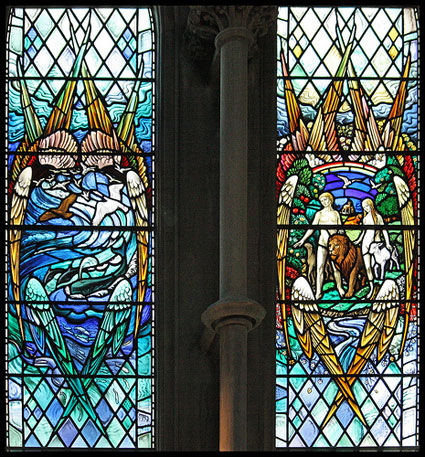
To reinforce some of these ideas, I draw your attention to this piece written recently by Tim at Taliesan. Here I’ve unashamedly pasted the whole thing:
The Layers of Intelligent Design
1. Primordial cosmos: ”without form and void”. This is not matterless. It is unorganized matter/energy. It suggests the existence of random events, without — surprisingly — a moral color (we are inclined to see randomnity as bad.) There is no reason to believe the creation week obliterated or exhausted this formless stuff. I believe we still see this with senses and scientific instruments.
2. Creation. The stuff got organized. The residuum of this is what we perceive when we look at the night sky, and this is the Design the biblical writers talk about. But the biblical writers are not necessarily seeing what we think when we think “design”, which is more like “pattern”. They are seeing size, scale, and beauty. The fabrication of the Garden, later, will reveal that this Creation, whatever it looked like, though it is “very good”, has no clear human purpose, except as raw material for a further ordering. Even before the Fall there were at least two strata in the created universe that were not meant to look “designed” to unfallen human perception. What we see now has no apparent purpose, unless explained by revelation, but we’re not seeing it clearly.
3. The Garden. The creation of the Garden in Genesis seems not to mean anything to Christians who argue with the evil evolutionists about design in the natural world. But it seems crucial. The distinction between the garden and the wide world is precisely the degree of apparent order. And, in this context, the word “order” means something like “pleasant to humans”. It was an island of suitableness within the infinite ocean of the Creation, which was itself on top of, or imposed on, the deep layer of formless stuff. The idea was probably that the Garden would grow and take over all the Creation, which of course never happened. So the Garden was the one place visibly designed for humans. We do not perceive it now. A flaming sword has been set at its door.
4. The Creation, fallen. Whatever degree of design the original creation displayed — something less than what God had in mind for us — must be broken down now, to some unknown degree. And our vision is also broken.
I realize I am speculating here. The point is not to nail all this down into creedal clarity. The point is that the concept “design” is used by culture-warriors as if it means one thing. It is either “evidence of design” or, I guess, “evolved by chance”; I find this dichotomy laughably simplistic — from a biblically literalist point of view. Actually, the biblical concept of design is richly nuanced. And that nuance not nearly mined to date. We do the biblical picture great trauma by talking about it so carelessly.
Those of us who aren’t so certain to argue that we see “design” in the physical universe are often looked down on by our more dogmatic brethren. As if we don’t really believe the Word. Not so; we just see more in it than you, and see more that we don’t clearly see. It’s hard to fight over something you know you aren’t seeing clearly.
I’m speculating too. I see a lot going on in the Bible, especially in the Genesis narrative. I see the potential for God pulling the strings on a thousand other things in the background and not feeling it necessary to tell us about them. The nuance in what we DO have hints at much more about the history of the universe than we’ll ever know. Tim’s idea of God going from less order –> more order makes a lot of sense from a creative standpoint.
As Dorothy Sayers point out, the very first attribute we discover about God, in Genesis 1:1, is that he is a CREATOR. We, in is image, are also creators. We’re always putting things into order. The creation of Earth and the life on it was one step in God taking what he had made (matter, energy, physical fundamentals) and putting them more in order. VERY ordered in this particular window of space of time. Then he told us about some of it via special revelation to Moses, who wrote it down in the Pentateuch. That’s good. Take it for what it is.
Somehow, He made a planet of a particular mass and put it just the right distance from a certain star of the proper energy to support rich biological life. The fact that the little snip of it we see in the Bible has the sun and moon created on the 5th day, long AFTER plants and vegetation are cooked up should not give us pause. When we come up with crazy theories in the language of contemporary science to explain this, we’ve already lost. We’re playing on the modernists turf, trying to use their own enlightenment tools against them. They will not believe the word of God even if a dead man returns to them. (Luke 16:31) Peer-reviewed journals and rhetorical footwork will not save their souls nor quell their rebellion. (Grace on the other hand, will blow their mind.)
So there you go. The really short version of why I believe in an old earth AND space aliens, with the caveat that I think space aliens are completely irrelevant.
“The heavens declare the glory of God, and the sky above proclaims his handiwork.” – Psalm 19:1