
Well, I saw Avatar in the 3D theater this weekend. Wow. Absolutely stunning visuals. Definitely worth checking out if you haven’t yet.
As for the plot, you’ve seen it before, though perhaps with better acting (Dances with Wolves), more emotion (The Last Samurai), fewer phosphorescent trees (Dune), more music (Pocahontas), or more gags (FernGully). There is also the tragic edition where all the good guys die at the end (The Mission), which happens to be the only one based on a true story.
One thing I found interesting in the film is how Cameron (the writer and director) presents a wholly scientific explanation for the pantheistic energy that connects all living creatures on the planet. The trees have actual, observable neural-network connections to each other and all the plants around them and even the animals and people. The natives have nerve endings at the tips of hair that can be plugged into animals, trees, etc. to form a bond with nature. In one scene, the characters hook into one of the “sacred” trees (explained as simply a sort of tree with a much more dense neural network) and can hear the echoing voices of their ancestors and even the groanings of all life on the planet itself. It seems that a bit of their ancestor’s consciousness was absorbed into this network of memories. No spiritual or religious explanation is given. It is implied that perhaps long ago Earth used to have bonds similar to this between it’s organisms, but they have since faded and become difficult to observe by science.
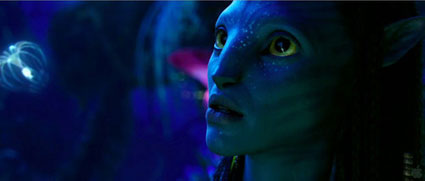
So how would a devout atheist like Cameron reconcile “spiritual” phenomenon? This is one way – with a “natural” explanation. Drawing from my discussion of “natural magic” earlier, I actually think this is a pretty good way to set up a secondary (story) world. I really appreciate how he explained the phenomenon with visuals and not a lot of awful explanatory monologues. Explanatory monologues are the hallmark of bad sci-fi. If your story has to pause for 10 minutes while your character recites from the appendices of a role-playing game manual, you know your narrative needs a serious rewrite. Anyway, despite it’s flaws, Avatar did this part well I think. That’s cool.
It also struck me how similar this idea was to W.B. Yeat’s explanation of magic, which he outlined in one of his early essays:
I believe in the practice and philosophy of what we have agreed to call magic, in what I must call the evocation of spirits, though I do not know what they are, in the power of creating magical illusions, in the visions of truth in the depths of the mind when the eyes are closed; and I believe in three doctrines, which have, as I think, been handed down from early times, and been the foundations of nearly all magical practices. These doctrines are
(1) That the borders of our minds are ever shifting, and that many minds can flow into one another, as it were, and create or reveal a single mind, a single energy.
(2) That the borders of our memories are as shifting, and that our memories are a part of one great memory, the memory of Nature herself.
(3) That this great mind and great memory can be evoked by symbols.
-W.B. Yeats, Magic, Ideas of Good and Evil, Essays, p.33
Yeats didn’t see God and spirits and demons. He saw memories and invisible connections between all people and places. Yeats often participated in seances where he believed he could tap into some of these memories. The similarities to his view of spirituality and the explanation presented in Avatar are, I think, remarkably similar. Yeats was a man of old literature and poetry though, not a contemporary scientist. He would not use the language of quantum mechanics and electromagnetic fields in his theories. He would instead draw on metaphors, mythologies, and symbols – the stuff he knew best.