
I think one of the handy uses of Girard’s theory is that it does a good job of explaining, from a psychological/sociological standpoint, how Original Sin is passed down to each member of the race of Adam (us). Now, there are other dimensions in which original sin is passed down. It is more than just a psychological phenomenon – but a deep spiritual corruption. What we are looking at here is the MECHANICS of how it is played out. Sin doesn’t just “magically” get tacked on to each newborn baby. There is, more or less, an observable way in which it is transmitted.
On one hand, there is genetics. Adam’s physiology was the same as ours, except that he was initially designed to live forever. The early patriarchs lived for many hundreds or years. Gradually, sin and death deteriorated our genetics so that by about 1500 BC, we are down to what we would consider the normal human lifespan (typically less than 100 years). So that is one way: Sin and death are in our blood, in our genes. Our bodies reflect the curse. Even Lazurus (whom Jesus raised from the dead) got sick and died again a few years later.
Ah, but if we follow the theory of imitative desire to its logical ends, we come up with another way that sin is ALWAYS transmitted: by imitating our parents and those around us. It’s the only thing we have to work with as babies learning how to be human beings. And what do we imitate? Vessels full of envy, strife, misdirected love, and so on. We can’t help it. Alison deals with this idea here: (The language is a bit murky. I had to read it twice. Emphasis mine.)
…we build our identity both by receiving the identity which is given to us by what is other than us and, at the same time, by erecting fronteirs of negation of our dependence on that other. And it is not simply that we are, ourselves, reacting against something like an invasion from outside, as though there were an original “I” within the hostile elements without, but rather that the sort of desire which we receive from the other already includes elements of rejection and ambivalence. That is, everything that enables me to have an “I” already includes these elements of rejection and denial. By saying this I am not saying anything other than what the Church has always said when it affirms that the whole person is, from conception, and in every case, formed from within by “Original Sin”.
-James, Alison, Raisin Abel, p.114
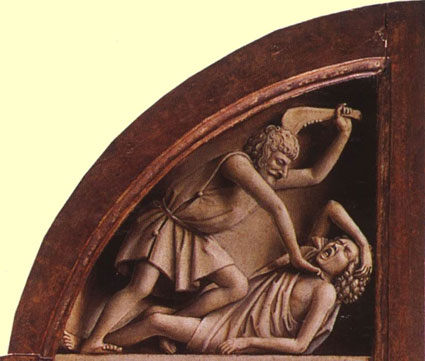
We all grow up imitating Cain. However many generations we may be removed, he’s still there, helping form part of the foundation of our early childhood development.