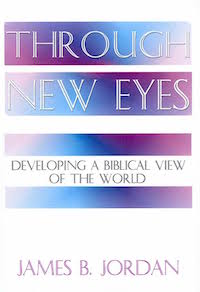
Misc Notes on James Jordan’s Through New Eyes

through-new-eyes

I finally got around to reading one of James Jordan’s larger works. This is the one friends have been telling me was worth looking at for years. It’s too bad it’s out of print and so expensive on Amazon. Don’t let the title and the now tired mention of “worldview” in the subtitle dissuade you. This is a rich systematic overview of biblical (especially Old Testament) typology. Having listened to a lecture of his in person before as well as read some of his shorter essays and seen a few video interviews, my experience with Jordan previously was one of 90% keen insights mixed with 10% “WTH?”-inducing straight-faced crazy talk. I was delighted to discover that Really Weird Stuff only constituted maybe 5% of this book and that none of it was particularly distracting.

Growing up baptist, I was exposed to pretty much zero biblical typology in my youth. Everything in scripture was always to be taken as literally as possible – eschewing symbolism, the mere existence of literary devices, and often even broader context. In hindsight, it seems a bit odd that I encountered so little as I now know a lot of it isn’t terribly esoteric.  Fortunately, several of the leaders at the charismatic church I attended in college had a decent handle on a lot of this stuff already and I absorbed enough of that such that many parts of this book were not novel to me. Still, I found quite a few new good things to share. I think for anyone wanting to dig into the Old Testament some more, this and Robert Alter’s The Art of Biblical Narrative would be top on my recommended reading list.

Here are some assorted passages of interest that I copied down, along with a few notes of my own.

This is a great passage explaining the parallel of what the people were trying to accomplish with the Tower of Babel in Genesis 11 with God’s call of Abraham in the following chapter.

God’s judgment on the Tower of Babel, however, was accompanied as always with a new announcement of salvation. All the things that man had sinfully tried to seize at Babel – land, name, priestly influence – God announced that he would bestow upon Abraham.

They had wanted land, “lest we be scattered abroad over the face of the whole earth” (Genesis 11:4). God, howeer, scattered them (11:8), and gave land to Abram: “Go forth from your country and from your relatives and from your father’s house, to the and which I shall show you” (Genesis 12:1).

They had wanted a name: “And let us make for ourselves a name” (genesis 11:4b). God, however, confused their languages, so that they could not understand one another’snames (11:7), and gave a great name to Abram: “And I will make you a great nation, and I will bless you, and make your name great” (Genesis 12:2).

Finally, they had wanted to be religious leaders. Their tower was to reach to heaven. They would be the points of contact between other men and “god” (Genesis 11:4). God, however, prevented their tower-building (11:8) and set up Abram and his seed as the priestly nation: “And so you shall be a blessing; and I will bless those who bless you, and the one who curses you I will curse. And in you all the families of the ground shall be blessed” (Genesis 12:2-3).
p.178

So much replacement and renaming going on in scripture! It may not seem like such a strong pattern and first glance until you line them all up.

God gave new names to His restructured people. God changed Abram to Abraham and Jacob to Israel. Jacob means Supplanter, and pointed to his being the younger son who replaces the older. The older son is often a type of Adam, and the younger of the Second Adam. Thus, Seth replaced Cain, Shem replaces Japheth (Genesis 5:32; 9:24; 11:10), Isaac replaced Ishmael, Jacob replaces Esau, Joseph replaced the older brothers, Ephraim replaced Manasseh (Genesis 48:18), Eleazar and Ithamar replaced Nabad and Abihu (Exodus 6:23; 24:1; Leviticus 10:1-6), David replaced his older brothers, and Jesus replaced Adam.
p.188

An interesting comment about how the hundreds of years of slavery in Egypt leveled existing class structures among the Hebrews and equalized social relations for some time.

Once the people were reduced to slavery, the distinction between the blood line of Jacob and the multitudes of servants in the nation broke down. All were servants now When Israel came out of Egypt, we do not find an aristocracty of true-blooded Israelits dominating a plebeian class made up of the descendants of the servants, as probably would have been the case had God not put the nation through the crucible of enslavement. The result of this change was that government by patriarchs shifted into government by elders (Exodus 3:16; 4:29). Men of discernment rather than men of Blood came to hold power in Israel.
p.197

Some great commentary on the rise (and occasional fall) of Christianity throughout history.

In the way of cultural movement, we find that when Christians first penetrate a pagan culture, they have to meet in homes and even catacombs. When the culture has been permeated by Christian influence, and becomes a Christian homeland, then the great and beautiful Garden-Churches (cathedrals) can be built. So it was with Rome. So it was with Europe. So it must be in our day.
Our cathedrals have been defiled, and our homes are under assault as officials of the secular humanist government seek to close down Christian schools and invade Christian homes. Thus, ours is not a day of cathedral-building, but a day of cultural permeation. Faithfulness must come first, and only then will glory come.
p.155

Since we live in an age of setback, it is not always apparent to us that the Kingdom has, in fact, grown. But if we take a look at the Kingdom in the year 300, we find it suffering in pre-Constantinian tribulation. A few centuries later, the Church was wrestling the tribes of Northern Europe into the Kingdom; while in the East, Christianity experienced a real golde age, and what we call “Nestorian” Christians had influence throughout India and China. A few centuries later, after the high “Middle” ages and the Protestant Reformation, Christianity greatly discipled the European countries, spread to the Americas, and gave birth to the printing press, university education, technology, and many other benefits. During the last century, Christianity extended all over the globe as a result of the missionary movement and almost eradicated slavery (though slavery still exists in some Islamic countries, and behind the iron curtain).
p.287

On things like the U.S. Constitution or the Westminster Confession gradually morphing into symbols.

In a way what has happened with the U.S. Constitution, and with the Westminster Confession, is that their value as symbols has changed. Originally it was the CONTENT of these documents that was their primary value. The power of their contents has diminished over time, however. At the same time, with age they have become symbols in another sense, functioning like flags or banners, or security blankets. To put it another way, they have moved from being primarily verbal symbols to being to a considerable extent non-verbal symbols. People are loyal to the Constitution, but most have little idea what it says.
p.293

I would add that more than a few Reformed chuchmen are loyal to the IDEA of the Westminster Confession, even while formally tossing numerous paragraphs (e.g. the part about the Pope literally being The Anti-Christ) and informally ignoring others.

“arborescent theophanies” – what a wonderful phrase. The book is chock-full of this kind of thing.

Connecting the Tower of Babel, Jacob’s Ladder, and Jesus’s conversation with Nathaniel:

Just as the Tower of Babel was a counterfeit ladder to heaven, so Jacob’s visionary ladder was the true one (Genesis 28:12-17). Babylon means “gate of heaven,” and at the foot of Jacob’s ladder was the true gate of heaven (v.17). Just so, if Nebuchadnezzar’s ladder tree was a counterfeit, there must also be a true ladder true. That true Ladder is the Messiah. Jesus said to Nathaniel, “You shall see the heavens opened, and the angels of God ascending and descending upon the Son of Man,” referring to Jacob’s vision (John 1:51). But also, in context, Jesus stresses that Nathaniel has been sitting under a fig tree (John 1:48, 50). the fig tree, a symbol of Israel as God’s priestly nation, is correlated with the ladder of heaven, with the True Israel, Jesus Christ.

An excellent explanation of how prophecies like “the moon will turn to blood!” are not about end of the physical world doomsday events:

Let us now briefly survey the passages where sun, moon, and stars are used in a prophetic-symbolic sense. A failure to understand the symbolic nature of these passages has led a few popular writers to assume that such expressions as “the sun turned to sackcloth and the moon to blood” can only be understood as referring to the collapse of the physical cosmos. Nobody takes these verses literally, after all. The question is, to what kind of event does this symbolic language refer? For modern man, it seems that it can only be speaking of the end of the natural world. For ancient man, it was indeed the end of the “world” that such language indicated, but not the “world” in our modern scientific sense. Rather, it was the end of the “world” in a socio-political sense.

For instance, Isaiah 13:9-10 says that “the day of the Lord is coming,” and when it comes, “the starts of heaven and their constellations will not flash forth their light; the sun will be dark when it rises, and the moon will not shed its light.” It goes on to say in verse 13, “I shall make the heavens tremble, and the earth will be shaken from its place at the fury of the Lord of hosts in the day of His burning anger.” Well, this certainly does sound like the end of the world! BUT, if we read these verses in context, we have to change our initial impression. Verse 1 says, “The oracle concerning Babylon which Isaiah the son of Amoz saw,” and if we read on, we find nothing to indicate any change in subject. It is the end of Babylon, not the end of the world, that is spoken of. In fact, in verse 17, God says the he will “stir up the Medes against them,” so that the entire chapter is clearly concerned only with Babylon’s destruction.

If we read Biblically, this won’t seem so strange. What verse 10 is saying is that Babylon’s lights are going to go out. Their clocks are going to stop. Their day is over, and it is the Day of Doom for them. And, since these astral bodies symbolize governors and rulers, their rulers are going to have their lights put out as well.

The “heavens and earth” in verse 13 refer to the socio-political organization of Babylon. The “heavens” are the aristocracy, roughly speaking, and the “earth” are the commoners.

We find the same kind of thing in Ezekiel 32. In verses 7-8 of the chapter God declares, “And when I extinguish you, I will cover the heavens, and darken their stars; I will cover the sun with a cloud, and the moon shall not give its light. All the shining lights in the heavens I will darken over you and will se darkness on your land.”
The end of the world? Yes, indeed, but not for everybody.
p.62

And finally, a great analogy about how the Levitical law was not nearly as complicated as we sometimes think.

Why do people think the Mosaic law was hard to keep? In general, it is because they do not know what the law really commanded, and because they have the Mosaic law confused with the rabbinical traditions of Judaism. The rabbinical traditions were a “heavy yoke” (Matthew 15:1-20; Mark 7:1-23; Acts 15:10; Matthew 23:4). Jesus called the people back to the Mosaic law, making it His own, and in doing so said that He was offering an “easy joke” (Matthew 5:20-48; 11:29-30).

What about all those sacrifices, you may ask? There were the Burnt, Meal, Peace, Than, Votive, Sin, Reparation, “Heave,” and “Wave” Offerings, for starters. Some sued salt, some did not. Some used oil, some did not. Some required a lamb; others, oxen; others, birds. Leavened bread was used with some, unleavened with others. Some parts of the animal were burned up, others given to the priests, and others were eaten by laymen. These things differed for each sacrifice. it was an awful lot of detail to master. The Israelite citizen, however, never offered any sacrifices himself. Only the priests were allowed to do the sacrifices, and they did them every day. They soon become familiar with all these details.

Compare the details of the complicated sacrificial system with the details of auto repair, and it suddenly becomes clear just how simple the priest’s job was. How many different kinds of cars are there? Add on the fact that they change from year to year. Now consider all the different parts and aspects that can go wrong. next time you take your car in, look at all the volumes of Chilton auto repair manuals that your mechanic keeps on hand, and compare their size and detail with the book of Leviticus. If you mechanic can learn to fix cars, and enjoy it, obviously the priests of Israel had no trouble managing the sacrificial system.

What about the sabbath? Wasn’t that a burden? No, it was a time of rest. But weren’t they forbidden to cook on the sabbath? No, they kept the sabbath as a feast. But weren’t they forbidden recreation on the sabbath? No, the Bible nowhere says this. Well the, what did they do? They wen to church to worship God at the synagogue (Leviticus 23:3), and relaxed the rest of the day. The sabbath was not an “impossible burden.”
p.200

We need some history to make a fertile ground for the gospel

Here, in a passage from his book The Wounded Healer, Henri Nouwen talks about how preaching doesn’t work when your audience is essentially post-Christian and doesn’t see itself as part of a larger forward-moving narrative.

Only when man feels himself responsible for the future can he have hope or despair, but when he thinks of himself as the passive victim of an extremely complex technological bureaucracy, his motivation falters and he starts drifting from one moment to the next, making life a long row of randomly chained incidents and accidents.

When we wonder why the language of traditional Christianity has lost its liberating power for [modern/contemporary] man, we have to realize that most Christian preaching is still based on the presupposition that man sees himself as meaningfully integrated with a history in which God came to us in the past, is living under us in the present, and will come to liberate us in the future. But when man’s historical consciousness is broken, the whole Christian message seems like a lecture about the great pioneers to a boy on an acid trip.
p.9

What’s especially interesting is when this was penned – the very early 1970s. Preachers at that time might have had some excuse for being slow to pick up on all the social and philosophical changes that occurred the previous decade. Fast-forward 45 years, we should know better but it seems as if we sometimes still take this for granted. When man’s historical consciousness is broken, the gospel doesn’t seem freeing anymore. Let’s try to patch things up integrating history (both ancient and modern) into our preaching, (something our grandfather’s didn’t have to do). Let’s also figure out how to present Jesus as the savior of those drifting on the sea of nihilism. The days of making the gospel sound compatible with the American Dream are long gone now. Ours is like strange new missionary frontier.

Later, Nouwen continues along a similar line:

Without this hope, we will never be able to see value and meaning in the encounter with a decaying human being and become personally concerned. This hope stretches far beyond the limitations of one’s own psychological strength, for it is anchored not just in the soul of the individual but in God’s self-disclosure in history. Leadership therefore is not called Christian because it is permeated with optimism against all the odds of life but, because it is grounded in the historic Christ-event which is understood as a definitive breach in the deterministic chain of human trial and error, and as a dramatic affirmation that there is light on the other side of darkness.

Every attempt to attach this hope to visible symptoms in our surroundings becomes a temptations when it prevents us from the realization that promises, not concrete successes, are the basis of Christian leadership.
p.76

Feel your inferiority

Modern psychology, in particular, favors independence over dependence, confidence over feelings of inferiority, avoidance of pain, and strong will. The Rule says just the opposite: submit to authority, feel you inferiority, embrace suffering, and have no will of your own. How can anyone live this rule and enjoy emotional health?
The Rule makes it clear that familiar modern values come from a purely secular frame of Mind. As [Lutheran theologian] Rudolf Otto says in his classic definition, religion is fundamentally a sense of awe. It is based on an awareness that we are indeed quite small in the scope of things. If we want to live a less secular life, one that includes religious virtues, as well as secular prudence, then we may have to discover the implications of this existential humility.
-p.xxi, from Thomas Moore’s introduction to the Rule of St. Benedict

That phrase – FEEL your inferiority. Good grief, have your ever heard anyone give you that advice? In our world of self-esteem anthems and trigger warnings you’ll only hear the opposite at all costs. Even from the pulpit you are more likely to hear that “God has a wonderful plan for your life” than anything that might acknowledge your low-ness. But we only need Jesus when we are broken. The gospel is only good news to those who have been brought low. Pretending you are high or respectable before is a false place to begin.

A gospel message for modern America

I delivered this as part of the sermon at church today. It borrows heavily from a passage in Paul Zahl’s ‘Who Will Deliver Us?’. Here in the increasingly post-Christian west, in the popular consciousness today, the idea of sin carries very little weight. I think sometimes, perhaps even often, it is going to be more effective and arresting to speak of the crushing weight of stress, expectations, and performance-ism than the crushing weight of the righteous law. In the end, they are two sides of the same coin and our rebellion against either can rightly be called “justification by works”. I don’t mean to downplay the importance of sin, but when speaking about it directly is going to largely result in miscommunication, than we need to be able to also proclaim news to people that is more immediately recognizable as good. This is one possible angle to take.

Let’s start by considering some of the everyday problems of living. Let’s consider the problem of stress. Talk to any parent of small children, any college student, any one working two jobs or even one job or caring for an elderly parent, any person trying to make it in any business, heck, any person living in the USA today and you will hear about stress. But what is stress anyway? Stress is pressure caused by the convergence of strong and conflicting claims upon the self. If for example, we feel pressure to perform at peak efficiency at work, and to be an attentive partner to our spouses and an engaged parent to our children, we will most certainly experience stress. How can we balance the strong conflicting claims upon our time and energy? Add to this the desire to have time for our own interests or hobbies, or just things that we think are interesting or cool, and we will have a very hard time reconciling the demands. This type of stress is familiar to many of us.

And it’s much worse in a time like our own when what we’ll call the “law of capability” is in force. This is the law that judges us wanting if we are not capable, if we can’t handle it ALL, if we are not competent to balance our diverse commitments without a slip. We have to be good at ALL THE THINGS or we are judged to be losers. We are filled with dread that we won’t be able to keep all the plates spinning.

Back in the 80s, Pulitzer winner Ellen Goodman gave a commencement speech where she described the ideal model woman of today something like this. She gets up at six-thirty in the morning and jogs five miles. At seven-thirty she cooks a totally nourishing breakfast for her husband and two beautiful children. By eight-thirty the children have left for school, her husband to his office, and she is on the way to her incredibly demanding job: she is an advertising director for a major company. All day long she attends meetings and makes important decisions. When she finally arrives home, it is quite late because she had to attend a board meeting for a community-service organization of which she is the chairman. But she does not get home too late to fix her children an excellent supper. She helps both of them with their homework and has meaningful good-nights with each. Yet she still has energy left to prepare a gourmet, candlelit supper for herself and her husband. As the day comes to an end, the model woman has a totally fulfilling yet deeply honest sexual relationship with her admirably sensitive husband.

Whew. Now we may be able to rationally look at that and say it sounds silly, but I think that most of us, most of the time, are under an unwritten pressure to perform like that.

Under the law of capability, the model woman, like any of us, is bound to sicken. We are all simply human. Stress, comes from all these different claims upon the self. Ultimately, stress involves a religious problem. The problem underlying our need to reconcile conflicting demands is this: What establishes my identity? What IS my identity? Who the heck am I? That’s very much a religious question.

Many of us act as if the answer to this question were performance – what we DO. If I can do enough of the right things, I will have established my worth. Identity is the sum of my achievements. Hence, if I can satisfy my boss, meet the needs of my spouse and children, and still do justice to my inner aspirations and dreams, then I will have proven my worth. There are infinite ways to prove our worth along these lines. The basic equation is: I am what I do. It is a religious position in life because it tries to answer in practice terms, the question, “Who am I and what is my niche in the universe?” This popular position says, my place in the universe is in proportion to my deeds.

You ready for this? In Christian theology, such a position is called “justification by works”. It assumes that my worth is measured by my performance – what I do. Conversely, it conceals a terrible and ghastly fear: If I do not perform, I will be judged unworthy. I will be worthless. To myself I will cease to exist.

What is the antidote to this deeply entrenched crushing expectation that the world squashes us with? This is the spirit of our age. It is not something we can work our way out of. It is not something we can think our way out of. It is only something that we can be rescued from by a powerful outside force that is completely independent of ourselves.

The Good News, is that God, the creator of all living things, has done this very thing, this rescuing, in the person of Jesus Christ. He died for us while we were clearly unworthy. And he has promised to deliver us from death for no good reason at all, except that he loves us dearly. That is the good news.

What I think I need is more money, more time, more energy, less sinning, but no, what I really need is Jesus – God himself.

The great Christian philosopher Soren Kirkegaard said: “And this is one of the most crucial definitions for the whole of Christianity; that the opposite of sin is not virtue but faith.” That is, the opposite of doing it wrong isn’t doing it right, it’s faith – faith in someone else to do it right. Faith in the only one who can do it right.

You may not understand what all that it entails, but today, whether you are old in the faith, or young in the faith, or on the fringe of faith, or outside of the faith. Put your trust in the Lord Jesus Christ, your savior, the eternal King.

Against nostalgia for the parish

CHPuMA0UgAA_eBa

I’m tired of being shamed from the pulpit for not befriending/investing in/ministering to my physical block-level neighbors. I literally NEVER see these people – ever. It’s just the reality of the modern city, at least as I have experienced it in the USA. I have circles of acquaintances at church, at work, with regulars at the coffee shop and the park, and with my family scattered around the world. I have precisely zero interaction with the people that live more than one house down the street from me in any direction. I’ve lived in the same house now for seven years and in the same city for 16 years and there has been no variation in this. To engage these physical neighbors would required a forceful awkward action on my part, and to continue to engage them would require heaps of creepiness. I suspect that many with an ounce of tact know this, but yet we often nod our heads whenever the preacher or the latest book on evangelism or non-traditional church community exhorts us to witness to our physical neighbors or conjure up a block party. It’s not gonna happen, at least not with the way our cities, jobs, and families are currently set up.

Some of churches I know of, including several in my town, decided to chop up their small groups by “parish”, that is, by their physical location within town, with lines that are very similar to those used for school district zoning or voting districts. The idea is to harken back to the way parishes effectively existed for centuries in the Christian west. But of course the whole thing is contrived and the people in the small groups will unconsciously resist this sort of (previously natural but now unnatural) grouping. At the end of the day, who are you going to hang out with? The family that shares your interests and who has kids the same age as yours, that likes to watch the Seattle Seahawks and that lives a 5-minute drive from your house, or the single German grad student in Biology who just happens to live in an apartment 3 blocks away and who sometimes attends your church?

For starters, denominationalism has made the idea of a local physical parish a complete lost cause. Forget cars and compartmentalized specialist jobs and everything else Wendel Berry laments. The fact that the people on my block attend at least 5 different churches (some in the next city over) and many take part in no church at all makes any thought of making the parish (Latin ‘parochia’, dwelling beside) meaningful hopelessly broken. I can’t fix this and I can’t push back on it in a substantial way either. I get a hundred times more mileage investing time and energy into the people I do meet naturally day-to-day. For better or worse, in the modern west, the parish is now a web, not a circle. Maybe you live somewhere (an isolated midwest small town or a tiny village in Honduras) where the parish model still makes sense. Great! Maybe you are that one guy ministering to a collective of artists living in an experimental rent-controlled apartment. Cool – whatever. Maybe some day the parish model will work again here, but not today. So how about let’s spend our energy on something other than pining away for this nostalgic model of pre-automotive Christendom. No I don’t really like it either and it’s really too bad that it’s gone, but we have a lot of foundational things to change if we want to recover the parish and it’s benefits. We can’t just dictate them out of thin air.

Misc Notes on Robert Louis Wilken’s The First Thousand Years

I recently finished reading Robert Louis Wilken’s rich overview of church history. It was well written and packed with a lot of core information – very little fluff and very few rabbit trails. Ultimately though, as is the case with most histories, especially ancient ones, it focused a bit too much on kings, emperors, and popes. I’d love to read something that took a closer look at life on the ground level for the average Joe, if such a thing exists or is even possible.

Of the thirty plus chapters, only three dealt with topics that I was familiar enough with personally to be aware of what was cut out for brevity. (Those would be the chapters on Celtic Christianity, Ethiopia, and the development of the Apostles Creed.) Assuming that just as much was abridged from the other chapters (and this was not a short book), it serves to make one aware of how much more there must have been going on behind the scenes.

The following are assorted passage I found of interest while reading.

On the origin of Christian art and how it is nearly always story-telling.

In constructing a catacomb with chapels and altars as well as tombs Christian leaders had more in mind than a place of burial. The dead created for the first time a Christian space that bound the community together over time, knitting the tremulous present to the grander past and forging solid and stable feelings through collective memory. And it is in this setting, where the irresistible ravages of time and mortality were most palpable, where hope was joined to memory, that the first Christian art is found. “Dead,” as Wallace Stevens wrote, “is the mother of beauty.”
p.49

Christian art tends toward narrative, the telling of a story, the depiction of events from biblical history. Even if the artist pictured only a single event, such as the denial of Peter, the event was understood as part of a larger story. On occasion Christian artists used symbols, for example, a lamb or a cross, but these are exceptions, and as we shall see later in discussing the controversy over icons, there came a time when symbols were discouraged, even prohibited. Further, unlike later Islamic art with its love of calligraphy, Christian art seldom includes scriptural texts. Though the Scriptures include the poetry of the Psalms, the moral precepts of the Proverbs and Sirach, and the letters of Saint Paul, the Bible is first and foremost a book of history, the history of the people of Israel and of Jesus Christ and the first Christian communities. So it was to this history, and the persons and events who appear in the biblical stories, that Christians turned when they wished to decorate their churches.
p.140

Some “Christian bakeries” (as some journalists phrased it) were in the news recently for refusing to bake wedding cakes for homosexual couples. More accurately, these were retail bakeries that happened to be owned and operated by Christians. But it turns out that the church has a long history owning and operating bakeries, to provide food to the poor.

Papyri from Egypt give tangible evidence of the administrative structures that had been set up to distribute aid to the needy. In the city of Oxyrhynchus, twenty-five miles south of present-day Cairo, four memos were issued on one day ordering that the widows of three churches were to receive one diploun (three to four liters) of wine, and widows of another church were to receive five diploun. On another day the “holy church” of Oxyrhynchus instructed Peter, the steward of the church, to provide a widow named Sophia with a coat. Churches kept lists of widows who needed assistance. These provisions were not random acts of charity; they were part of an organized and regular system for providing food and clothing. In these cities the responsibility for overseeing the care of widows was taken over by a group of laywomen known as the “women of the widows”. Significantly, the most common commercial property owned by churches was a bakery.
p.158

The most impressive evidence of the presence of Christianity in ancient China is a large stone monument discovered in the seventeenth century on the precints of a temple in Sian-fu, not too far from Xi’an. The monument of black limestone is ten feet high and three and a half feed wide, with seventeen hundred Chinese characters, interspersed with Syriac words and Syriac names with Chinese characters indicating how they are to be pronounced. It was erected in 781 on the site of a monastery of the Church of the East.
Besides this… a cache of Christian documents was found in a walled-up chapel in Tunhuang early in the nineteenth century. These include writings in Chinese by Christian monks, some translated from the Syria, others original contributions. There is a hymn in adoration of the “Transfiguration of our Lord”, a work entitled Jesus Messiah Sutra that outlines the fundamental teachings of Christianity, a Discourse on the Oneness of the Ruler of the Universe, and another on almsgiving. According to those who have studied them, these writings are difficult to understand because they were written by someone who did not know Chinese well. Nevertheless, they show that Christian monks were consciously attempting to present Christianity in a way that would be intelligible to Chinese. For example, they emphasize virtues such as ancestor worship, filial piety, even veneration of the emperor. Other documents written 150 years later display a surer knowledge of the Chinese language, a more accomplished literary style, and skillful presentation of Christian beliefs.
p.242

I love that we have records of some early missionary trying to hack his way through learning a foreign language. If you were trying to learn Chinese from scratch with no reference materials, of course you would suck! But these monks kept trying and it paid off. They got better over time. It’s also interesting that in their early attempts to communicate the gospel, local beliefs and ideas (or at the very least vocabulary) was mixed in to try and get the point across. This resulted in syncretism of course, but a temporary and fading syncretism – the best kind! It’s unfortunate that this strain of Christianity was wiped out in a later century.

A keen early observation regarding Islam:

The earliest recorded comment of a Christan reaction to Muhammad dates from ounly a couple of years after the Prophet’s death. When tales of a prophet amont the Arabs reached Christian Syria, someoe asked an old man, “What can you tell me about the prophet who has appeared with the Saracens?” The old man groaned deeply and said, “He is false, for the prophets do not come armed with a sword.”
p.308

[Alcuin’s] most enduring achievement [around 800 AD] was the introduction of a new and more uniform script, what is known as the Carolingian or Caroline minuscule. In the ancient world, Latin manuscripts had been written soley in capital letters, without punctuation or divisions between words and sentences. To read aloud publicly required great skill and preparation. The new script used small letters, called minuscules, as well as capital letters, majuscules, to mark the beginning of a sentence or a new train of thought. Clearer and more legible, simpler to write, friendly to the reader, it quickly became the standard for the copying of books. Punctuation was added, including commas and periods, and the question mark appears for the first time. Manuscripts from this time begin to resemble the printed page of a modern book.
p.342

I guess if you have studied printing at all you know all about the monk Alcuin, but this was new to me. The idea that centuries of early writing happened without spaces between sentences or words is kind of mind-blowing.

A funny anecdote about Christianity’s inherent friendliness to drinking:

An account of Vladimir’s conversion to Christianity is told in a colorful story in The Russian Primary Chronicle, a work made of different sources from the eleventh and twelfth centuries. According to the chronicle, Vladimir received visits from representatives of the several religions practice by neighboring peoples. First came a group of Muslims from the Bulgars. When Vladimir asked them to explain their faith to him they said they believed in God, practiced circumcision, ate no pork, and drank no wine. When he hears what they had to say, the told them that circumcision and abstinence from pork were disagreeable to him. As for drinking, that “is the joy of the Rus. We cannot exist without that pleasure.”
p.352

On the broad cultural expressions of Christianity – only the core of it is monolithic:

The global outreach of Christianity in the early centuries is a testimony to its cultural adaptability and diversity. Christianity as practiced among the Armenians differed from the ways of the Greeks or Ethiopians. Of course, the Armenians, Greeks, and Ethiopians had much in common: they were governed by bishops; they fostered monastic life; they baptized in the name of the Father and of the Son and the Holy Spirit; they confessed the Creed of Nicaea. But the difference in language, customs, liturgical practices, architecture, and art gave birth to distinctive spiritual and cultural forms of life across the Christian world. When the Crusaders arrive in the East to free their fellow Christians from the yoke of Islam, they had great difficulty recognizing and understanding the way Easter Christians lived and prayed.
p.356

Textbook accounts of Christianity preset its history as a tale of continuous growth and expansion. By a selective choice of periods, events, and geographical regions the conventional account (seen from the perspective of Europe and North America) gives the impression that Christianity is always moving forward. Seen in global perspective that picture is illusory. If on injects in this sanguine narrative the spread of Islam, things take on a different coloring. Set against the success of Islam and its staying power, the career of Christianity is marked as much by decline and attrition as it is by growth and triumph.
p.358

At one point ~50% of Christians lands had been conquered by Islam, but then it bounced back. We should not be dismayed if we have to live through some kind of decline. The acceptance of Christ as Lord among the nations has always been in a combination of small growth, lurches, and occasional setbacks.

Misc notes from Thomas Merton’s Seasons of Celebration

Liturgy is, in the original and classical sense of the word, a political activity. Leitourgia was a “public work,” a contribution made by a free citizen of the polis to the celebration and manifestation of the visible life of the polis. As such it was distinct from the economic activity or the private and more material concern of making a living and managing the productive enterprises of the “household.”
p.3

This is interesting as in the USA, the “religious nonsense” that one does inside the walls of a church are largely lumped in with all things “private” – along with what happens in your kitchen or bedroom. But historically, it’s more clearly delineated as public. Worshipping in public is a public act, but some economic acts that we now would call “public” were considered essentially private – with the end being ones own household. It is curious how some of this has been flipped on it’s head in the modern world.

We must be on our guard against a kind of blind and immature zeal – the zeal of the enthusiast or of the zealot – which represents precisely a frantic compensation for the deeply personal qualities which are lacking to us. The zealot is the man who “loses himself” in his cause in such a way that he can no longer “find himself” at all. Yet paradoxically this “loss” of himself is not the salutary self-forgetfullness commanded by Christ. It is rather an immersion in his own willfulness conceived as the will of an abstract, non-personal force: the force of a project or a program. He is, in other words, alienated by the violence of his own enthusiasm: and by that very violence he tends to produce the same kind of alienation in others. This type of zeal does great harm.
p.18

Benedict warns against the same sort of thing in his Rule though Merton is clearer here. To restate, there is a “losing oneself in a cause” that is actually just a selfish magnification of oneself. This must be guarded against when you are a leader or some of your closest and most enthusiastic followers will prove to be rotten eggs in the long run.

Here, Merton does a good job of describing time in a way that turns it from a claustrophobic constraint to an artistic one. Good stuff with a lot of potentially positive implications.

Time for the Christian is then the sphere of his spontaneity, a sacramental gift in which he can allow his freedom to deploy itself in joy, in the creative virtuosity of choice that is always blessed with the full consciousness that God wants His sons to be free, that He is glorified by their freedom. For God takes pleasure not in dictating predetermined solution to providential riddles, but in giving man the opportunity to choose and create for himself solutions that are glorious in their very contingency.
p.46

The universe which came into being will some day grow cold, perhaps, and die. What will remain? Such is the view of life and time implied by the Hellenistic mystery religions, with their ontological foundations in Platonism. Time, the realm of matter and of “becoming” is the prison of eternal and divine spirits who have been punished by their descent into bodies, and seek desperately some way to return to the pure spiritual realm which is their “home.” This climate of dualism and myth has, in effect, influence much Christian thought, though it is not found in the Bible.
p.50

It’s pretty easy to turn “gnosticism” (the scare quotes are intentional in this case) into the bogeyman in nearly any theological debate today. Nevertheless, the underlying spirit/body divide is a big deal and really has been terribly influential in Christian thought. So much so that one has to consciously examine an idea with it in mind to detect it’s presence since it’s so often assumed in casual discourse.

Misc notes from Alan Jacob’s The Narnian

The Narnian is a recent biography of C.S. Lewis that I found to be quite interesting. I wrote about Lewis’s dissonant legacy among evangelicals here. These here are just the rest of the excepts I copied down while I was reading along. A few comments are included. Like all “misc notes” posts, it’s not at all comprehensive and some of the best parts were likely forgotten due to my notebook or computer being far away when I encountered them.

Here, Chesterton defends crappy fiction. Hopefully this would extend to kids who grew up reading Transformers fan fic instead of Proust.

Chesterton is half-puzzzled and half-offended by the alarm [about ‘penny dreadfuls’ pulp fiction]. He has no wish to defend the “dreadfuls” as literature, but he does want to defend them as “the actual centre of a million flaming imaginations.” To Chesterton, “the simple need for some kind of ideal world in which fictitious persons play an unhampered part is infinitely deeper and other than the rules of good art, and much more important. Every one of us in childhood has constructed such an invisible dramatis personae, but it never occurred to our nurses to correct the composition by careful comparison with Balzac.” In fact, he continues, “literature is a luxury; fiction is a necessity.” That is, while we can live without Balzac, brilliant though he may be the, the penny dreadful are truly vital to human well-being.
p.123

A marvelous passage from Surprised by Joy about the call of God:

The Prodigal Son at least walked home on his own feet. But who can duly adore that Love which will open the high gates to a prodigal who is brought in kicking, struggling, resentful, and darting his eyes in every direction for a chance of escape? The words compelle intrare, compel them to come in, have been so abused by wicked men that we shudder at the; but properly understood, they plumb the depth of the divine mercy. The hardness of God is kinder than the softness of men, and His compulsion is our liberation.

In his poem Mythopoeia, Tolkien says that  trees are not “trees” until named and seen. But where does the name come from? I’ve dealt with this before here and also here. Here, Tolkien likens naming to “divination” – a sensing of God’s creative Word (capital W) behind the created thing.

The argument here is that when imagined unfallen beings – Tolkien does not speak directly of Adam, that was not his way – first named the things of this world, they did so by means of an instinctive insight into (a “divination,” a “deep monition” of) their natures. And the natures of things are primarily defined, always by their having been created, made by the commanding Word of God. (Likewise, in his Confessions Saint Augustine looks are the world and asks what it can tell hi about God, and everything “shouts aloud, ‘He made us!'”)
p.144

Fabulous quote from Owen Barfield here – this should be required contemplation for anyone who as ever used the phrase “the wrong side of history” unironically.

“You must find out why [a belief held commonly in the past] went out of date. Was it ever refuted (and if so by whom, where, and how conclusively) or did it merely die away as fashions do? If the latter, this tells us nothing about its truth or falsehood.”
p.165

His students would invariables say that [Lewis] never made any attempts to impose or even “push” his Christian beliefs in lectures or tutorials, but it could not have escaped Lewis’s notice – or that of the more attentive students – that in laying the groundwork for an appreciation of medieval and Renaissance literature, he was also silently removing some of the impediments to an appreciation of the religion of those eras – which happened to be Christianity.
p.166

Laying this groundwork is super important and fairy stories help that happen. It matters little how refined our preaching is if the seed falls on hard ground, and heavier doses of theology will not till the soil further.

Several money quotes from the Abolition of Man:

St. Augustin defines virtue as the ordo amoris, the ordinate condition of the affections in which every object is accorded that kind of degree of love which is appropriate to it. Aristotle says that he aim of education is to make the pupil like and dislike what he ought… Plato before him had said the same. The little human animal will not at first have the right responses. It must be trained to feel pleasure, liking, disgust, and hatred at those things which really are pleasant, likeable, disgusting, and hateful.
p.177

What we call Man’s power over Nature turns out to be a power exercised by some men over other men with Nature as its instrument.
p.185

I loved this anecdote on Lewis not being an ascetic.

When the London newspaper the Daily Telegraph did a story on [Lewis] in 1944, the writer referred to him at one point as “ascetic Mr. Lewis,” a description that made Tolkien splutter with incredulity and indignation. He wrote to his son, “‘Ascetic Mr. Lewis’ –!!! I ask you! He put away three pints in a very short session we had this morning, and said he was ‘going short for Lent.’ To any who might might criticize such gusto as unseemly for a Christian, Lewis could reply, “There is no good trying to be more spiritual than God. God never meant man to be a purely spiritual creature. That is why He uses material things like bread and wine to put the new life in us. We may think this rather crude and unspiritual. God does not: He invented eating. He likes matter. He invented it.”
p.190

When it is necessary to approach difficult questions, one must, Lewis believes, stick as closely as possibly to “the belief that has been common to nearly all Christians at all times.” This is especially important when such questions are raised in the presence of unbelievers, that is, in public: “I think we must admit that the discussion of these disputed points has no tendency at all to bring outsiders into the Christian fold… Our divisions should never be discussed except in the presence of those who have already come to believe that there is one God and that Jesus Christ is His only Son.” This is a very strict rule! Never discuss those divisions in public? But Christians’ failure to obey it seems to have done Christianity little good and much harm.
p.215

THIS right here. I’d read the quoted passage before, but hadn’t realized what Lewis was saying until Jacobs drew such attention to it. Christians should NOT discuss inside baseball where pagans can see us bickering with each other. It destroys our witness. We should present a unified front of the foundations. This is probably a key aspect of successful ecumenical movements. The deep desire of some denominational leaders and theologians (past and present) to score points for their team in public is only every destructive.

In this passage from the Screwtape letters, the demons to minimize our awareness of the worldwide church throughout history and to just focus on problems within our local expressions. Satan hates wide reading and diversity of friends.

One of our great allies at present is the Church itself. Do not misunderstand me. I do not mean the Church as we see her spread out through all time and space and rooted in eternity, terrible as a army with banners. That, I confess, is a spectacle which makes our boldest tempters uneasy. But fortunately it is quite invisible to these humans.
p.217

An “easy conscience” is precisely the problem, Lewis felt, with the “liberal and ‘broad-minded'” Christians of his or any other time: their self-satisfaction, their inability to sense that they need to be “obedient” to ANY particular teach of set of beliefs. Feeling no need to obey, they never discover that they CANNOT obey, and therefore never discover the need for repentance, conversion, transformation – the kind of transformation that would make them fit participants in the great assembly of the redeemed that John envisioned in his Revelation.
p.219

This gets to the heart of the problem with liberal theology quicker than just about anything I have ever read. When there is nothing to obey, you do not sufficiently discover that you CANNOT obey and your faith in man’s strength and cleverness and progress remains naively uncontested.

More on how “showing” morals is generally more powerful than teaching them explicitly.

What do children want? What do children need? It is better not to ask the questions at all. Let the pictures tell you their own moral. For the moral inherent in them will rise from whatever spiritual roots you have succeeded in striking during the whole course of your life.
p.244

A timeless and widely applicable quote from George Orwell:

“There is no argument by which one can defend a poem” – and by poem he meant any work of literary art. “It defends itself by surviving, or it is indefensible.”
p.309

Circling back around to the first passage about Chesterton and the pulp fiction, here Lewis asserts that children reading adventure stories are probably where the real action and learning (good or ill) is happening.

“Yet, while this goes on downstairs, the only real literary experience in such a family may be occurring in a back bedroom where a small boy is reading Treasure Island under the bedclothes by the light of an electric torch.”
p.295 (from an Experiment in Criticism)


A brief and hazardous review of Richard Rohr’s spiritual writing

At the recommendation of several acquaintances, I recently read Richard Rohr’s Falling Upward. It starts out well. He has a sound critique of how most of our western institutions (church, university, etc.) prop up the youthful ambition of the “first half of life” but are lost at sea for what to do with those past mid-life and especially the elderly. Some of his anecdotes and ideas effectively push back against performance-driven culture and works-based religion in the same way that Robert Capon used to and that my Lutheran friends at Mockingbird continue to do. There were a few eyebrow-raising nods to Islamic and Buddhist mystics here and there, but I can appreciate this kind of eclecticism to a point. At least it’s not boring.

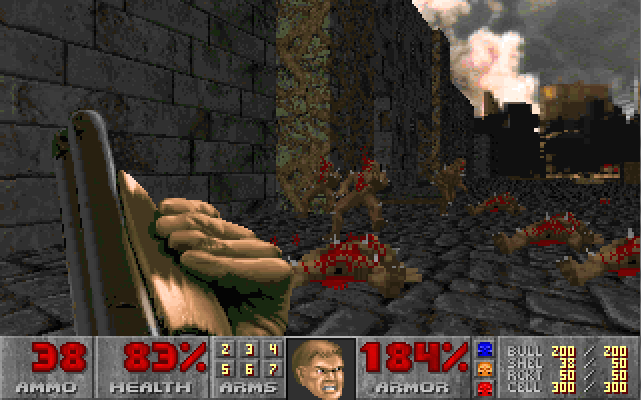
But it soon become boring. Rohr’s introduction is like a smattering of ideas at turns brilliant and ridiculous. The writing is like Philip Yancy on a bad day – a whiplash of barely connected thoughts changing every paragraph instead of every page or chapter. He promises early on to provide a guide through the “second half of life” in the forthcoming chapters, but all one really finds is just more introductory appetite-whetting material. Rohr loads up his shotgun shells with quotes from the early church fathers, Carl Jung, Julian of Norwich, the Dalai Lama, Thomas Merton, Sigmund Freud, Ghandi, and occasionally St. Paul. He then blasts them at the reader with the rhythm of a gamer fraggin’ demons in Doom as if it were 1993 even though the book was published in 2011.

doom-shotgun

His writing is dressed up like it’s going to a Halloween party. How you say? Scare quotes. Scare quotes on all. the. things. I’ve never seen so many congregating in one place before. I counted only one place where the word “sin” occurred without scare quotes. The same goes for the word “salvation” though ideas imported from modern psychology and eastern religion apparently don’t require them:

If you get mirrored well early in life, you do not have to spend the rest of your life looking in Narcissus’s mirror or begging for the attention of others. You have already been “attended to,” and now feel basically good – and always will. This Hindus call this exciting mutual beholding darshan. Once you have your narcissistic fix, you have no real need to protect you identity, defend it, prove it, or assert it. It just is and is more than enough. This is what we actually mean by “salvation”. (p.5)

Actually, I don’t think that’s what ANYONE on earth means or has ever meant by the word “salvation”, even those on the fringe of Christianity.

In Rohr’s writing, there is no train of thought or sustained argument. It’s like a music video where the camera cuts every two seconds between a tranquil forest scene, a church full of chanting monks, a bevy of Buddhist break-dancers, and a time-lapse shot of bustling downtown Manhattan.

breakdance-monks

Falling Upward was like the B-side of a Sufjan Stevens record with a sublime melodic air interrupted by atonal electronic beeps every 30 seconds. If what Rohr is playing is Christianity, it’s been run through every stomp box that The Edge owns, all at the same time.

guitar-pedals

And you know what? That’s fine. All of that’s fine. If Rohr wants to make his way as a spiritual writer and self-help speaker like Deepak Chopra, I don’t have any problem with that. It doesn’t mean he can’t be or hasn’t been helpful to lots of people who have listened to him, read his works, or attended his retreats. Some of my own favorite authors and thinkers are very much not Christian at all. My only real issue is with the name he trades under. He is quick to present himself (in the first paragraph of his bio on the dust jacked) as a legitimate friar of the Order of St. Francis – a bonafide ordained Roman Catholic priest in good standing. How it is that he hasn’t been defrocked is beyond my understanding – likely due to some deeply rooted dysfunction within the RC. An Episcopal friend of mine informs me that the Franciscan order, despite it’s virtues, has long been a haven for all kinds of fringe elements and that if folks like him had been in the Benedictine order, they likely would have been kicked out ages ago. Maybe that’s it. I’m not familiar enough with the internals to know.

It is clear that Rohr’s philosophy and theology is very broad from the beginning. It has to be large enough to include Sufi Islam, Buddhism, some forms of Hindu, and even some primitive paganism inside it’s tent. In the middle of the book he recounts how elated he was when he discovered in college that the story of Abraham was actually just a myth and not real history. If only the rest of us could be so enlightened. Jesus pops up here and there in Rohr’s understanding of the universe, but at no time is the incarnation ever really necessary. Human beings have no need for a savior because the only thing we really need saved from is our own wrong thinking. He mocks “substitutionary atonement theory” (using scare quotes of course), but doesn’t invoke Christus Victor either. The reason is, Christ doesn’t apparently need to be victorious over anything. The Trinity (without scare quotes for some reason, probably a mistake) is described not as reality, but as just a helpful way Christians developed to talk about God. Rohr is a theist, but a highly univerasalist one. Not a Christian universalist like (maybe) Robert Capon was, with Jesus always at the center, but an explicitly pluralistic one.

And again, I’m fine with him being that. My chief annoyance ends up being his fluffy writing style, and his appeal to formal church authority in his credentials while abhorring dogmatic authority in all other places. He should keep the blurb from Dr. Oz on the back of his books, but bury the lead about him being a legit priest for a historically orthodox institution. I believe it to be in bad faith.

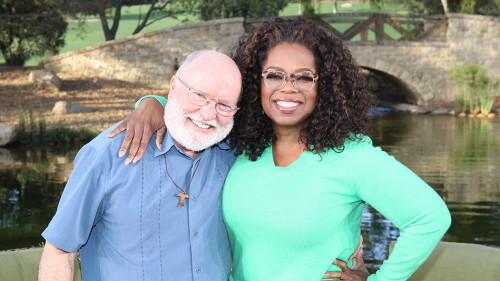
rohr-oprah

Is this blog post not a rather sloppy shotgun blast of metaphors, half-formed arguments and even silly pictures? I’m afraid it is! It’s akin to the terrible Mandarin accent I pick up after speaking with local Chinese students. Time to go try reading something else!

Best introductory paragraph to a history book

I often find introductions to be the home of the very best writing and ideas in many large works. This was most definitely the case in Robert Louis Wilken’s The First Thousand Years:

“What power preserves what once was, if memory does not last?” – Czeslaw Milosz
The past doesn’t vanish at once; it dies slowly. But if remembered, the dead maintain their ground and live among us. Historical memory, like all memory, is selective, and there are many claimants to the telling of Christianity’s early history. The Christian Church has a long and crowded past, and whether by design, forgetfulness, or ignorance, its history will be remembered in different ways. Our knowledge of the past is not objective but personal and participatory. (p.1)