
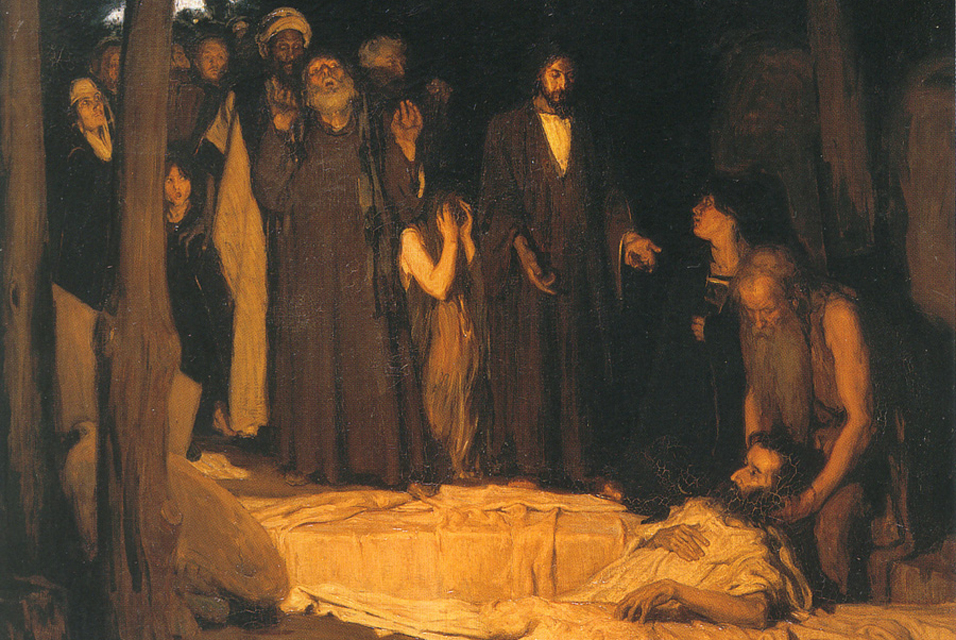
The Resurrection of Lazarus, (Part 3/3): Dead men can do exactly nothing

Now we come to see the divine nature of Jesus here. The time for sadness is over. For a moment now, he is going to give us a hint of what the power of the resurrection is really like. Jesus commands the dead Lazarus in the same tone of voice as he earlier commanded the storm to still earlier when he was on the boat.

Imagine yourself for a moment as something else in nature. Can you imagine being a rock? I think it would be a very boring existence, just being a stone there, maybe as part of the pavement of a road if you’re lucky. I think I would get pretty sleepy. But then Jesus speaks up, WHOA! What was that?? Holy smokes, that is the voice of my creator. That rock isn’t asleep anymore. That wind that was howling and just doing its thing on the sea of Galilee earlier? It stopped on a dime. Jesus holds sway over all of nature.

The same goes for dead bodies. Notice how much Lazarus had to DO to wake up. How hard did he have to work? Did he hear Jesus’s voice and (fortunately) decide to come out and see him? Of course not. He was a corpse.

The disciples did not yet fully understand this at the time. Martha confessed her faith that Jesus was the Messiah and could easily have healed Lazarus earlier, but it hasn’t entered her imagination yet that he can just as easily heal him after the fact. Her faith is about to be expanded.

These next few things I have to say about the subject are a mix of my own thoughts and some some commentary by theologian Robert Capon, a writer I’ve been influenced by quite a bit. These aren’t really my ideas, but they make me very excited to be a Christian!

For Lazarus to stay dead was a metaphysical impossibility! You can’t get away from a love that will not let you go. When Jesus, the Resurrection and the Life says, “Lazarus, come forth!”, the rest of the story doesn’t depend on Lazarus. Jesus wasn’t dealing with someone who just needed a pep talk to get their act together. He was dealing with a dead body.

You remember when Martha was worried about opening up the tomb because of the terrible smell? She spoke the whole truth not only about Lazarus but about every one of us in particular and about the human race in general. ‘Lord, by now we stink.’ We have been dead four days, four thousand days, four hundred thousand times four thousand days. In the midst of all our life we have been in death. And in the midst of that abiding death we have been in Nothing. Knee-deep in it, waist-deep in it, up to our noses and over our heads in Not-a-Thing.

But Jesus shouts to us in the mire to wake us up, to pull us up. Making things jump out of nothing is God’s favorite act. He creates us out of it (ex nihilo) and he raises us up from in. Jesus came to raise the dead. Not to improve the improvable, not to perfect the perfectible, not to teach the teachable. That stuff doesn’t work and he knows it. Those things only work on nice health people, but that’s not us. We’re dead, dead in our sin and helpless to even role over. But he, the Son of God is our total help.

He holds us now, even as he held Lazarus in the tomb and kept his body from decaying so that he could wake him back up and show the Glory of God to all the people around watching. A few years later, Lazarus kicked the bucket again and was buried for a long time, just like we will be. But because Christ has conquered death, he will hold us in his love even then and raise us to eternal life at the end of days.. The seventh sign of John was the raising of Lazarus. But that miracle was resuscitation back into the fallen world. Jesus’ own resurrection, the one that we follow him in, is a resurrection into a deathless world. That is our permanent hope in Christ.

Now, I know this is a Sunday and you’ve all shown up in a church building, so one might be able to assume that everyone here more or less believes all this stuff in the Bible about Jesus. You may be confused about how many of these stories (or my explanations!) you believe or not. If you think this account about Jesus raising some guy from the dead a long time ago is only a myth, then congratulations – you are part of a large company when it comes to the entire world.

Now I could try to show you archeological evidence proving that Jesus really existed and was held in amazingly high regard. There are old manuscripts that have been dug up dating the book of John from the first century. Some folks really get a kick out of that sort of thing, but I doubt any of those things mean anything to you today. Honestly, they don’t to me. The reason I find this story about Jesus so compelling is the picture of unmerited grace and unaided power it provides. When I get angry at my kids (and there are four of them now, so there is plenty of opportunity to completely lose my gourd), or when I fight with my wife about something stupid, when that happens I feel like a dirtbag. The same goes for when I feel lazy at work. I can make excuses like complaining that I don’t have enough money or time to do a good job at (fill in the blank), or blame my problems on other people. I don’t buy the modern wisdom that this guilt I feel is just some kind of social conditioning or imaginary religious oppression. I know what’s beautiful when I see it and I know what’s ugly. So do you, right? And in myself I see a whole lot of ugly, a whole lot of decay. My heart is still beating and I’m walking around, but it’s like a prelude to death. I’m up to my eyeballs in shortcomings and seriously, it’s not getting any better! You can “get religion” and that won’t help – I got it when I was young– you just might notice it a little more if you do.

But if there is any meaning in this life, if there is a God who cared enough about our race to make it out of nothing, who cares enough to sustain MY little life here and let me keep breathing, then he must love me very much indeed. When Jesus raised Lazarus from the dead, he wasn’t playing the role of a life coach but rather a death-defying Messiah, whether Lazarus deserved it or not. (Hint: He didn’t deserve it and I definitely don’t and neither do you.) But that sort of love is the only kind worth having. Christ alone dispenses that to me, to you, every day. I’m certain of it.
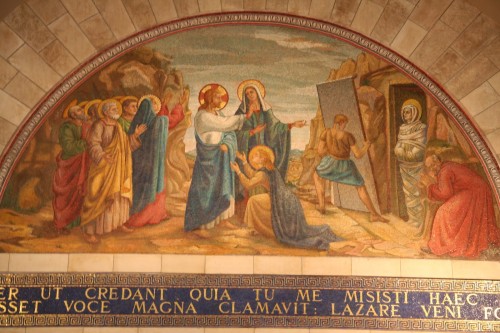
The Resurrection of Lazarus, (Part 2/3): “Jesus Wept” and the two natures of Christ

This is a rich passage (John 11:1-46) and there are a ton of things we could look at today. I would like to just touch upon a couple aspects. The first is the emotional outburst of Jesus when he wept at the tomb of Lazarus. If John thought it worth mentioning in his highly edited account, it must be significant.

If you’ve ever played a round of bible trivia, I’m sure you’ve come across the fact that John 11:35 is the shortest verse in the New Testament. “Jesus wept”. Think about it for a moment though. Who was God? Who was there at the creation of the universe and knew the entirety of the future? Jesus! Shouldn’t he have been as cool as a cucumber in the face of death? So what’s with the crying? Was he just faking it? He couldn’t have seriously been sad, could he? Wasn’t he about to fix everything! Was it just some sort of act?

I remember being confused about this when I was young, and even sometimes today it makes me raise an eyebrow and reconsider what I believe. Some people have used this sort of emotional outburst from Jesus to try and show that he wasn’t really God. Sure, he was a pretty special guy who did miracles and taught some hidden truths about heaven and such, but if he were really God, he wouldn’t have needed to get upset about anything. (And this is by no means the ONLY time Jesus got upset, annoyed, or even angry about something!)

Consider what it would be like if you were playing a game of poker and were fortunately dealt a straight flush. Would you be sad? Of course not. You’ve got the winning hand and you can pull in a lot of chips if you can just look nonchalant for a few minutes. Jesus had the trump card over death – the power to bring Lazarus back at a command. In fact, he had planned from several days earlier to do just that! Was Jesus just playing games with us?

I believe that to resolve these questions we must go back to the doctrine of the incarnation. We as Christians believe that Jesus Christ was 100% fully God, but also 100% fully man. Not 50/50. Not God dressed up in a human body. Not a guy filled with some of God’s power. He was (and is) one person with two natures: A divine nature and a human nature.

Jesus as God was eternal, here forever since the beginning. Jesus as Man was temporal, on earth for just a few years in the first century. Jesus as God was infinite, knowing all the past and future in every imaginable sense and more. Jesus as man had eyes, ears, hands, mind, and body just like we do. When he helped Joseph build a table in the carpentry shop, he only had two hands to hold the wood with. When he had a long day, he ended up tired and hungry. None of this was fake; it was completely natural for him. Unlike us though, he was uncorrupted by sin. Doing the will of his father was his only delight.

You won’t find a one-off bible verse to fully explain this idea of the two natures of Christ, but it’s something that Christians thinkers and leaders had been puzzling over from the very beginning. Most of it was all hashed out in a meeting called the Council of Chalcedon that took place in 451 A.D. Nearly all Christians of every flavor have held to this God-man explanation about who Jesus was ever since then.

This isn’t just an old idea to make sense of some confusing scripture passages. A right understanding of who Jesus really was and who WE really are is not at all something you can assume that we all have a handle on. In our modern world, there is a lot of confusion about whether what goes on inside our minds is entirely physical or something soulful or spiritual. Many scientists and psychologists today say that faith in God is just a curious combination of chemicals inside your brain. Some Christians say the utter opposite – that, for example, depression is entirely the result of sinful unbelief and can’t possibly have anything to do with stress, or diet, or sleep or medication. Jesus will have none of these divisions – serving as our mediator by being just like us, and just like God.

Some Buddhists say that someone who is properly enlightened has no need to cry or grieve at a funeral. I think sometimes that is what we expect of Jesus. But God seemed to think grief was entirely called for at times! Jesus wasn’t a holy robot unaffected by the lives of people around him. When Mary fell at his feet crying, he empathized with her and cried too. He affirmed her anguish. It was the right thing to do. Jesus never did anything wrong! When he arrived at the tomb and came face to face with the death of a close friend, he was upset. Jesus hated death and promised to destroy it. It was JUST for him to be trouble when it touched him and those around him.

Remember it is the manly, human nature of Jesus that was troubled, not the eternal, immutable Godly divine nature. There is no sin or unbelief in the sort of emotion we see displayed by Jesus. If we are like him, we may very well be upset by death – taking no pleasure in it. This is conjecture, but I think perhaps Jesus was also troubled by the thought of his own upcoming death. He knew that it would be physically and psychologically difficult to endure, though his faith in the father would never wane.

I know there are people in this church right here that have lost loved ones and family in just the past week! If what we read in John today is any indication (and I believe it is), if Jesus were here in the room today, he wouldn’t tell the grieving people to get tough, nor would he wave them off saying, “Hey, don’t worry, it will all be cool later.” He would cry right along with them. We can do that too. He’s already arranged to take care of it all in the end.

The last enemy to be destroyed is death.

(1 Corinthians 15:26)

So, what does this actually mean to us today? Well, I think we can relate this to what Hebrews 4 tells us about Jesus.

For we do not have a high priest who is unable to sympathize with our weaknesses, but one who in every respect has been tempted as we are, yet without sin.

(Hebrews 4:15)

When we face all sorts of trials and troubles and sadness here on earth, Jesus knows how terrible they really make us feel. He is not a big entity in the sky that rolls his eyes at our smallness and instability. He became very small just like us, because he loved us so much. Jesus doesn’t just steamroll death as if it were something insignificant. He weeps. And then he stands up and commands.

The Resurrection of Lazarus, (Part 1/3): Introduction

We’ve spent quite a few months here working through the gospel of John and today’s passage in John 11 has a lot of interesting things going on. We’ll only have time to touch upon a few of them though. First, a bit of background leading up to today.

Unlike the other three gospel accounts, (Matthew, Mark, and Luke), the gospel of John is not strictly chronological. He, the author, John, had an agenda. He had several key points about Jesus that he wanted to emphasize and drive home to his readers. We believe that this wasn’t just part of a personal style or individual way of thinking, but something inspired by the Holy Spirit, God himself, when John wrote this all down in the mid first century.

Near the end of the book, John makes this aside:

“Therefore many other signs Jesus also performed in the presence of the disciples, which are not written in this book; but these have been written so that you may believe that Jesus is the Christ, the Son of God; and that believing you may have life in His name.”

(John 20:30-31)

So he is telling us that there are many volumes worth of things he COULD have told us about Jesus. John was, after all, with him during his entire earthly ministry and even took care of Mary after Jesus was gone. He could have written much more than 20 short chapters, but he didn’t, and he told us he didn’t because his curated collection is enough to help us understand who Jesus really was – the Son of God. He also makes reference to “signs”, and that is how most people studying this gospel throughout the centuries have organized their reading.

Let’s take a quick look at these signs:

1. Turning water into wine, John 2:1-12

2. Healing the royal official’s son, John 4:46-54

3. Healing the paralytic at the Bethesda pool, John 5:1-17

4. Feeding the five thousand, John 6:1-14

5. Walking on water, John 6:15-25

6. Healing the man born blind, John 9:1-41

And finally, the last and greatest one (in some regards):

7. Raising Lazarus from the dead, John 11:1-46

Now, even though Jesus did many miracles, he often tried to keep a low profile. He didn’t advertise what he was doing and he would often disappear when the village started to get excited. As far as we can tell, he wanted to stay under the radar of the religious leaders (who didn’t like unorthodox competition) and the Romans, who were a bit jumpy about revolutionary leaders destabilizing the country. Jesus knew that he would have to die, but he must have had in mind a number of things he wanted to accomplish before the time was ripe.

With the resurrection of Lazarus, which we’ll read in a minute, he didn’t try to hide anything. In fact, Jesus even narrates out loud some of what is going on to make sure all the people around him understand his intentions. The time for the Passion, for his death and resurrection, is coming up soon and so he begins to pull out all the stops.

Now let’s take a look at the scripture. I love these long narrative passages. They stand up pretty well on their own and don’t need to be wrapped up in much of a sermon!

The passage: John 11:1-46 (ESV)

            Now a certain man was ill, Lazarus of Bethany, the village of Mary and her sister Martha. It was Mary who anointed the Lord with ointment and wiped his feet with her hair, whose brother Lazarus was ill. So the sisters sent to him, saying, “Lord, he whom you love is ill.” But when Jesus heard it he said, “This illness does not lead to death. It is for the glory of God, so that the Son of God may be glorified through it.”

Now Jesus loved Martha and her sister and Lazarus. So, when he heard that Lazarus was ill, he stayed two days longer in the place where he was. Then after this he said to the disciples, “Let us go to Judea again.” The disciples said to him, “Rabbi, the Jews were just now seeking to stone you, and are you going there again?” Jesus answered, “Are there not twelve hours in the day? If anyone walks in the day, he does not stumble, because he sees the light of this world. But if anyone walks in the night, he stumbles, because the light is not in him.” After saying these things, he said to them, “Our friend Lazarus has fallen asleep, but I go to awaken him.” The disciples said to him, “Lord, if he has fallen asleep, he will recover.” Now Jesus had spoken of his death, but they thought that he meant taking rest in sleep. Then Jesus told them plainly, “Lazarus has died, and for your sake I am glad that I was not there, so that you may believe. But let us go to him.” So Thomas, called the Twin, said to his fellow disciples, “Let us also go, that we may die with him.”

Now when Jesus came, he found that Lazarus had already been in the tomb four days. Bethany was near Jerusalem, about two miles off, and many of the Jews had come to Martha and Mary to console them concerning their brother. So when Martha heard that Jesus was coming, she went and met him, but Mary remained seated in the house. Martha said to Jesus, “Lord, if you had been here, my brother would not have died. But even now I know that whatever you ask from God, God will give you.” Jesus said to her, “Your brother will rise again.” Martha said to him, “I know that he will rise again in the resurrection on the last day.” Jesus said to her, “I am the resurrection and the life. Whoever believes in me, though he die, yet shall he live, and everyone who lives and believes in me shall never die. Do you believe this?” She said to him, “Yes, Lord; I believe that you are the Christ, the Son of God, who is coming into the world.”

When she had said this, she went and called her sister Mary, saying in private, “The Teacher is here and is calling for you.” And when she heard it, she rose quickly and went to him. Now Jesus had not yet come into the village, but was still in the place where Martha had met him. When the Jews who were with her in the house, consoling her, saw Mary rise quickly and go out, they followed her, supposing that she was going to the tomb to weep there. Now when Mary came to where Jesus was and saw him, she fell at his feet, saying to him, “Lord, if you had been here, my brother would not have died.” When Jesus saw her weeping, and the Jews who had come with her also weeping, he was deeply moved in his spirit and greatly troubled. And he said, “Where have you laid him?” They said to him, “Lord, come and see.” Jesus wept. So the Jews said, “See how he loved him!” But some of them said, “Could not he who opened the eyes of the blind man also have kept this man from dying?”

Then Jesus, deeply moved again, came to the tomb. It was a cave, and a stone lay against it. Jesus said, “Take away the stone.” Martha, the sister of the dead man, said to him, “Lord, by this time there will be an odor, for he has been dead four days.” Jesus said to her, “Did I not tell you that if you believed you would see the glory of God?” So they took away the stone. And Jesus lifted up his eyes and said, “Father, I thank you that you have heard me. I knew that you always hear me, but I said this on account of the people standing around, that they may believe that you sent me.” When he had said these things, he cried out with a loud voice, “Lazarus, come out.” The man who had died came out, his hands and feet bound with linen strips, and his face wrapped with a cloth. Jesus said to them, “Unbind him, and let him go.”

Desire is endless, we are not

Below, Lewis articulates a contemporary rendition of Augustine’s “God-shaped hole”:

Most people, if they have really learned to look into their own hearts, would know that they do want, and want acutely, something that cannot be had in this world. There are all sorts of things in this world that offer to give it to you, but they never quite keep their promise. The longings which arise in us when we first fall in love, or first think of some foreign country, or first take up some subject that excites us, are longings which no marriage, no travel, no learning, can really satisfy. I am not now speaking of what would be ordinarily called unsuccessful marriages, or holidays, or learned careers. I am speaking of the best possible ones. There was something we have grasped at, in that first moment of longing, which just fades away in the reality. I think everyone knows what I mean. The wife may be a good wife, and the hotels and scenery may have been excellent, and chemistry may be a very interesting job: but something has evaded us.

-C.S. Lewis, Mere Christianity, Ch.3

I’m tracking with him here for sure, but I’ve met quite a few Christian (with whom this also resonates) that are mystified at how few people around them seem to find this sort of thing compelling. Michael Spencer discussed the same thing about six years ago in light of a London Times study on religion and youth. The relevant summary goes like this:

“Nevertheless, young people do not feel disenchanted, lost or alienated in a meaningless world. “Instead, the data indicated that they found meaning and significance in the reality of everyday life, which the popular arts helped them to understand and imbibe.” Their creed could be defined as: “This world, and all life in it, is meaningful as it is”, translated as: “There is no need to posit ultimate significance elsewhere beyond the immediate experience of everyday life.” The goal in life of young people was happiness achieved primarily through the family…The researchers were also shocked to discover little sense of sin or fear of death. Nor did they find any Freudian guilt as a result of private sensual desires. The young people were, however, afraid of growing old.”

Capon though, (to string some metaphors together), gets closer to the bone, closer to the bare metal, closer to the raw psychology behind this and in the process borrows a page out of Girard’s book (whether he knows it or not).

The untamability of romance, the endlessness of the vision of the beloved, threaten constantly to send us off in successive limitless expeditions after something that grows successively harder to define. The movie star on her fifth marriage seems always to be less clear about what she wants and less free to make her wanting serve her well. For under it all lies the endlessly expansive pride of a being who cannot add a cubit to her stature or a minute to her life. That is our dilemma: desire is endless; we are not.

-Robert Capon, Bed and Board, p.56

Romance is never ultimately satisfying, not necessarily because we have this longing for God that is mistakenly misdirected at the nearest lover (thought that can be an accurate way to describe it at times), but because our desire is alive and regenerated and unlimited. Ambition for power and success can never be satisfied because our capacity to envy will always exceed the magnitude of our own frame.

A man who drinks gets thirsty again, but Christ explicitly(!) describes what He gives as a “spring of living water welling inside” (John 7). Oughourlian argues convincingly in his Genesis of Desire that this thirst is most certainly from God, not the product of our corruption or of the devil. Adam was thirsty in Eden, and then he was satisfied by drinking water. So are we. But we cannot add one cubit to our stature. We steadily covet more than our humble (but beautiful) selves can ever contain. To be satisfied in God and to find rest in him implies, chiefly, that we no longer need what our neighbor has, or what only our creator has. In due time He wills to give us all in an ongoing and eternal fashion.


The Love that moves the sun and stars

From the very end of Dante’s Divine Comedy:

Here my exalted vision lost its power.
But now my will and my desire, like wheels revolving
with an even motion, were turning with
the Love that moves the sun and all the other stars.


Books from my youth: Tricks of the Game Programming Gurus

From 1994, this is another one I encountered at about age 13. I poured over this one so many times! I remember how thrilling the ideas introduced where: Using trigonometry to rotate x,y,z points in 3D space, bit-shifting and Assembly code to improve the performance of your ray-casting engine, simple AI path-finding methods. Wow, so much good stuff, even if I didn’t understand what half of it meant. It didn’t matter that I was just writing little puzzle games in VB6 on Windows 3.1 at the time and couldn’t actually put any included C snippets directly to use.

This book inspired so many afternoon projects and daydreams. It was fascinating to get under the hood of some of my favorite games at the time and realize that this was all stuff *I* could do. My friend Pat (who was always much brighter than I) lent this one to me. I’m sure I kept it far too long before giving it back. Nowadays, there are a hundred modern books like this, probably with example code that actually works, but back in the early nineties, there weren’t many.

Books from my youth: Prophet

The other day, I was thinking back to what books I read as a child that were the most formative. It seems at times that I must not have read much of anything at all – there are so many gaping holes in my education. If I’m honest though, there are a couple of instances that stand out. It’s a good vehicle to briefly jot down a few memories.

Frank Peretti often gets a bad rap for his depiction of demons in the “This Present Darkness” novels. Having met him and heard him speak though, I must say that the man himself is much more interesting than some of his fans.

The major theme of Prophet is not unlike Fahrenheit 413 or 1984 – the spinning of media and suppression of information to control the public. Peretti’s description of how the opening music sequence for the nightly news struck is perfect: Duhduh Duhduh Duhduh… News is happening, happening, happening! Reading the book didn’t make me paranoid, but I can’t help but say that I never took what I heard on the news or read in the paper quite as seriously again. When you see how the sausage is made, you don’t easily forget.

I also enjoyed how Peretti introduced only one small supernatural element into his novel, and only near the very end. It gives you the shivers that much more when the previous 250 pages were all as straight as any procedural crime drama.

I think I was about twelve years old when I read this. The fact that part of the story centers around a bloody botched abortion was certainly a more serious theme than I had encountered before. It’s better to “grow up” by experiencing some of these things at a distance than being tossed into the heavier and more sorrowful things of life first hand before adulthood.

Seeing a girl of about fourteen reading this the other day and is what brought this one to mind.

What happened to the Thomistic method?

Here in the introduction to his annotated edition of Aquinas’ Summa, Peter Kreeft the current state of intellectual discourse as one of the great “unsolved mysteries”.

If our question is vaguely or confusedly formulated, our answer will be too. If we do not consider opposing views, we spar without a partner and paw the air. If we do not do our homework, we only skim the shallows of our selves. If we do not prove our thesis, we are dogmatic, not critical. And if we do no understand and refute our opponents, we are left with nagging uncertainty that we have missed something and not really ended the contest.

Like Socratic dialogue for Plato, this medieval method of philosophizing was very fruitful in its own day – and then subsequently neglected, especially in our day. That is one of the unsolved mysteries of Western thought. Surely both the Socratic and the Thomistic methodological trees can still bear much good fruit. Perhaps what stands in the way is our craze for originality and our proud refusal to be anyone’s apprentice. I for one would be very happy to be Aquinas’ apprentice, or [even!] Socrates’.

-p.18

This could be elaborated upon, but I think his quick theory at the end is largely spot-on.

Units of art: Against anthologies

“A single book is a unit, like a work of art.”

Peter Kreeft mentions this in his introduction to Aquinas’ Summa. I can’t help but feel exactly the same way about books and music. There is something terribly insufficient about a hit single. The same is true for “best of” books and abridged collections. I mistakenly bought a heavily edited topical volume on Augustine. It’s proven to be almost entirely useless. I’ve fallen in love with albums, but rarely with songs. A single song may be a pretty face, but it needs a skeleton underneath it, to hold it aloft. In my mind, the studio album is still THE artistic unit of recorded music.

Why still so much interest in vinyl, in an age of iTunes? It’s not the thick sound quality or the retro street-cred, though those things certainly play a part. At the end of the day, I believe the real reason that listening to a whole album at a time is still the very best way to experience music. The most energy is transferred from the creator to the listener. I’ve long been a fan of the concept album. “Best of” collections are typically unsatisfying – the ideas just aren’t connected, only their distant popularity. Forget playlists – take an album and drive it into the ground.

For classical composers, (most of them working before the invention of recordings) the large-scale work or song cycle is the olde-world equivalent. The 5th symphony should be listened to in it’s entirety. Playing only the famous first movement turns it into the latest radio-ready dance hit. Would Beethoven do anything less than tear his long hair out if he knew that his masterpiece, the 9th, was nearly only ever played in sound-bite format – about a minute’s worth of the finale?

Oddly enough, this is also why techno seems so thin when it goes mainstream. A long – say 20 minute – trance mix is meant to be experienced over time. Encapsulating the highlights and running the melody through just a few iterations loses the bulk of what makes the music so entrancing in the first place. “Um, this just sounds like a drum machine and some lady singing nonsense for 3 minutes.” Why yes, that’s exactly what it sounds like if you don’t hear the entire album. It is designed, from the beginning to be a LONG experience. In fact, the medium demands that it be to have a significant effect. Pear it down and it just become cute.

Can you imagine watching feature-length movie, say The Godfather, and only seeing a highlight reel of Marlon Brando’s one-liners along with a few shots of guys getting shot up by Tommy-guns. Is that what the film is really about? Is that why it’s a classic? Of course not. You have to watch the whole thing, including the 15-minute wedding intro that contains almost no dialogue.

Why train your children in classical music? I don’t believe its status as high-brow art makes it superior musically or culturally. Perhaps the most valuable thing to discover (the younger the better) is to learn to love LONG things. Love, marriage, raising children, and (to some degree) building a house or a business – these are looooooooooooooong things. They “contend with time” as Kierkegaard says. How can one develop the patience to discover all the things that are enjoyable about them? Not by soaking yourself in sound-bites and ring-tone length creations. If you can’t stand Bach, go listen to some long progressive rock epics (although you’ll find these are often full of Bach too). The length is absolutely essential to it’s being. At the same time, it can’t be TOO long. A book. An album. A sculpted figure. A complete visual scene. These are the most effective and satisfying units of art.

A couple of passages from Captain Alastriste

I haven’t touched a novel in a very long time, but this past week I read through Captain Alatriste by Arturo Perez-Reverte. Nothing too fantastic about it, but it was enjoyable. I noted a few places where I enjoyed his descriptions of 17th century Spain:

Here, the young narrator, Inigo, describes how the captain gave him a dagger after Inigo saved his life from an ambush the previous night.

The next day, I found a fine dagger on my pillow, recently purchased on Calle de los Espaderos: damascened handle, steel cross-guard, and along, finely tempered blade, slim and double-edged. It was one of those daggers our grandfathers called a misericordia, for it was used to put caballeros fallen in battle out of their misery. That was the first weapon I ever possessed, and I kept it, with great fondness, for twenty years, until one day in Rocroi I had to leave it buried between the fastenings of a Frenchman’s corselet. Which is actually not a bad end for a fine dagger like that one.

-Arturo Perez-Reverte, Captain Alatriste, p.172

Ah, those were the days when a young man of thirteen could be sent into the city from the countryside to be an apprentice. Is what we do now tremendously better?

I well remember – and I believe this happened during the festival of the bulls honoring the Prince of Wales, or perhaps a later one – that one of the beasts was so fierce that it could not be hamstrung or slowed. No one – not even the Spanish, Burgundian, and German guards ornamenting the plaza – dared go near it. Then, from the balcony of the Casa de la Panaderia, our good King Philip, calm as you please, asked on of the guards for his harquebus. Without losing a whit of royal composure or making any grandiose gestures, he casually took the gun, went down to the plaza, threw his cape over his shoulder, confidently requested his hat, and aimed so true that lifting the weapon, firing it, and dropping the bull were all one and the same motion.

The public exploded in applause and cheers, and for months the feat was celebrated in both prose and verse. Calderon, Hurtado de Mendoza, Alarcon, Velez de Guevara, Rojas, Saavedra Fajardo, and don Francisco de Quevedo himself – everyone at court capable of dipping a quill into and inkwell – invoked the Muses to immortalize the act and adulate the monarch, comparing him now with Jupiter sending down his bolt of lightning, now with Theseus slaying the bull at Marathon.

I tell these thing that Your mercies may see what Spain is, and what we Spaniards are like, how our good and gentle people have always been abused, and how easy, because of our generous impulses, it is to win us over, and push us to the brink of the abyss out of meanness or incompetence, when we have always deserved better. Had Philip IV commanded the glorious tercios of old, had he retaken Holland, conquered Louis XIII of France and his minister Richelieu, cleared the Atlantic of pirates and the Mediterranean of Turks, invaded England and raised the cross of Saint Andrew at the Tower of London and before the Sublime Porte, he could not have awakened as much enthusiasm among his subjects as he did with his elan in killing the bull.

p.176

Can you imagine President Obama winning acclaim for his prowess with a rifle during a public sport? Neither can I. The kings of old had their terrible shortcomings, to be sure, but there were times when they still had some class. Nowadays, politics has reduced men to a bad-joke caricatures of themselves.