Another blow against the “dark” ages

If it weren’t for those darn Christians and their science-hating ways, we might have had King Arthur on the freakin’ moon! How cool would that have been?

The sort of claims that were once part of the homiletic repertoire of, say, Arthur C. Clarke or Carl Sagan – that the tradition of Greek science to which the rise of Christianity supposedly put an end was progressing inexorably toward modern physics, modern technology, and space travel – are sheer fantasy. To quote David C. Lindberg, “It is agreed by most historians of ancient science that creative Greek science was on the wane, perhaps as early as 200 B.C., certainly by A.D. 200. Science had never been pursued by very many people; it now attracts even fewer.

Lindberg also notes, there is no historical warrant for the belief “that the advent of Christianity did anything to diminish the support given to scientific activity or the number of people involved in it.”

-David Bently Hart, Atheist Delusions: The Christian Revolution and its Fashionable Enemies, p.67

Silly anti-Christian legends we grew up with

Take a look at this. You’ve heard it before, I’m sure. I heard it a lot growing up. It’s taught (at least in summary format) in every academic discipline. It’s referred to in politics and all matters of historical discourse as if it is something nobody, not even Christians, deny. It’s a wonderful story about the goodness of man rising up to overcome evil. It just so happens, that when you look at each detail of this story closely, every element of it is baloney.

…modernity’s first great attempt to define itself:

an “age of reason” emerging from and overthrowing and “age of faith.”

Behind this definition lay a simple but thoroughly enchanting tale.

Once upon a time, it went, Western humanity was the cosseted and incurious ward of Mother Church; during this, the age of faith, culture stagnated, science languished, wars of religion were routinely waged, witches were burned by inquisitors, and Western humanity labored in brutish subjugation to dogma, supersition, and the unholy alliance of church and state. Withering blasts of fanaticism and fideism had long since scorched away the last remnants of classical learning; inquiry was stifled; the literary remains of classical antiquity had long ago been consigned to the fires of faith, and even the great achievements of “Greek science” were forgotten till Islamic civilization restored them to the West. All was darkness.

Then, in the wake f the “wars of religion” that had torn Christendom apart, came the full flowering of the Enlightenment and with it the reign of reason and progress, the riches of scientific achievement and political liberty, and a new and revolutionary sense of human dignity. The secular nation-state arose, reduced religion to an establishment of the state or, in the course of time, to something altogether separate from the state, and thereby rescued Western humanity from the blood-steeped intolerance of religion. Now, at last, Western humanity has left its nonage and attained to its majority, in science, politics, and ethics.

This is, as I say, a simple and enchanting tale, easily followed and utterly captivating in its explanatory tidiness; its sole defect is that it happens to be false in every identifiable detail.

-David Bently Hart, Atheist Delusions: The Christian Revolution and its Fashionable Enemies, p.33

Hart goes on in several following chapters to completely demolish this legend. One of his best chapters debunks the legend of the knowledge-hating Christians burning the magnificent Library of Alexandria in 390. I’ll have more on this later. (He argues), careful historians recognize that the library was attacked three different times from 47 B.C. onward. When the “christians” dealt the final blow in 390, it was collateral damage from a Roman political war, not some kind of church-backed anti-pagan religious crusade. Also the numbers about how many scrolls were burned (700,000+) are completely made up by contemporary critics. Numbers like this appear absolutely nowhere in old documents. Despite all the credit given to the Muslims, it was actually Christian monks that preserved the bulk of old Greek works by Plato, Aristotle, etc. that we still have today. How about that?

Update: Here, Leithart reviews a book that suggests the high technology and scholarship of the Muslim world during the middle ages is ALSO a myth.

Unfortunately, Christian’s themselves have sometimes added fuel to this silly secular non-history in their attempts to distance themselves from Roman Catholicism. That’s too bad. It’s like swinging the battle axe down, scraping your perceived enemy, only to bury the blade into your own foot.

New Age, self, and Religion as interior decorating

This right here nails modern cafeteria spirituality to the wall:

…we do not draw near to the “mystery of God” with anything like the fear and trembling of our ancestors, and when we tire of our devotions and drift away we do not expect to be pursued, either by the furies or by the hounds of conscience.

This is especially obvious at modern Western religion’s pastel-tinged margins, in those realms of the New Age where the gods of the boutique hold uncontested sway. Here one may cultivate a private atmosphere of “spirituality” as undemanding and therapeutically comforting as one likes simply by purchasing a dream catcher, a few pretty crystals, some books on the goddess, a Tibetan prayer wheel, a volume of Joseph Campbell or Carl Jung or Robert Graves, a Nataraja figurine, a purse of tiles engraved with runes, a scatering of Pre-Rachaelite prints drenched in Celtic twilight, and Andean flute, and so forth, until this mounting congeries of string, worthless quartz, cheap joss sticks, baked clay, kitsch, borrowed iconography, and fraudulent scholarsip reaches that mysterious point of saturation at which religion has become indistinguishable from interior decorationg.

There could scarcely be a more thoroughly MODERN form of religion than this. The peoples of early and late antiquity actually believed in, adored, and feared their gods. No one really believes in the gods of the New Age. They are purchased gods, gods as accessories, and hence are merely masks by means of which the one true god – the will – at once conceals and reveals itself.

-David Bently Hart, Atheist Delusions: The Christian Revolution and its Fashionable Enemies, p.24 (with some editing)

I heard a LOT about the “New Age” growing up. It got a mentioned in a sermon at least once a month. Sunday school classes were devoted to topics like “Refuting Trancendental Meditation”. Even sun-catcher crystals were frowned upon as they might be mistaken for their (usually pyramid shaped I think) evil equivalents that were used for something called “channeling”. Frank Perreti was hot stuff. Actually, I still like Peretti. He’s a good storyteller.

The point is, I was always just a tad suspicious that nobody really cared about this stuff. I mean, these people don’t believe in a god that ACTUALLY cares about what you do. He (probably She actually) certainly doesn’t have strict moral standards. Is the cancer of our communities and our nation the fact that some folks take their Yoga class a bit to seriously or that Sally read a book about Wicca or that somewhere out there, somebody is into astral projection? I’m not talking about the trance electronica band, by the way.

I didn’t know ANYONE into the “new age” growing up. But I sure as heck knew a lot of people who were really into their big-screen TVs, their cars, their beer, their sex. Later, I moved to a more urban area where there really were some people that toyed around with Zen Buhdism, shaman sticks, you name it. Did that show up in their life though? What I saw was people caring a heck a lot about their jobs, their vacation time, their mortgage, their (nicer) cars, their weight. Same thing all over again.

Hart nails it here. All this is not any sort of real religion. It’s just a front for the one true god, our own self, our own will. It’s just another way we consumers worship… ourselves. What’s missing from all the scary “new age” we Christians are supposed to be really on the watch for? Real power. Real spiritual forces. Real invisible anything other than our own selves. How come (I’m guessing) 99% of people toying around with some form of new age spirituality don’t actually encounter any real energy? Because when you get beyond the beyond and all that, all you find in the center of the universe is your own self, doin’ whatever the hell you want to. Big surprise there.

Going back to my childhood for just one more moment – I’m not knocking the fact that some people were concerned about this sort of thing. I just think a bit more exhortation against consumerism and self-centeredness would have got closer the heart of the problem. I could still use a big dose of that from time to time.

Girard on contemporary John Piper-esque Calvinism

Medieval and modern theories of redemption all look in the direction of God for the causes of the Crucifixion: God’s honor, God’s justice, even God’s anger, must be satisfied. These theories don’t succeed because they don’t seriously looking the direction where the answer must lie: sinful humanity, human relations, mimetic contagion, which is the same thing as Satan. They speak much of original sin, but they fail to make the idea concrete. That is why they give an impression of being arbitrary and unjust to human beings, even if they are theologically sound.

-Rene Girard, I See Satan Fall Like Lighting, p.150

I, like many other folks, have been troubled by the seemingly “unjust” God that seems to show up sometimes when the sovereignty of God is explained in some quarters. I think Girard is on to something here in explaining why that is. It’s in line with Robert Webber’s focus on the Christus Victor theory to also soften up Calvinism a bit through selective emphasis. If your theology talks about God a lot and rarely mentions Satan or man, then you don’t sound much like the Bible, which brings these other characters up quite regularly.

On the strange allergy of modern research to all the forms of the sacred

This phrases comes from the footnotes of one of Rene Girard’s works. I think “Allergy” is the right word.

He discusses it earlier on:

The modern social sciences are essentially antireligious. If religion is not a kind of tough weed, irritating but unimportant, what can we make of it?

Throughout history religion is the constant element in diverse and changing institutions. Therefore we cannot discount it in favor of the pseudo-solution that takes it as a mere nothing, the fifth wheel of all the coaches, without coming to grips with the opposite possibility, disagreeable as it is for modern antirelgiion.

Later, while taking shots at postmodernism, he continues:

The old anti-Christian anthropologists knew better. Like the Christians themselves, they believed in truth. To demonstrate the Gospels were meaningless, they tried to show that they resembled myths too closely not to be mythical as well. They did, therefore, just what I have done; they sought to define what the myths and the Gospels have in common. They hoped that the two had so much in common that no room would be left for any significant difference between them. In this way they tried to demonstrate the mythic character of the latter.

These industrious researchers never discovered what thy were looking for, but in my view they were right to persist in their search. Paradoxically, their anti-Christian perspective prevented the old anthropologists from discovering ALL the similarities between the Gospels and the myths. Fearing, no doubt, that they might fall again into the orbit of the Gospels, they kept their distance from them.

-Rene Girard, I See Satan Fall Like Lighting, p.89, 103

A primary point in Girard’s theory is that Jesus’ death and resurrection where the turning point in human history, precisely because they were exactly the same as all the myths before it from the dawn of man. The one critical difference is that in this case, the victim is innocent, the crowd is guilty. There’s no going back.

Avatar, Yeats, and pantheism as ‘natural magic’

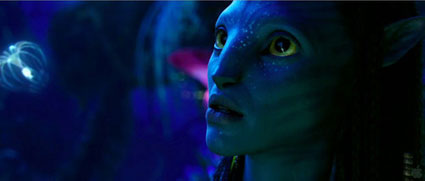
Well, I saw Avatar in the 3D theater this weekend. Wow. Absolutely stunning visuals. Definitely worth checking out if you haven’t yet.

As for the plot, you’ve seen it before, though perhaps with better acting (Dances with Wolves), more emotion (The Last Samurai), fewer phosphorescent trees (Dune), more music (Pocahontas), or more gags (FernGully). There is also the tragic edition where all the good guys die at the end (The Mission), which happens to be the only one based on a true story.

One thing I found interesting in the film is how Cameron (the writer and director) presents a wholly scientific explanation for the pantheistic energy that connects all living creatures on the planet. The trees have actual, observable neural-network connections to each other and all the plants around them and even the animals and people. The natives have nerve endings at the tips of hair that can be plugged into animals, trees, etc. to form a bond with nature. In one scene, the characters hook into one of the “sacred” trees (explained as simply a sort of tree with a much more dense neural network) and can hear the echoing voices of their ancestors and even the groanings of all life on the planet itself. It seems that a bit of their ancestor’s consciousness was absorbed into this network of memories. No spiritual or religious explanation is given. It is implied that perhaps long ago Earth used to have bonds similar to this between it’s organisms, but they have since faded and become difficult to observe by science.

So how would a devout atheist like Cameron reconcile “spiritual” phenomenon? This is one way – with a “natural” explanation. Drawing from my discussion of “natural magic” earlier, I actually think this is a pretty good way to set up a secondary (story) world. I really appreciate how he explained the phenomenon with visuals and not a lot of awful explanatory monologues. Explanatory monologues are the hallmark of bad sci-fi. If your story has to pause for 10 minutes while your character recites from the appendices of a role-playing game manual, you know your narrative needs a serious rewrite. Anyway, despite it’s flaws, Avatar did this part well I think. That’s cool.

It also struck me how similar this idea was to W.B. Yeat’s explanation of magic, which he outlined in one of his early essays:

I believe in the practice and philosophy of what we have agreed to call magic, in what I must call the evocation of spirits, though I do not know what they are, in the power of creating magical illusions, in the visions of truth in the depths of the mind when the eyes are closed; and I believe in three doctrines, which have, as I think, been handed down from early times, and been the foundations of nearly all magical practices. These doctrines are

(1) That the borders of our minds are ever shifting, and that many minds can flow into one another, as it were, and create or reveal a single mind, a single energy.

(2) That the borders of our memories are as shifting, and that our memories are a part of one great memory, the memory of Nature herself.

(3) That this great mind and great memory can be evoked by symbols.

-W.B. Yeats, Magic, Ideas of Good and Evil, Essays, p.33

Yeats didn’t see God and spirits and demons. He saw memories and invisible connections between all people and places. Yeats often participated in seances where he believed he could tap into some of these memories. The similarities to his view of spirituality and the explanation presented in Avatar are, I think, remarkably similar. Yeats was a man of old literature and poetry though, not a contemporary scientist. He would not use the language of quantum mechanics and electromagnetic fields in his theories. He would instead draw on metaphors, mythologies, and symbols – the stuff he knew best.

Salvation for your flesh too

Check this out:

Finally, if salvation was only for the soul, what more would this be than what is already said by Pythagoras and Plato? The gospel is ‘a new a strange hope’, not a slight variation on one already well known. The fragmentary treatise concludes with a passage which belongs exactly with the overall argument of 1 Corinthians: because the flesh rises, its behavior in the present time matters enormously, whereas if it did not, one might as well indulge its various appetites. In fact (and here he quotes Justin Martyr) if Christ our physician(God having rescued us from our desires) regulates our flesh with his own wise and temperate rule, it is evident that he guards it from sins because it possesses a hope of salvation.

-N.T. Wright, The Resurrection of the Son of God, p.503

Think about that. What is so different about the resurrection described in the Bible? It’s NOT just a spiritual fly away to heaven thing. It involves your body – the one you have right now. That’s why it matters what you do with your body right now (even though it’s going to be redeemed).

Glow in the dark people?

But our citizenship is in heaven, and from it we await a Savior, the Lord Jesus Christ, who will transform our lowly body to be like his glorious body, by the power that enables him even to subject all things to himself.

-Phillipians 3:20-21 (ESV)

“Transform our lowly body to be like his glorious body” – does that mean we glow in the dark? Nope.

See Phil 3:21 where doxa ‘glory’ is contrasted with atimia, ‘dishonour’ and tapeinosis, ‘humiliation’. In a vast range of ancient literature the regular meaning of doxa is ‘good repute, honour’, as opposed to shame and humiliation…That the ‘glory’ of the different creatures does not primarily refer to luminosity, though in several cases it includes that, is clear from verse 40b, where physical objects in the heavens have one kind of glory, and those on the earth have another. Objects on earth do not shine as do the sun, moon and stars; but they still have their own proper ‘glory’. Here ‘glory’ seems to mean ‘honour’, reputation, ‘proper dignity’.

-N.T. Wright, The Resurrection of the Son of God, p.345 (footnotes)

“Proper dignity” sounds like a return to pre-fall standards if you ask me. Again, not something ethereal and floaty. The post-resurrection accounts of Jesus didn’t include rays of energy shooting from his body. He only did that on the mount of transfiguration for a short time. Ours will be like his.

Yeats was no musician

In reading a collection of essays by W.B. Yeats, I came across this passage:

A girl has been playing on the guitar. She is pretty, and if I didn’t listen to her I could have watched her, and if I didn’t watch her I could have listened. Her voice, the movements of her body, the expression of her face, all said the same thing. A player of a different temper and body would have made all different, and might have been delightful in some other way. A movement not of music only but of life came to its perfection. I was delighted and I did not know why until I thought, ‘That is the way my people, the people I see in the mind’s eye, play music, and I like it because it is all personal, as personal as Villon’s poetry.’ The little instrument is quite light, and the player can move freely and express a joy that is not of the fingers and the mind only but of the whole being; and all the while her movements call up into the mind, so erect and natural she is, whatever is most beautiful in her daily life. Nearly all the old instruments were like that, even the organ was once a little instrument, and when it grew big our wise forefathers gave it to God in the cathedrals, where it befits him to be everything. But if you sit at the piano, it is the piano, the mechanism, that is the important thing, and nothing of you means anything but your fingers and your intellect.

-W.B Yeats, Essays, p.332

Ha! Try telling a piano player that. Your playing is all just fingers and intellect and mechanism? Yeats may have been a great poet, but it’s clear he didn’t rub shoulders with many musicians or attended the concert hall often. He would have been cured of these silly statements in short order. The fact that the first thing he notices about the guitar playing is that the performer is a pretty girl… that is telling. By these standards, perhaps he would have enjoyed some booty-shaking on MTV more than a night at the symphony.

The 10th commandment is the key

Right here at the start, Girard lays down the biblical foundation for his theory of human conflict. I believe this reading of “do not covet” is much more accurate than we are used to.

In the bible, and especially in the Gospels, there is an original conception of desire and its conflicts that has gone largely unrecognized. In order to grasp how old it is we must go back to the Fall in Genesis or to the second half of the Ten Commandments, which is entirely devoted to prohibiting violence against one’s neighbor.

Commandments six, seven, eight, and nine are both simple and brief. They prohibit the most serious acts of violence in the order of their seriousness:

  • You shall not kill.
  • You shall not commit adultery.
  • You shall not steal.
  • You shall not bear false witness against your neighbor.

The tenth and last commandment is distinguished from those preceding it both by its length and its object: in place of prohibiting an act it forbids a desire.

“You shall not covet the house of your neighbor. You shall not covet the wife of your neighbor, nor his male or female slave, nor his ox or ass, nor anything that belongs to him.” (Exodus 20:17)

Without being actually wrong the modern translations lead readers down a false trail. The verb “covet” suggests that an uncommon desire is prohibited, a perverse desire reserved for hardened sinners. But the Hebrew term translated as “covet” means just simply “desire.” This is the word that designates the desire of Eve for the prohibited fruit, the desire leading to the original sin.

The notion that the Decalogue devotes its supreme commandment, the longest of all, to the prohibition of a marginal desire reserved for a minority is hardly likely. The desire prohibited by the tenth commandment must be the desire of all human beings — in other words, simply desire as such.

-Rene Girard, I See Satan Fall Like Lightning, p.7

He goes on to explain how desire per se is not evil (like some Buddhists would assert), but that desire for what belongs to our neighbor (his social capital, his possessions, his wife, etc.) can be convincingly proven to be the root of all human conflict and ALL hatred and sin against others.